
Border pass
One summit linking countries; the transition is the story
A historic Alpine crossing linking the Tarentaise to the Aosta Valley, the Col du Petit‑Saint‑Bernard / Colle del Piccolo San Bernardo (2,188m) is a long, steady ascent with a classic high‑mountain feel.
It falls well outside the top 25 of high road passes, but it is Europe’s 7th highest international pass.
The French side offers a smooth, consistent climb through La Rosière and onto wide‑open alpine slopes, while the Italian side delivers a shorter, more dramatic finale above La Thuile.
Fully paved and ideal for a road bike.
Why ride the Col du Petit‑Saint‑Bernard
The Col du Petit‑Saint‑Bernard is defined by continuity rather than difficulty. It is a high Alpine crossing where both approaches allow you to settle into a steady effort and carry it across the border.
When approached from either side—Bourg‑Saint‑Maurice or Pré‑Saint‑Didier—the climb shares a core structure:
- long duration
- moderate, consistent gradients
- no decisive sections that interrupt rhythm
What distinguishes the pass is not intensity, but how evenly the effort is distributed. Unlike many major climbs, there is no clear moment where the climb “switches on” or forces a change in pacing.
This makes it one of the few high Alpine crossings where:
- the ride is defined by flow over distance
- effort remains predictable from start to summit
- the experience is shaped by progress through terrain rather than confrontation with it
The border itself reinforces this:
The climb does not reset or transform at the summit—it simply continues into another valley.
Petit‑Saint‑Bernard suits riders who:
- prefer sustained, uninterrupted efforts
- want to maintain rhythm over long distances
- are riding through the Alps rather than targeting individual climbs
It works particularly well:
- as a primary crossing between France and Italy
- within long valley-to-valley routes
- or as part of larger multi-day traverses
This is not a climb that defines the day—it is one that connects it seamlessly.
Seasonal notes
The Col du Petit‑Saint‑Bernard behaves as a classical high Alpine crossing with a defined seasonal window.
- Closed in winter due to snow
- Typically opens: late spring (often May or June, depending on conditions)
- Best months: June through September
As an international pass:
- it is maintained and prioritised, but
- still subject to full winter closure due to altitude
Key characteristics:
- Weather conditions can change significantly between valley and summit
- The upper section is wide and exposed, particularly on the French side
- Wind can become a factor once above La Rosière
Compared to higher passes:
- It is less severe in weather risk than Iseran or Stelvio
- But still requires seasonal awareness when planning
This is a reliable summer crossing—but not a year-round route.
France vs Italy
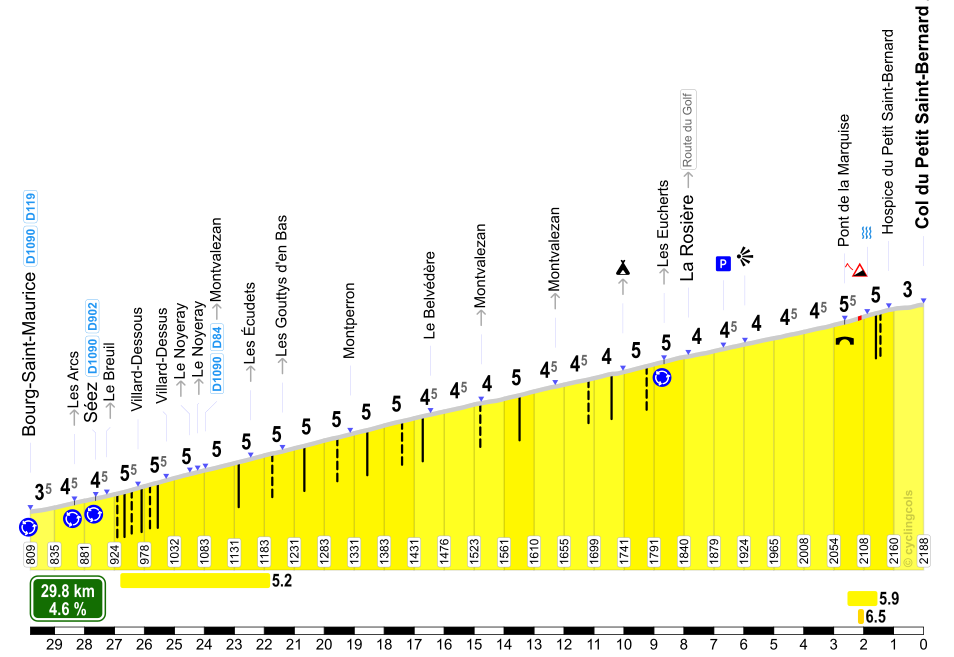
Bourg‑Saint‑Maurice
- Long (~26 km), steady ascent
- Gradients typically in the 4–6% range
- Clear progression:
- valley → forest → alpine plateau
This side:
- establishes rhythm early
- builds gradually without disruption
- feels like a continuous transition into high mountain terrain
Above La Rosière:
- the landscape opens fully
- gradients ease slightly
- effort becomes more about distance and exposure than incline
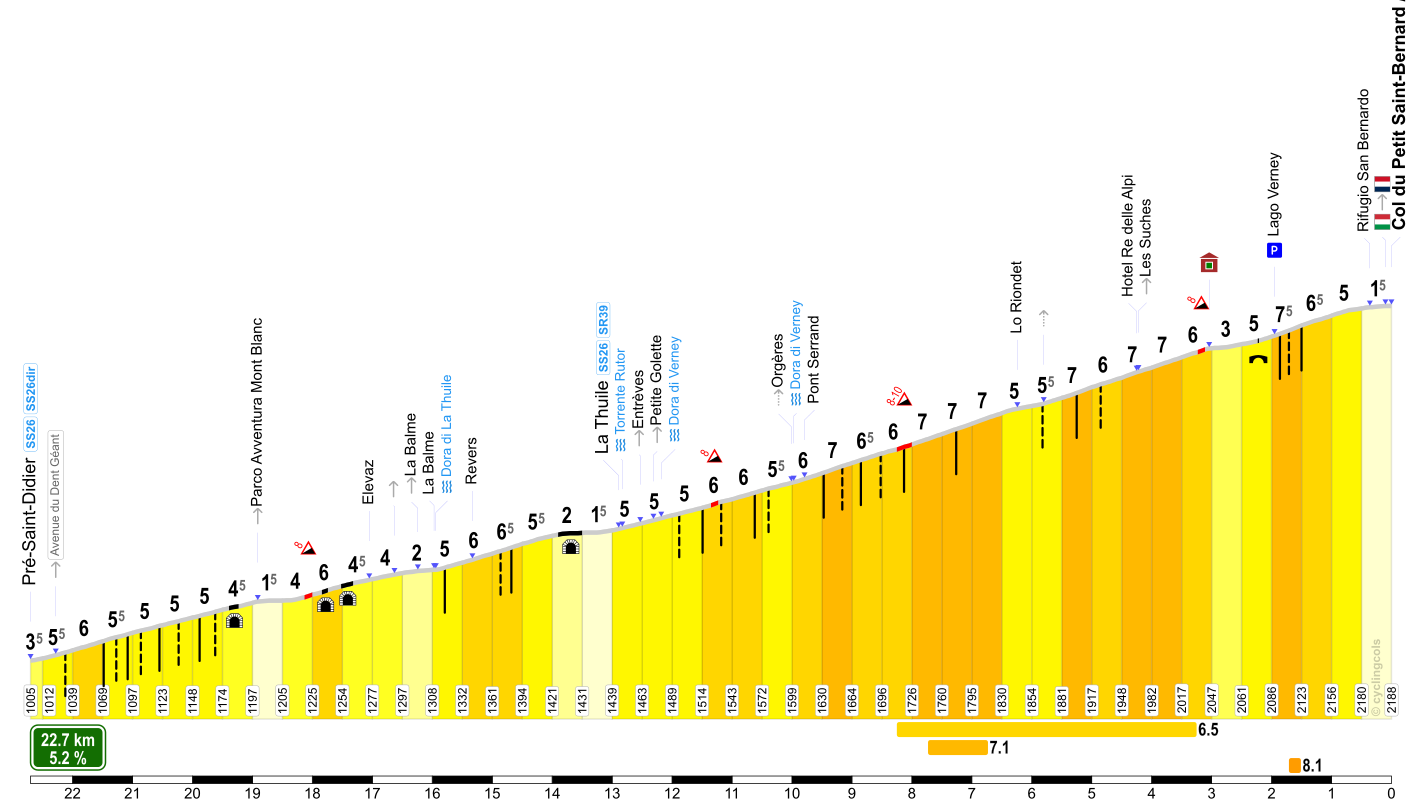
Pré‑Saint‑Didier
- Comparable overall length when ridden from the valley floor
- Similar average gradient (~5%)
- More immediate sense of climbing
This side:
- feels more direct early on
- gains elevation more visibly
- transitions from valley to alpine terrain more quickly
Compared to the French side:
- slightly less drawn-out progression
- but maintains the same steady gradient structure
I cycled both ends consecutively, the Italian end from La Thuille, in my Tour de France 2014. When based in or around Bourg-Saint-Maurice – or just starting there – and looking to do both ends in one ride, that would be your best option.
Summary
When both sides are extended to full valley depth:
The difference is no longer about length or difficulty—but about how gradually the climb develops.
- French side → longer transition into the mountains
- Italian side → quicker engagement with elevation
But:
Both sides allow the same riding approach: steady pacing from start to summit.
Bonus
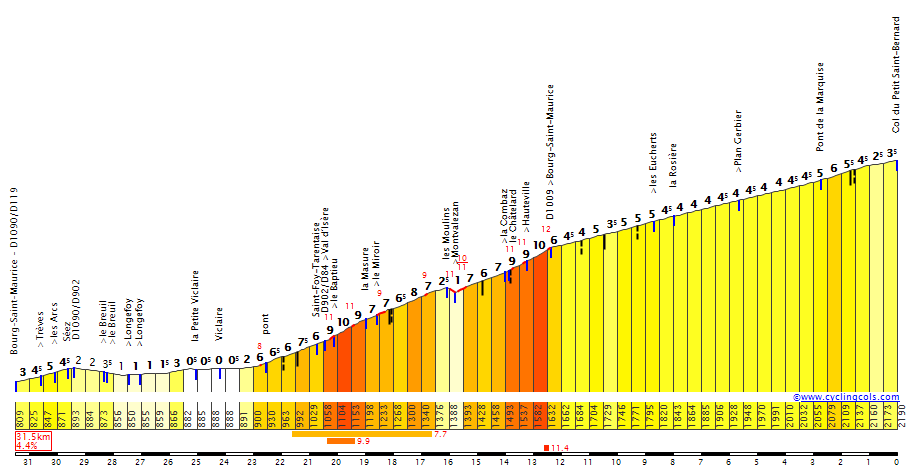
Via Sainte‑Foy‑Tarentaise (D84)
From Bourg‑Saint‑Maurice, it is possible to approach the climb via Sainte‑Foy‑Tarentaise and Montvalezan, using the D84 and its connecting roads before rejoining the main route toward La Rosière.
This is not a single fixed alternative, but a set of variations built around the D84, all of which share the same principle:
leaving the main road early to trade traffic for road character.
What changes
- The standard approach via the D1090 is:
- direct
- wide
- consistently graded, but busier
- The D84 variations:
- are narrower and quieter
- pass through smaller villages and less developed terrain
- introduce more variation in gradient and rhythm
Compared to the main road:
- the climb becomes less uniform
- short steeper sections (often in the 8–10% range) interrupt the pacing
- the effort feels more segmented than continuous
Role of the D902
The D902 itself is not part of the “quiet alternative” in the way the D84 is.
- It is the main access road toward the Iseran corridor
- Traffic levels can be similar to, or higher than, the D1090
The value of this variation lies in the D84 and its connectors—not in diverting onto another main road.
How to think about it
This is not a cleaner or more efficient line to the summit, on the contrary.
It is a deliberate trade-off:
- less traffic
- more road character
- but:
- more variable gradients
- slightly less predictable pacing
Once you rejoin the main climb above Montvalezan:
- the structure returns to the familiar steady ascent toward La Rosière and the border
When it makes sense
Use this variation if you:
- want to avoid the busiest part of the main road
- don’t mind breaking the rhythm early in the climb
- prefer road feel and terrain variation over consistency
Stick to the main D1090 if your goal is:
- a clean, uninterrupted pacing effort from the valley floor
Background image: Hagai Agmon-Snir, CC BY-SA 4.0,
via Wikimedia Commons
