
When the Pyrenees stop pretending to be reasonable
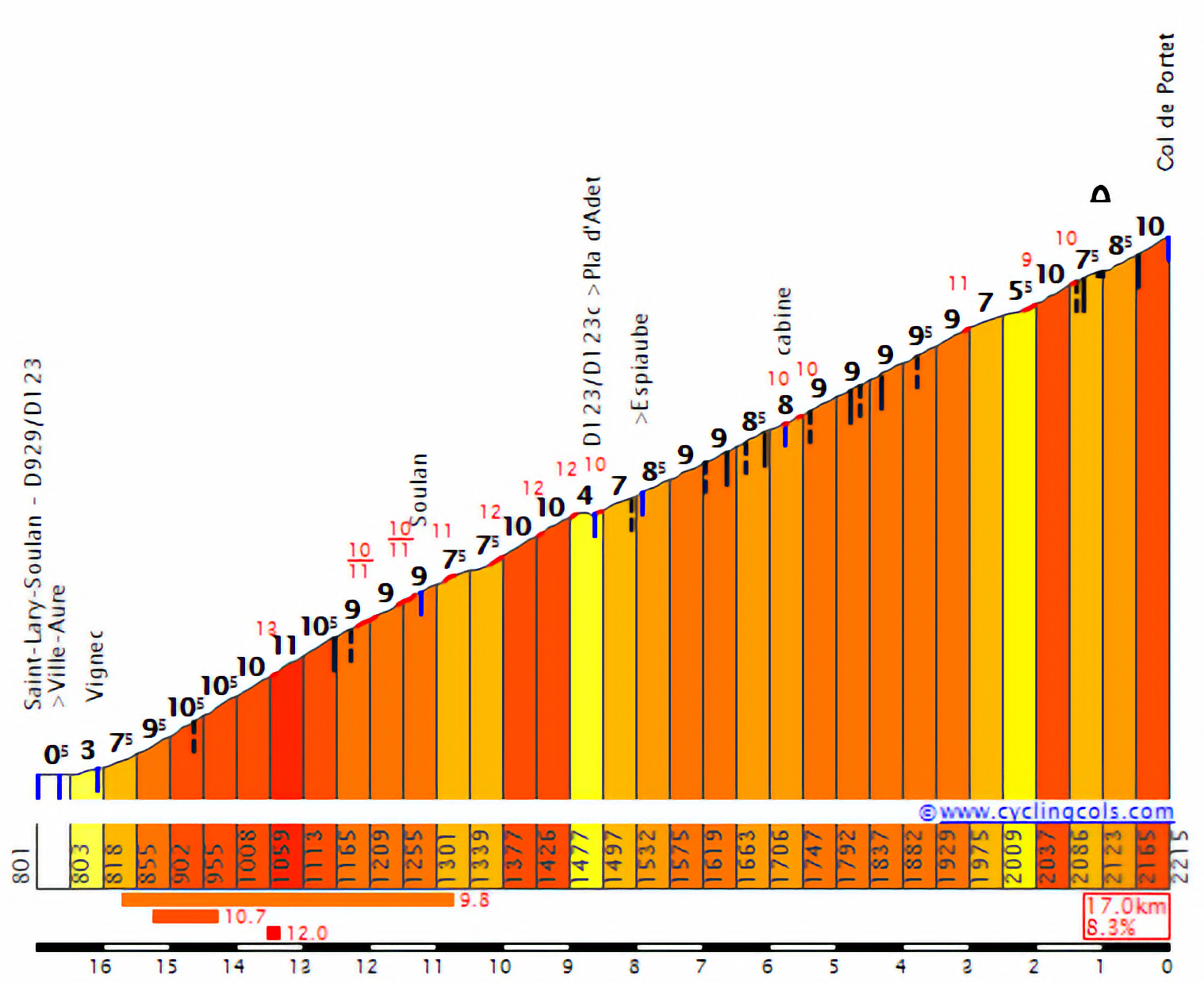
Col de Portet (2,215 m) is the highest paved road in the Pyrenees, beating the Tourmalet by 100 meters. It shares the first half with Pla d’Adet (1,680 m), the Tour stage finishing ski-resort with an older history.
It is a relatively new name in Tour de France terms, but it feels like it’s always been here. Not because of history, but because of how completely it fits the landscape: steep, exposed, and quietly brutal.
The road clings to the mountainside, exposing the valley beneath you in wide, open frames. You can see everything. Including how far you still have to go. No hiding, no distractions. Just you, the road, and a steady realization that this climb is not going to get any kinder.
Why Ride Portet
Because this is where the Pyrenees show their other side.
Not the ceremonial climbs with decades of mythology—but something newer, sharper, a little less forgiving. A road that skipped the nostalgia phase and went straight to difficulty.
Pla d’Adet gives you the history, Portet gives you the consequence, together, they form one of the most complete—and demanding—climbs in the range.
Tour de France
For decades, this mountainside belonged to Pla d’Adet.
The ski station hosted multiple Tour finishes long before the road continued higher, and cyclists repeatedly ended their efforts there rather than pushing on toward what is now the Col de Portet.
The idea of using the upper road existed as far back as the early 1980s, but it never materialized at the time.
It wasn’t until 2018 that the Tour finally extended the climb, paving and formalizing the route to the col itself. The result was immediate: a summit finish that was both higher and more demanding than the nearby Tourmalet, instantly redefining the mountain.
Since then, it has only hosted a stage finish once more, in 2021.
Practical Notes
- The biggest mistake is starting too hard in the shared lower section—those early kilometers set the tone for everything that follows.
- No motorized traffic allowed on the Portet final between 8:30 and 18:00.
- The junction comes early enough to matter; decide your route before you get there.
- The upper slopes of Portet are exposed and uninterrupted—settle into a sustainable effort before you reach them, avoid mid-day heat.
The Split: Choose Your Ending
After roughly 8 km, the mountain asks a question: do you go left to Pla d’Adet or right to Col de Portet?
Pla d’Adet is the older story, around 10 km at roughly 8.5%, relentless in the way only ski roads can be.
It doesn’t try to impress you—it just keeps leaning on you, kilometer after kilometer, until you run out of answers. Steep ramps, exposed sections, heat bouncing off the asphalt. The kind of climb where even when it “eases,” it doesn’t feel like relief.
And then there’s the finish: a functional ski station. Not beautiful, not romantic. But honest. You earned your way here.
Col de Portet, on the other hand, is the escalation. Where Pla d’Adet turns toward civilization, Portet goes the other way—higher, quieter, more isolated.
The gradients remain stubborn, the air thins, and the road begins to feel like an afterthought scratched into the mountain, shifting from exposed valley riding to something more internal.
The numbers tell you it’s around 17 km at 8.3% on average, but averages don’t matter here. What matters is that it never really lets go. Long sections sit above 10%, and the fatigue from the shared lower slopes is already priced in.
Higher up, you finally get the wide Pyrenean views—the kind that feel earned rather than given. And then, almost quietly, without drama, the summit arrives.
No circus, no crowds, just altitude and the sense that you’ve climbed something genuinely modern—one of the hardest ascents the Tour has added in decades.
I cycled Portet during stage 6 of my Tour de France 2023 – I then descended back to Espiaube and cycled the final to Pla d’Adet.
Bike Rebel Verdict
Col de Portet is one of the hardest climbs in the Pyrenees—not because of a single defining feature, but because it simply never gives you enough.
The shared lower slopes with Pla d’Adet set the trap, the upper slopes of Portet close it.
