
Accessible, deceptive, and steeped in Pyrenean legacy
The Col de Peyresourde (1,569 m) is one of the classic passes of the central Pyrenees, linking Bagnères‑de‑Luchon in the Haute-Garonne with the Louron valley in the Hautes-Pyrénées via the D618.
It doesn’t rely on savage gradients or altitude to make its mark. Instead, it builds its reputation through consistency, history, and subtle difficulty — the kind that creeps into your legs rather than smashing them outright.
Why ride the Peyresourde
What sets the Peyresourde apart is not raw difficulty, but its role as a gateway climb in the Pyrenees:
- The perfect introduction: a long, steady climb typically averaging around 7% depending on side — approachable but far from easy
- Historic significance: first raced in the Tour de France in 1910 and featured regularly ever since
- Deceptive difficulty: irregular pacing, short steep ramps, and false flats demand focus
- Scenic reward: wide-open Pyrenean views near the summit, especially on the Luchon approach
- Route connector: easily combined with Aspin or Balès for full Pyrenean days
More than most “entry-level” big climbs, the Peyresourde teaches you how to ride the mountains properly: pace, patience, and control.
Tour de France
The Peyresourde is one of the original Pyrenean climbs of the Tour. It was first included in 1910, in the legendary “Circle of Death” stage with the Col du Peyresoure, the Col d’Aspin, the Col du Tourmalet and the Col d’Aubisque.
Its role is often strategic rather than decisive: a place to soften legs, not always to land the knockout.
Climbing character
Think of the Peyresourde as a teacher rather than a punisher:
- Irregular pacing: rolling gradients, brief steep ramps, and occasional flatter sections
- Aerobic test: strong tempo riding is key, rather than explosive power
- Mental game: the lack of continuous steepness can trick you into overcooking it early
It’s not about hanging on — it’s about getting it right.
Practical notes
- Traffic: can be present on the wide D618, especially mid‑day
- Weather: exposed sections can feel hot in summer
- Best time: early morning for quieter roads and cooler temperatures
Bagnères-de-Luchon
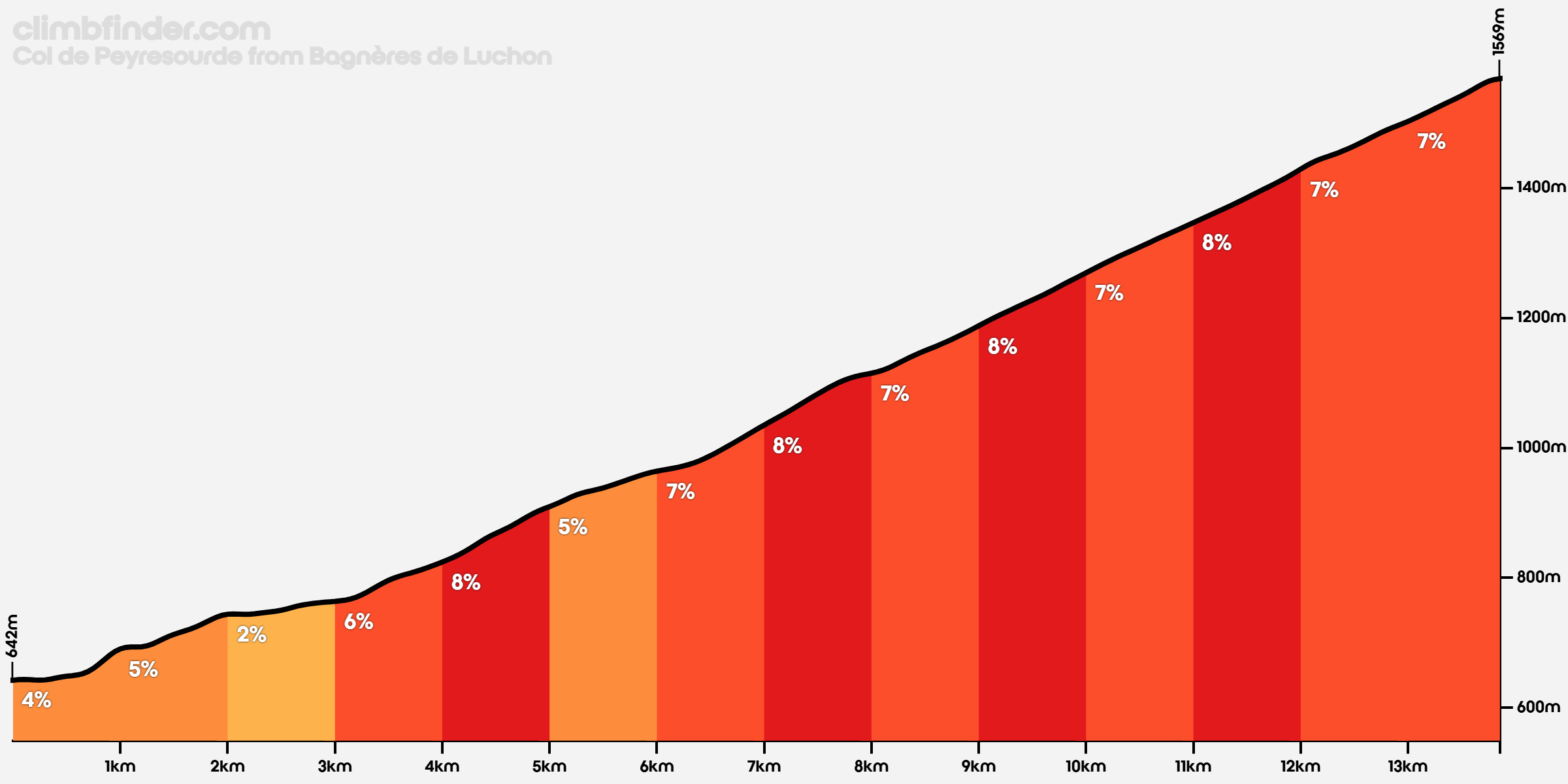
The Luchon side is the defining ride of the Peyresourde — a climb that builds gradually, settles into rhythm, and then quietly wears you down over time.
Expect a rhythmic but uneven ascent with sections that lull you into tempo before kicking up again. The result is a climb that rewards discipline: ride it smoothly and it flows; ride it too hard and it slowly comes back to bite you.
This ascent was in my Tour of 2023’s stage 1, with the Port de Balès before it, concluded with the Aspin.
Alternative
Via Portet‑de‑Luchon
In Garin, you switch to the D76 towards Portet-de-Luchon. This is the scenic alternative, trading flow for character. Longer, slightly less efficient, but more rewarding if you’re riding for the experience rather than the cleanest effort line.
Narrower roads, more rural feel, less through‑traffic, otherwise similar to the main ascent although more irregular and segmented. It rejoins the D618 two kilometers from the summit.
Arreau / Avajan
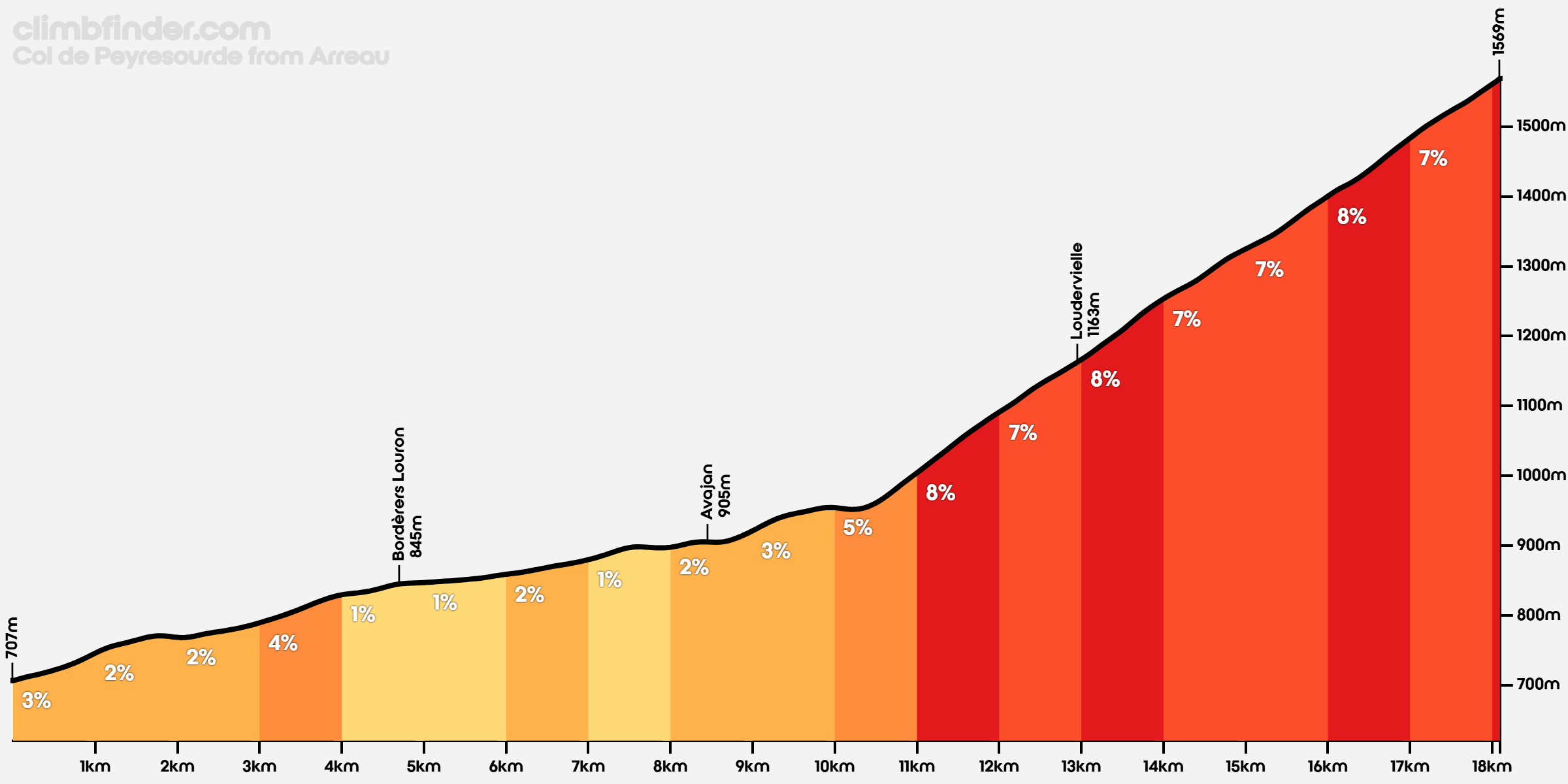
Starting in Arreau adds roughly 10 km of valley riding before the climbing properly begins at Avajan.
Less of a pure climb, more of a complete mountain approach — ideal if you want the full Pyrenean buildup rather than a standing start effort.
This ascent was in my Tour of 2023’s stage 15, which was the reverse of the stage 1.
Alternatives
Armenteule
The most direct western line: ~8.9 km at ~7.2%, with a 2-kilometer soft approach before getting serious just before Loudervielle, where it joins the route from Arreau / Avajan.
Armenteule via Peyragudes
A twist on the standard ascent over the D117, with a detour to Peyragudes (1,620 m) and via Montée de Peyresourde-Balestas (1,645 m) before rejoining the main road just under the summit.
This is the “upgrade” option — less flowing, more demanding, and a good test if the standard west side feels too tame.
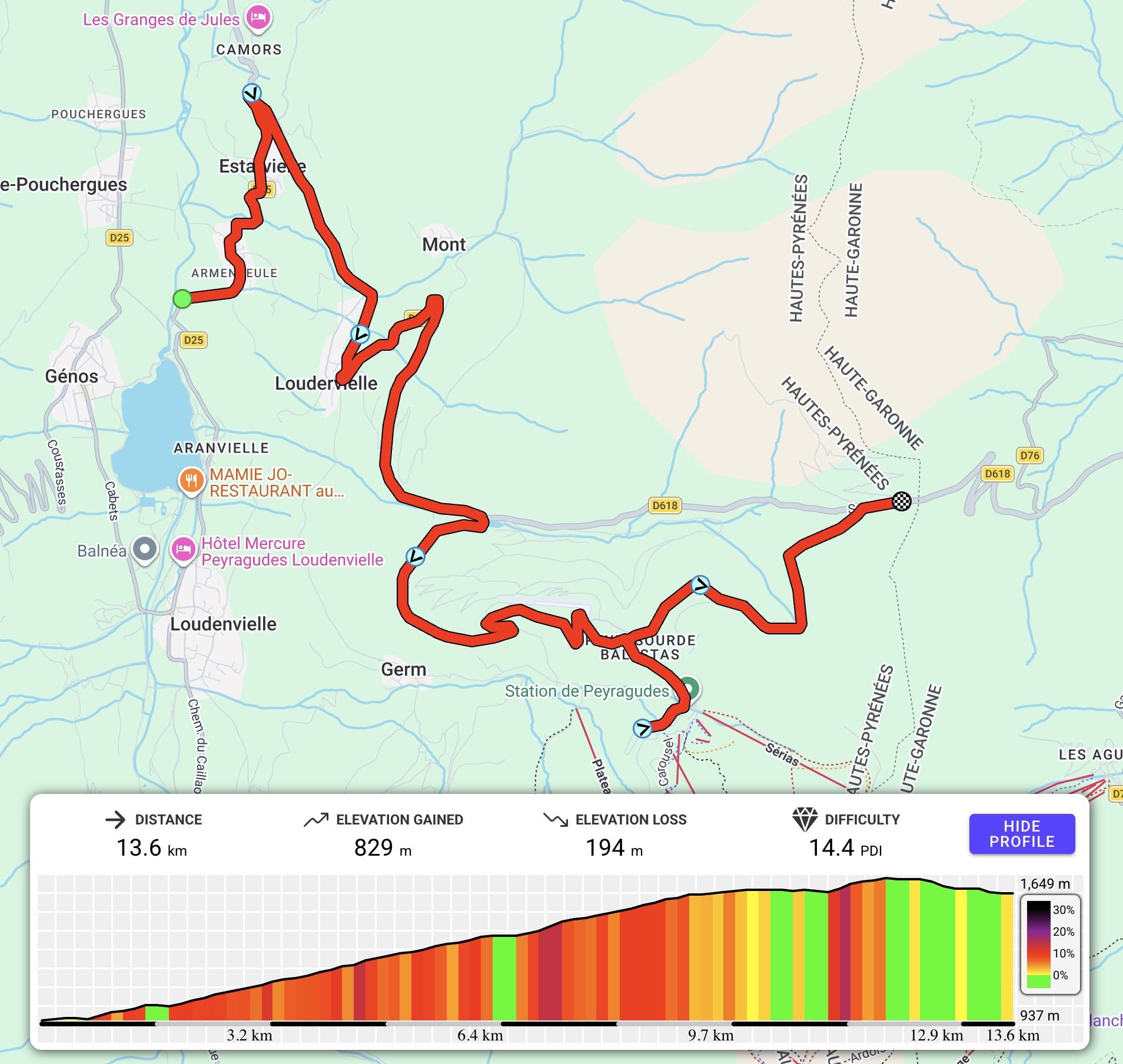
Peyragudes has somewhat of a Tour reputation itself, with 4 finish appearances, and its altiport featured in the Bond movie ‘Tomorrow never dies’. I cycled this alternative too, in 2023’s Tour stage 14, but you cannot cycle the steep final to the altiport, only the ‘standard’ finish to a big parking lot.
Bike Rebel Verdict
The Peyresourde doesn’t shout.
It doesn’t have the altitude of the Tourmalet or the brutality of Hautacam. But it doesn’t need to. What it offers instead is something subtler: a perfectly balanced climb that rewards smart riding.
If you can ride the Peyresourde well — controlled, steady, efficient — you’re ready for the rest of the Pyrenees.