
Border pass
The quiet Swiss giant
With a summit at 2,501 meters, the Umbrail Pass is the highest paved road in Switzerland and one of the highest in the Alps. It sits directly alongside the Stelvio, and that comparison is unavoidable — but also slightly misleading. While the two climbs share part of the same upper mountain, the Umbrail has its own character, its own rhythm, and its own appeal.
I’ve cycled the Umbrail in good weather, bad weather, and not at all — once blocked by a landslide just a few kilometers into the climb. It’s a pass that reminds you quickly who is in charge. On paper it may look like a Stelvio alternative, but on the road it stands up perfectly well on its own.
Identity and context
The Umbrail connects Santa Maria in Val Müstair with Bormio in the Valtellina valley and to the Vinschgau valley via the Stelvio. It is the highest road pass in Switzerland and Europe’s second highest international road pass.
The Umbrail is best known as the third approach to the Stelvio, and from Bormio it literally is the Stelvio — minus the final 3.3 kilometers. From Switzerland, however, it reveals a very different personality: quieter, steeper, and more exposed.
During the Giro d’Italia of 2011, the Umbrail briefly stepped into the spotlight as a Swiss detour on an Italian mountain. It has remained something of an insider’s climb ever since — well known among cyclists but still overlooked by most motorized traffic.
During the Giro d’Italia of 2017, Dutch rider Tom Dumoulin had to get off his bike in the approach towards Santa Maria because of stomach problems. He lost 2 minutes and the pink jersey in the GC but went on to win the Giro that year anyway.
Why ride the Umbrail Pass
You ride the Umbrail if you’re looking for intensity without spectacle, altitude without chaos. It suits riders who prefer steady pressure over endless hairpins, and who value quiet road moments as much as famous summit signs.
It may sit in the shadow of the Stelvio, but it doesn’t suffer from it. In fact, the Umbrail benefits from that proximity — offering an alternative way into the high mountains, and one that often feels more honest, and more personal, than the climb next door.
Characteristics
From Santa Maria in Val Müstair, the Umbrail is a shorter but more intense climb. At 13 kilometers with an average gradient of 8.6%, it wastes little time easing you in. The steepest section comes early, through a series of hairpins that open suddenly onto wide views of the Müstair valley below.
Higher up, the road straightens out and the climb becomes more exposed. There are fewer visual distractions than on the Stelvio’s Italian sides, and recovery opportunities are limited. The effort feels more constant, more compressed — less of a journey, more of a test.
From Bormio, the experience is different again. You ride the familiar lower slopes of the Stelvio before splitting off near the top, effectively choosing altitude and continuity over spectacle. It’s a subtler finish, but one that still feels properly earned.
Traffic and road character
One of the Umbrail’s biggest strengths is its relative quiet. Even in summer, traffic levels are noticeably lower than on the Stelvio. On certain days — like during Stelvio Bike Day — the road can be entirely car‑free, turning the climb into a rare, uninterrupted high‑mountain experience.
The Swiss side in particular feels open and calm, with a road surface that invites steady riding rather than stop‑start efforts. Wind can be a factor, especially once you’re above the valley and fully exposed.
Season and weather notes
Like the Stelvio, the Umbrail is a strictly seasonal climb. Winter closures are the norm, and the opening date varies with snow conditions. Even when the road is open, early‑season riding can feel raw and unpredictable.
The pass is fully exposed to weather near the top. Wind is common, temperatures can drop sharply, and conditions can change quickly. I’ve started the climb in rain and been forced to turn back — a reminder that at this altitude, flexibility matters more than plans.
When the weather cooperates, however, the Umbrail offers something increasingly rare in the Alps: a high, serious climb that still feels calm and unhurried.
Santa Maria
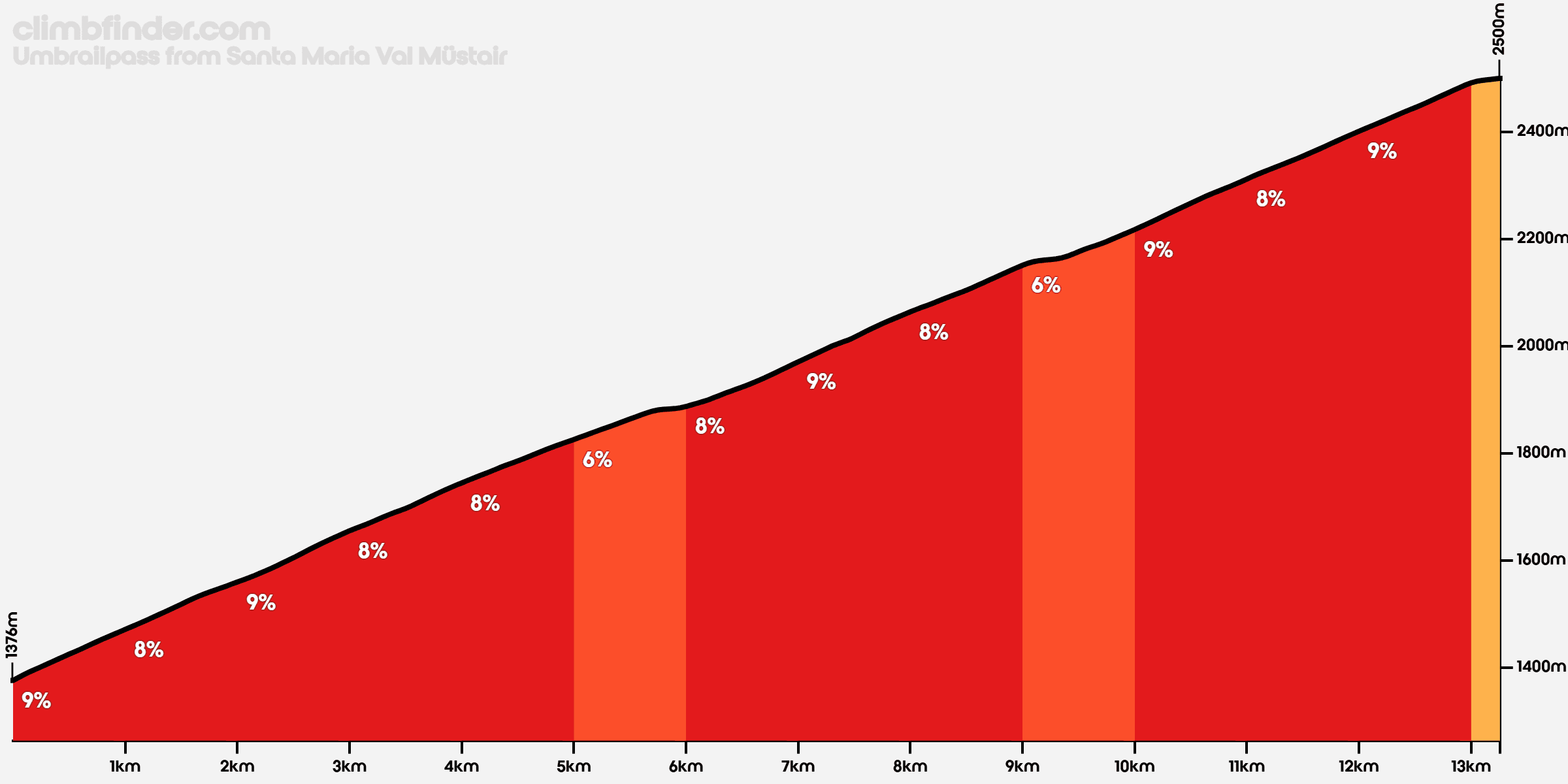
While the profile looks eerily steady, the steepest part is actually right at the start, were, after a series of hairpins, you will be rewarded with stunning views of the Müstair valley with Santa Maria in it.
Some 3.5 kilometers from the summit, another series of hairpins offers great views as well.
Reports of my ascents, including the Stelvio finish, here (2011) and here (2020).
Bormio
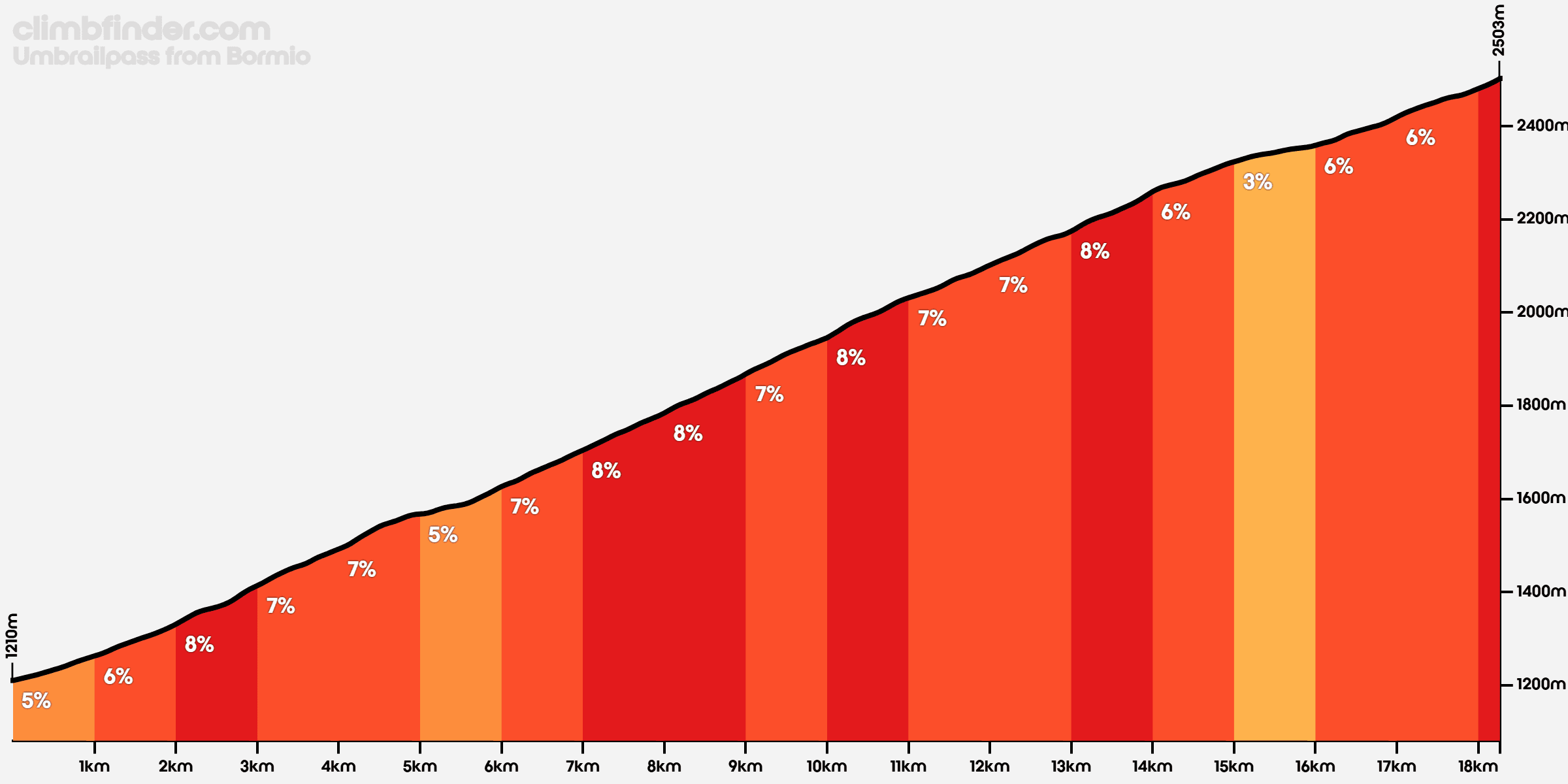
As stated, the climb from Bormio is better known for its more famous twin, the Stelvio.
For a more detailed description of this climb, with views similar to the Prato side of it, I refer to the Stelvio page.
Stelvio – Umbrail Loop
Mentioning the Bormio → Stelvio → Prato → Val Müstair → Umbrail loop is not optional on an Umbrail page; it’s one of the defining reasons the pass matters.
What makes this loop special is not just the elevation gain, but the contrast. Few Alpine rides combine such famous roads with such calm ones, or link two major passes while crossing three distinct valleys and two countries.
Done well — preferably with an early start and stable weather — it’s one of the most complete high‑mountain days the region has to offer.

Background image: by Zairon, CC BY-SA 4.0, via Wikimedia Commons
