
Dolomite pass
Punchy climb — varied gradients, no steady rhythm
The Sella Pass (2,243m) is an Alpine pass in the Dolomites, marking the border between the provinces of Trento and Alto Adige, located between the Sassolungo group and the Sella group.
It connects Canazei, in Val di Fassa, with Selva di Val Gardena, in Val Gardena.
The Sella doesn’t unfold gradually — it rises into you. The gradients are higher, the ramps more noticeable, and the road feels tighter against the landscape.
Where other climbs open slowly, this one surrounds you from the start — dominated by the Sassolungo and the walls of the Sella massif.
It’s not designed to be ridden the same way twice.
A climb that keeps your attention from start to finish
Why ride it
Because this is the climb that won’t let you switch off.
Unlike more regular ascents, Sella keeps changing just enough to disrupt any steady rhythm:
- gradients lift and ease
- corners arrive at different angles
- the road never quite settles
It’s not brutally steep, but it asks for constant adjustment — in pacing, position, and focus.
At the same time, the setting is unusually immediate:
- the rock faces feel close
- the scale of the mountains dominates the road
- the summit arrives almost without warning
That combination defines the ride:
- you don’t lock into a steady effort
- you stay engaged, responding to the climb as it develops
It works best when you want something that feels:
- intense without being overwhelming
- varied without being chaotic
- memorable not because of difficulty, but because of how it feels while riding
You don’t control Sella — you respond to it
It’s not the most even climb in the Dolomites, but it’s one of the few where the experience stays active all the way to the top.
Giro d’Italia
The Sella Pass was included 18 times in a Giro d’Italia stage between 1940 en 2024, often combined with the nearby Gardena, Campolongo or Pordoi passes.
On 4 occasions (1969, 1976, 1998 and 2024) it was also the Cima Coppi, the highest point reached during the race.
In 2016’s stage 14, the Maratona course with the Sellaronda from Arraba in it, was included as a tribute to the 30th Anniversary of the event.
Canazei
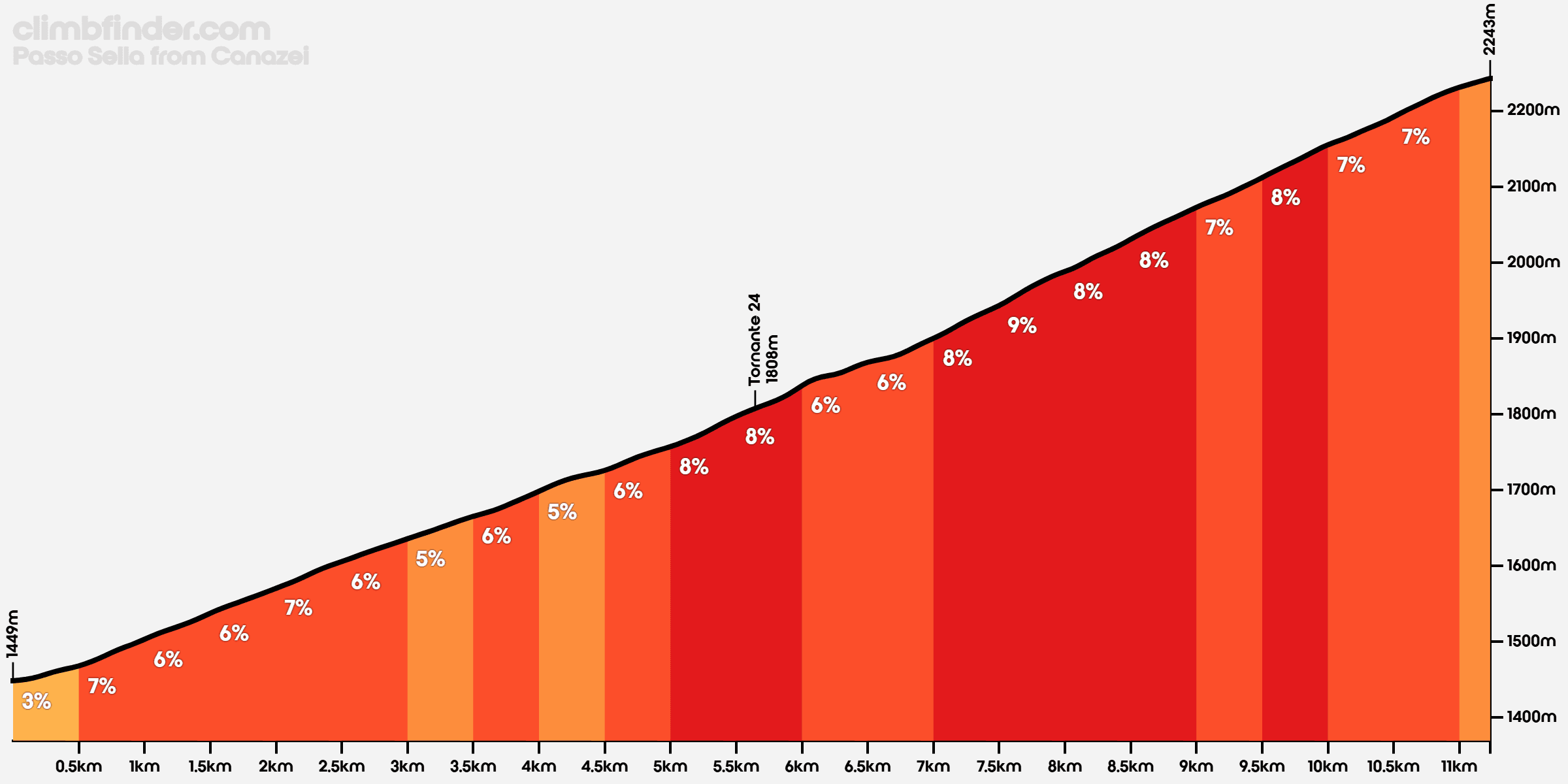
At just over 11 kilometers at a 7.1% average, this is the long ascend of the Sella1. It has the first half in common with the Pordoi – that is up to “Tornante 14” in the profile and the Sella hairpin numbering then continues from 10 down to 1.
These final 5 kilometers average 8.7% with a 1-kilometer stretch at 9.3% – as usual, the average is a little deceiving…
I cycled this end in full in 2015, in 2011’s stage 4, I cycled the bottom half it has in common with the Pordoi and during my Maratona of 2020, I cycled the top half, from the Pordoi split.
1 Unless you start down in Ponte di Gardena, see below.
Plan de Gralba
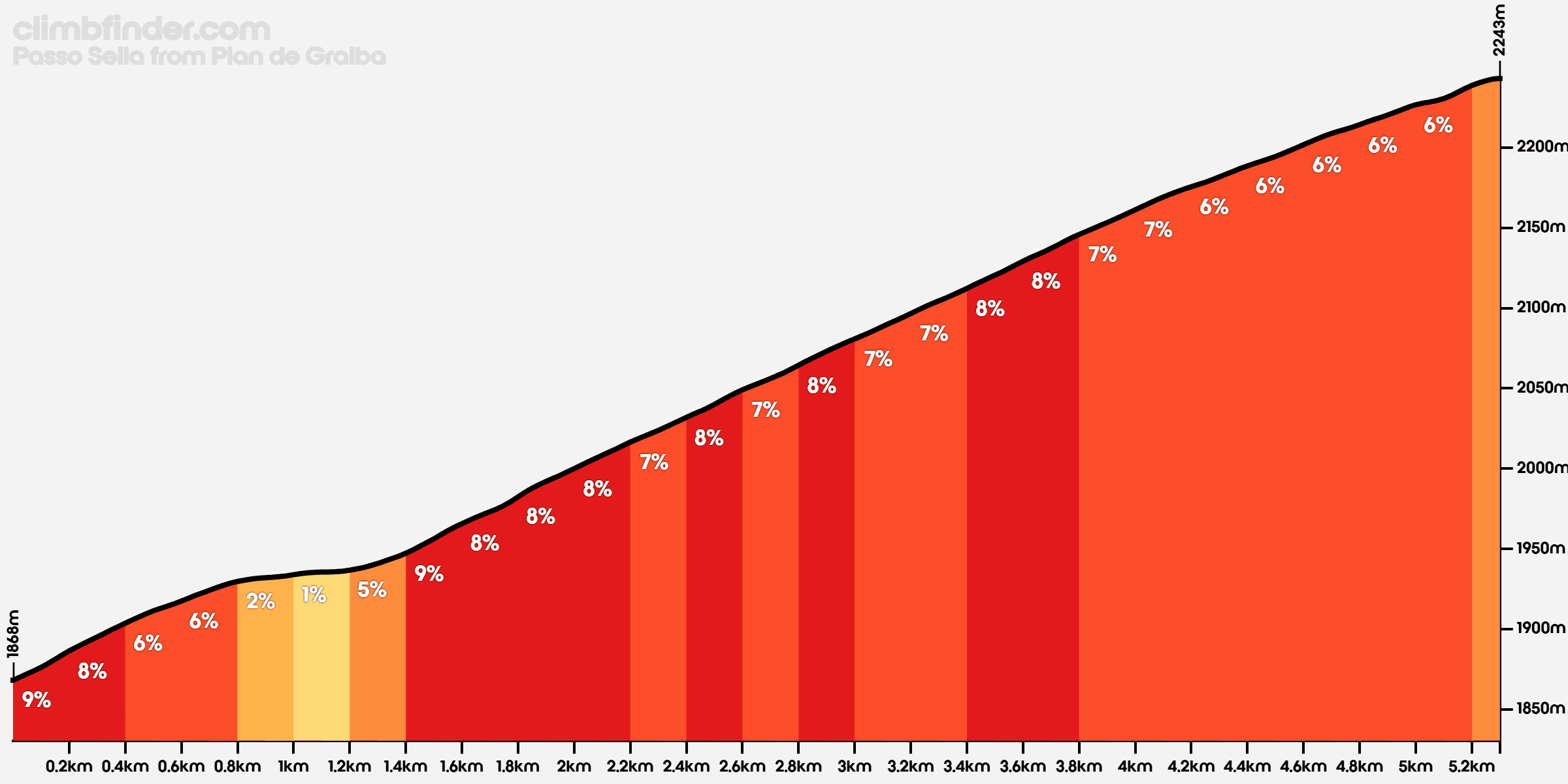
From where the Gardena and Sella split, at Plan de Gralba, the remainder of the Sella is ~5.2 kilometers long at a 7.1% average. It features over 10% stretches, but overall, it’s a fairly even climb.
Starting in Selva di Val Gardena adds another ~5.2 kilometers, for a total of ~10,5 kilometers at 6.7%.
If you want to start in Ponte Gardena, way down in the Isarco Valley, the ascent is almost 31 kilometers at a modest 5.8%, but besides the final from Plan de Gralba, that also features the painfully steep stretch between Gasthof Stern and Pontives: 3 kilometers at 9.5%.
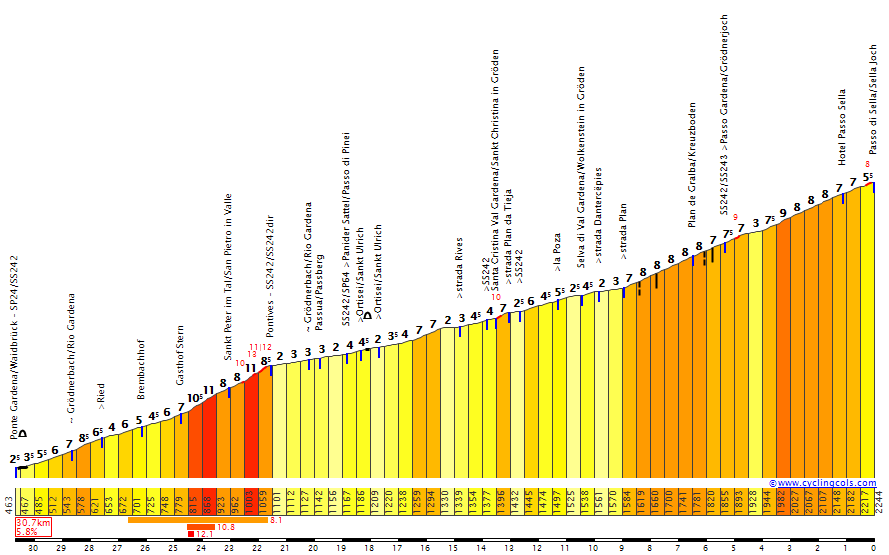
The short end I’ve cycled twice: in 2011, I started my Sellaronda in Sante Cristina Valgardena and in 2025, I started at the Hero Mall in Selva di Val Gardena.
Note that only get to cycle a full Sella if you start in Canazei in a clockwise Sellaronda. Clockwise from any other starting point you cycle only half of it, counterclockwise you will climb the other end of the Sella from Plan de Gralba.