
The line nobody took — until the Tour did
For decades, the Col de Spandelles (1,378 m) sat quietly in the shadow of its neighbors.
The Soulor and Aubisque carried the legacy, the Tour rode past and cyclists followed the obvious roads.
Then, in 2022, something happened: a narrow, irregular, almost forgotten climb — suddenly exposed at the highest level.
Why ride the Spandelles
What makes the Spandelles special isn’t prestige — it’s absence of it:
- Low traffic: one of the quietest paved climbs in the area
- Narrow road: closer to a mountain lane than a main col
- Irregular gradients: never quite steady, never quite predictable
- Hidden position: running parallel to the Soulor but rarely used
- Raw feel: less engineered, less polished, more “real”
This is not a showcase climb, it’s a back road that happens to cross a mountain.
At below 1,400 meters, the Spandelles isn’t about altitude, it’s about isolation:
- Long stretches through forest
- Minimal infrastructure at the summit
- Limited views until late in the climb
Tour de France
The Spandelles made its debut in 2022 but not quietly. It was included in stage 18 as a category 1 ascent positioned between the Col d’Aubisque and the summit finish at Hautacam.
The climb became instantly iconic when it hosted an aggressive battle for the yellow jersey, Jonas Vingegaard and Tadej Pogačar attacking each other mercilessly on its steep, narrow slopes.
On the descent, Pogačar made a mistake, clipped his tire in the gravel, and crashed. Vingegaard sportingly waited for his rival, eventually taking the stage win on Hautacam.
The Spandelles was included to change how the race was ridden – simply descending the Aubisque and then finish on Hautacam, would have been a completely different stage.
Climbing character
If Hautacam breaks rhythm and Luz Ardiden repeats it, the Spandelles does something subtler: it never lets rhythm exist in the first place
- Gradients fluctuate without warning
- Surfaces can vary slightly in quality
- The road narrows and twists constantly
It’s a climb where you’re always adjusting — but never dramatically. Just enough to stop you ever feeling fully in control.
Practical notes
- Road width: narrow, especially on the west side
- Surface: generally good, but less polished than major cols
- Traffic: minimal — one of its biggest strengths, possibility of livestock on the road
- Descending: technical and requires attention
Argelès‑Gazost
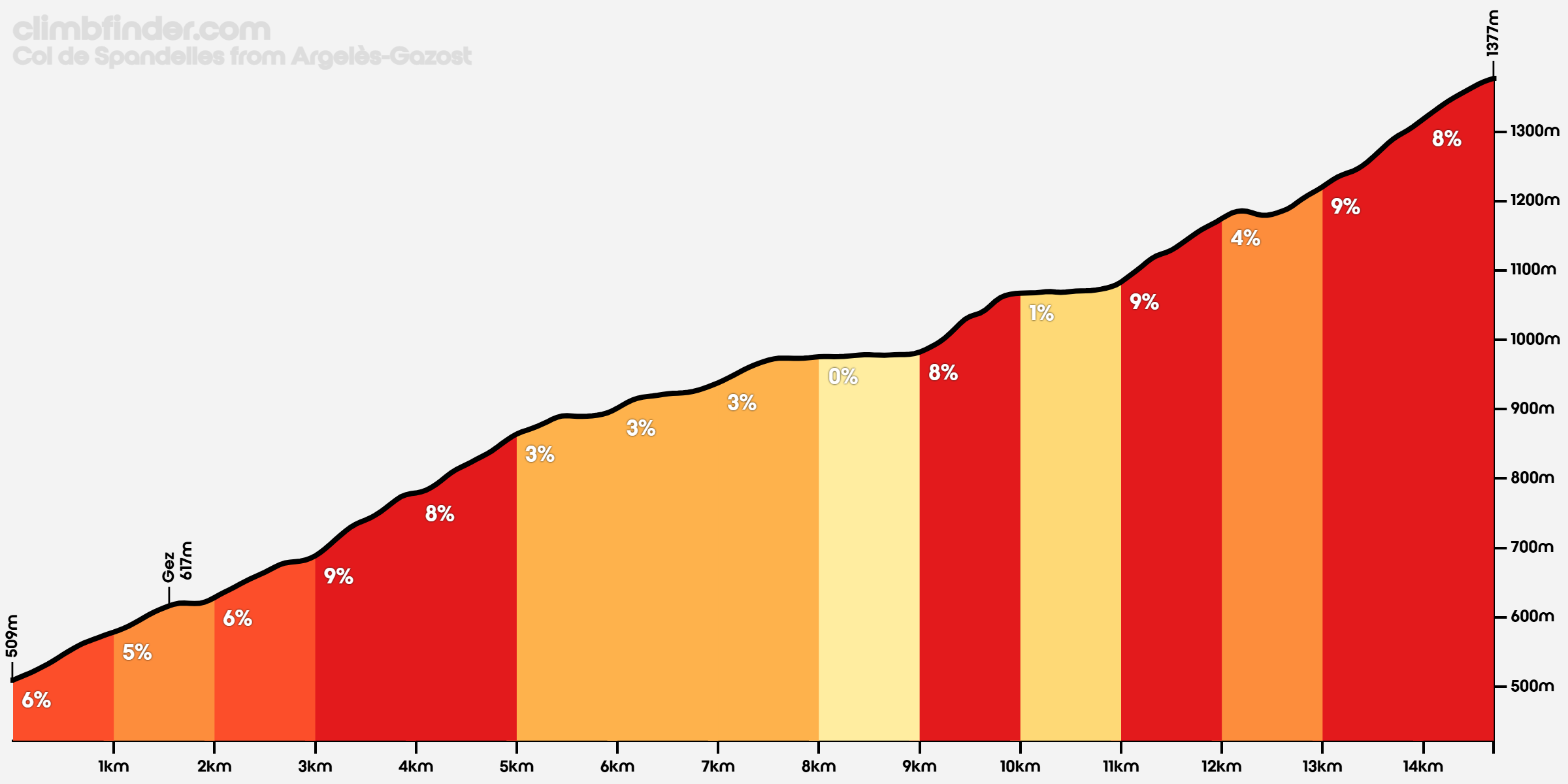
The longer, more deceptive approach — and the one that hides the true nature of the climb.
Leaving Argelès, the road enters forest quickly, and for a long time, that’s all you get. The gradient builds unevenly, with early steeper sections mixed into what should feel like a steady climb — except it never quite is.
Midway through, the slope softens slightly. There’s a short period where it feels like the climb might settle — where you might finally find rhythm.
But then the final section tightens again, with steeper ramps returning before the summit. Only here does the landscape start to open, revealing the position you’ve been climbing into all along.
This side is about false rhythm — it suggests flow, then quietly takes it away.
Ferrières
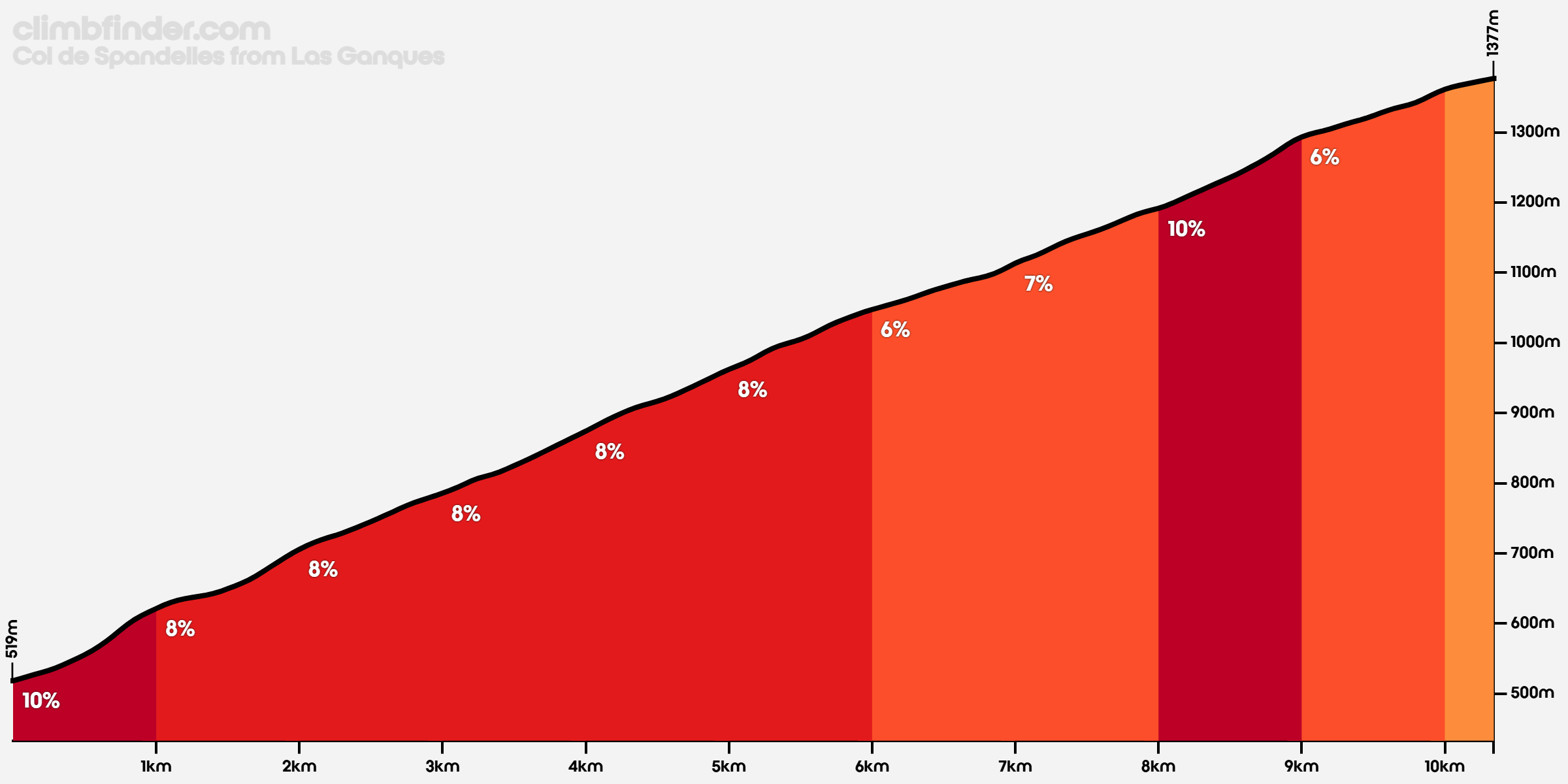
The true identity of the Spandelles — direct, narrow, and uncompromising. The road the Tour de France took.
From the village, the climb starts without ceremony. There’s no gentle introduction — the gradient locks in early and stays high, refusing to offer meaningful relief.
The road is noticeably narrower here, twisting tightly through forest and climbing with a sense of confinement. There are few distractions — just the road, the slope, and the effort.
Unlike many Pyrenean climbs, this side doesn’t evolve much. It doesn’t open dramatically or shift character, it simply continues.
Toward the summit, the trees finally give way and the view appears almost suddenly — not as a gradual reveal, but as a reward you didn’t realise you were approaching.
This side is about constant pressure — no story, just execution.
This is the end I climbed in stage 5 of my Tour de France 2023. Just me, Paula and the scorching heat, all the way up. The first people we met were at the summit parking, returning from a walk…
Note: despite Climbfinder positioning the Ferrières end in the Pyrénées-Atlantique, the entire Spandelles is in the Hautes-Pyrénées.
Bike Rebel Verdict
The Col de Spandelles doesn’t try to impress you. No frills, just a narrow road, a mountain, and a question: what happens when you take the road nobody else does?