
Where rhythm breaks down
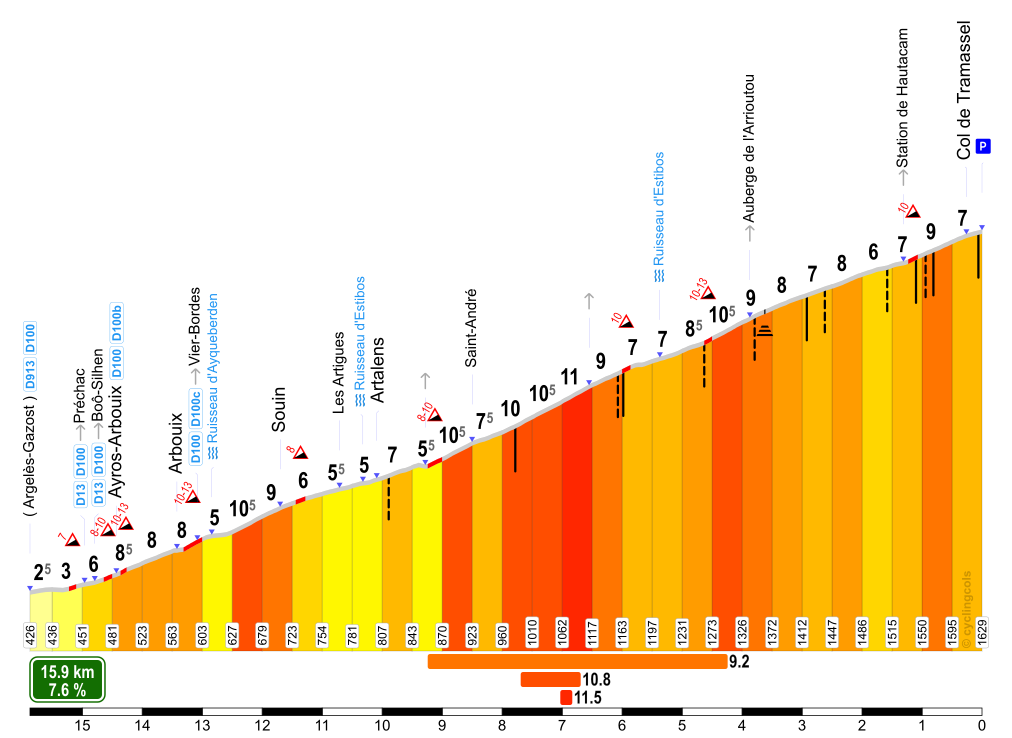
Hautacam (1,530 m) isn’t a pass, it’s dead-end road to a ski resort, climbing out of the Argelès‑Gazost valley and ending high above it.
No crossing, no transition, no narrative beyond the climb itself.
But unlike Luz Ardiden, where repetition dominates, Hautacam is something else entirely: a climb that refuses to give you rhythm.
Why ride Hautacam
What sets Hautacam apart is not length or altitude — it’s instability:
- Irregular gradients: constantly changing, never settling
- Explosive ramps: sharp pitches followed by partial relief
- Psychological load: hard to pace because the climb never “locks in”
- Tour pedigree: used as a decisive summit finish
- Open upper slopes: exposure increases as fatigue does
This is not a smooth climb, it’s one that keeps asking you to restart your effort.
Tour de France
Hautacam has been a stage finish 7 times since 1994 and it has a clear and consistent role:
- Used as a summit finish to decide stages outright
- Known for large time gaps and defining performances
- A climb where irregular gradients amplify fatigue accumulated earlier in the stage
For example, the Hautacam finish in the 1996 edition of the Tour effectively ended the reign of five-time champion Miguel Indurain when Bjarne Riis launched an attack there, claiming the stage victory and eventually winning the Tour that year.
In 2022 and 2025 Jonas Vingegaard and Tadej Pogačar fought a battle on Hautacam, Jonas gaining the upper hand in 2022 and Tadej taking revenge in 2025.
The Hautacam is not a connector, it’s a final selection test.
Climbing character
Hautacam is defined by broken rhythm:
- Gradients surge, ease, then surge again- it’s a climb made of segments rather than flows
- There are few truly steady sections
- Every time you think you’ve found a pace, it shifts
Where Luz Ardiden rewards control, Hautacam demands adaptation. It’s not about holding a number, it’s about responding to the road in real time.
Practical notes
- Road: good quality, purpose-built climb
- Traffic: generally light (dead-end helps)
- Exposure: high in upper section — plan for heat or wind
- Pacing: difficult to get right — conservatism early pays off
Argelès‑Gazost (Ayros-Arbouix)
The climb starts just outside Argelès and it doesn’t ease you in gently. The gradient appears early, not extreme but assertive enough to demand attention from the start.
The road moves through wooded slopes first, where the gradient fluctuates in short sequences — nothing long enough to lock into, nothing easy enough to relax.
As you gain altitude, the gradient behaviour doesn’t smooth out. If anything, the variations become more pronounced.
The final section toward the summit is less about gradients on paper and more about managing what’s left in your legs after repeated efforts.
Beyond the main summit area, the road continues for 1.5 kilometers toward the Col de Tramassel, where a restaurant and a second marker signal the true high point at 1,635 meters.
I climbed Hautacam / Tramassel during stage 7 of my Tour de France 2023, from a hot valley to a cold and foggy summit.
Hautacam vs Luz Ardiden
Hautacam sits very close to Luz Ardiden geographically — but they couldn’t be more different:
- Luz Ardiden → repetition, structure, controlled effort
- Hautacam → variation, disruption, reactive effort
On Luz you manage a steady output, on Hautacam you’re constantly adjusting. Luz tests your pacing, Hautacam tests your ability to adapt when pacing fails.
Bike Rebel Verdict
Hautacam doesn’t overwhelm with size, it challenges you in a different way: it’s a climb defined by inconsistency and cumulative fatigue
It’s not the steepest, not the highest, not the longest, but it might be the one where you feel the least in control.