Valley connector
A functional crossing where the role in the landscape matters most
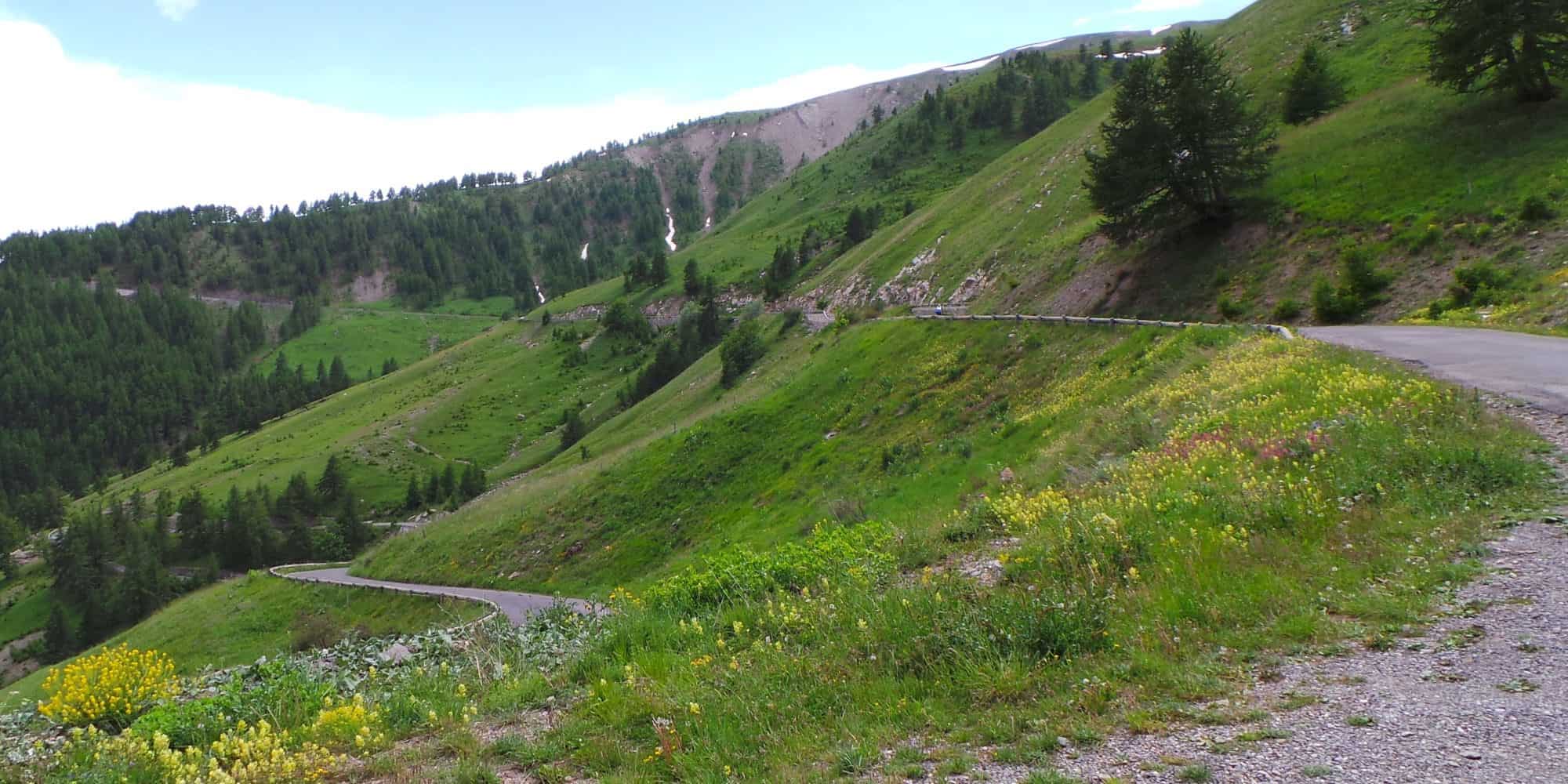
The Col d’Allos (2,250m) is a mountain pass in the Southern Alps, located in the French department of Alpes-de-Haute-Provence in the Provence-Alpes-Côte d’Azur region.
ion.
Linking the Ubaye valley to the north to the Verdon valley to the south, the Col d’Allos is located on the border of the communes of Allos and Uvernet-Fours.
The pass is also part of the Route des Grandes Alpes, connecting the French Riviera (Menton) with Lac Léman (Geneva).
The main reason I created this info page, is because it’s also part of the Brevet de 7 Cols d’Ubaye, which I obtained in my (first) Tour of 2014.
And while it is a nice climb with some good scenery, it’s not as scenic and quiet as the neighboring Cayolle.
Why ride the Col d’Allos
The Col d’Allos is often grouped with Vars and Cayolle, but it stands apart in how it rides. Where those climbs function as clear connectors through terrain, Allos feels more like a mountain road that happens to cross a pass.
What defines Allos is not its position, but its character:
- The road is narrower and less engineered, particularly on the southern side
- The gradients are less uniform, with frequent fluctuations that interrupt rhythm
- The climb feels closer to the landscape, rather than imposed on it
This makes Allos less predictable than its neighbours:
- You are not settling into a long, steady effort
- You are constantly adjusting to changes in gradient and road structure
From a route perspective:
- It still functions as a link between the Ubaye valley and the southern Alps
- It is often combined with Cayolle in longer routes
Allos is not simply a way through — it is a climb that demands attention throughout.
It suits riders who:
- are comfortable with irregular pacing
- prefer climbs with continuous variation
- value road feel and environment over clean gradient profiles
If Vars is controlled and Cayolle is directional, Allos is the most textured and least predictable of the three.
Seasonal notes
The Col d’Allos behaves like a true seasonal Alpine pass, more comparable to Cayolle than to Vars.
- Closed in winter due to snow
- Typically opens late spring or early summer (depending on conditions)
- Best period: June through September
Key characteristics:
- The road is narrow and less prioritised, which can delay opening
- Upper sections, especially on the southern side, can retain snow or debris longer
- Conditions can change quickly due to exposure and limited shelter
Compared to nearby routes:
- Less reliable than Vars
- Similar seasonal profile to Cayolle, but often feeling more remote
Traffic and conditions:
- Limited traffic overall
- More exposed sections near the summit
- Surface conditions may vary more than on larger passes
Allos should be treated as a seasonal objective, where timing matters and conditions are part of the ride.
North–South note
- North (Ubaye / Barcelonnette): more gradual entry
- South (Colmars / Var): narrower, irregular, more “mountain road” feel
The difference is less about difficulty and more about road character and flow.
Tour de France
Unlike that neighbor, the Allos has been included in a Tour stage no less than 34 times, but only 9 times since 1947.
The last passage of the Allos was in 2014, when Simon Geschke was the first rider to cross the summit.
Barcelonnette
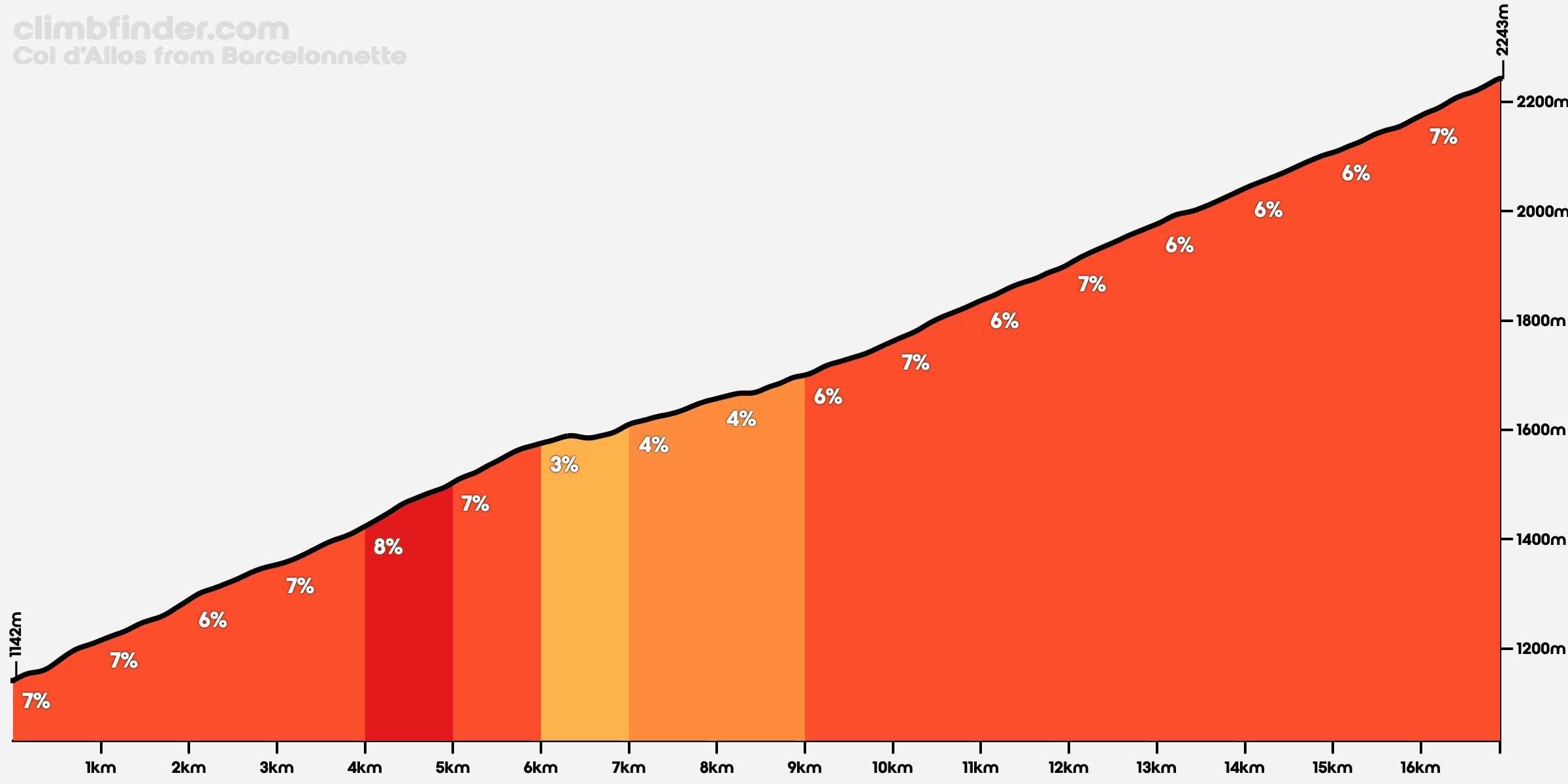
This ascent is 16.9 kilometers at 6.5%. It is steady throughout, except for an easier 4-kilometer stretch, increasing the average of the rest to 7%.
Colmars
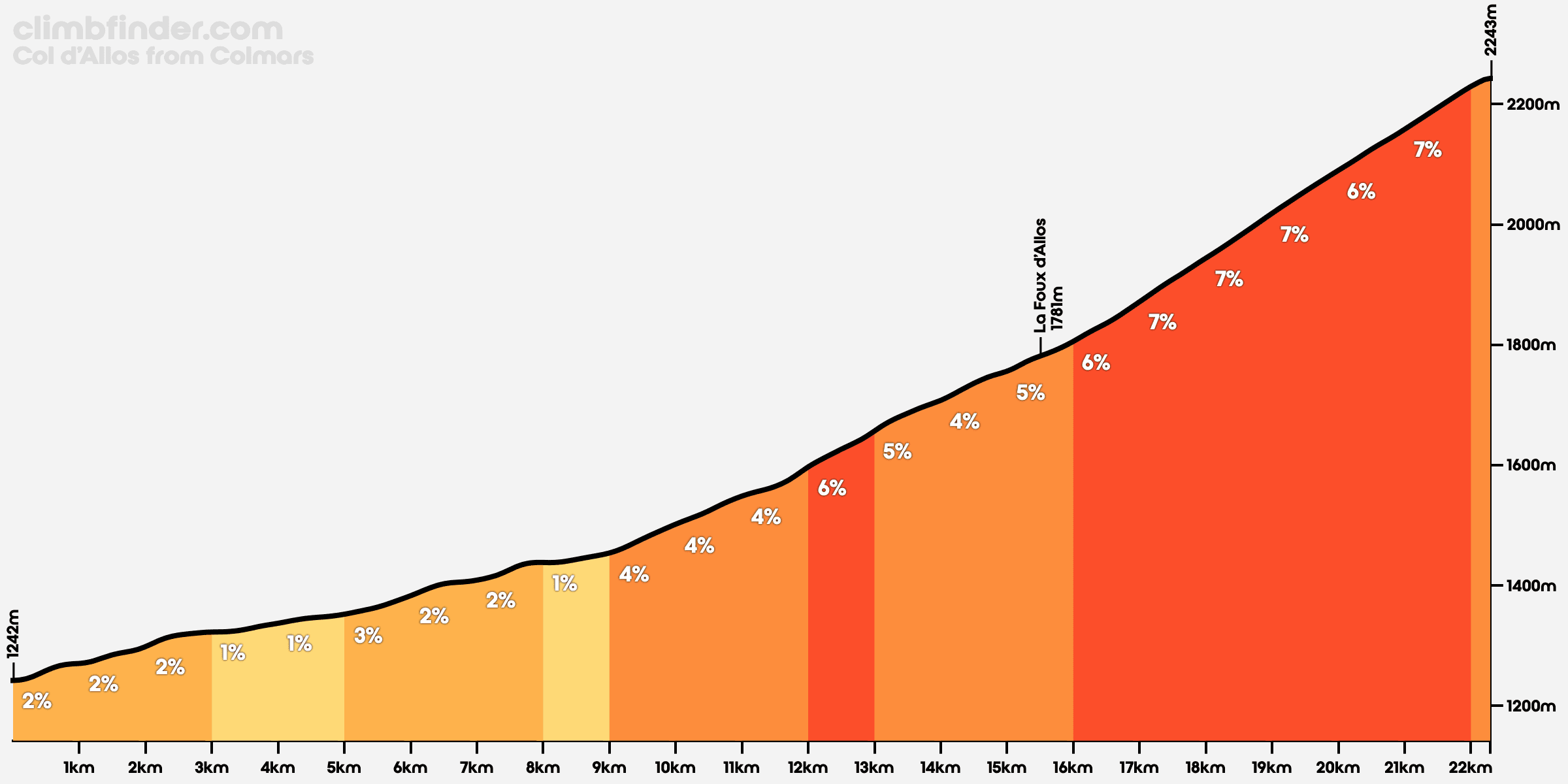
With 22.3 kilometers at an average of 4.5%, this ascent is seemingly easier. But taking out the easy 9-kilometer warm up, the rest is 6% on average, with the final 5 kilometers at 7.3%.