Race landmark
Defined by racing history, but understood through pacing and effort
The Col du Tourmalet (2,115m) is a mountain pass in the central French Pyrenees, the Hautes-Pyrénées department in the Occitanie region.
Dominated by the Pic du Midi de Bigorre to the north (2,877m) and the Pic d’Espade (2,467m) to the south, it connects the high valley of the Adour (Bagnères-de-Bigorre, Campan, La Mongie) in the east to the Gave de Pau (Luz-Saint-Sauveur and Barèges) in the west.
Why ride the Tourmalet
What sets the Tourmalet apart is not just difficulty, but legacy. This is a climb where the identity of the Tour de France was forged.
- The Tour’s defining climb: more appearances than any other col
- Living cycling history: from Lapize to modern GC battles, every era has passed here
- Mythical atmosphere: sparse upper slopes and the iconic Octave Lapize statue at the summit
- Pure climbing rhythm: long, steady gradients that reward pacing rather than explosiveness
- Pyrenean centrepiece: easily combined with Aspin, Luz Ardiden, Hautacam or Aubisque
More than most climbs, the Tourmalet is about context: you are riding through over a century of racing history.
Tour de France
The Col du Tourmalet is the defining climb of the Tour de France in the Pyrenees — and arguably the race’s most iconic mountain pass. First included in 1910, it marked the moment the Tour moved decisively into high mountains, fundamentally reshaping the race.
From the very beginning, the Tourmalet built its legend through hardship and drama. Octave Lapize was the first rider over the summit in 1910, famously calling the organisers “assassins” before going on to win the Tour. Just three years later, Eugène Christophe broke his fork near the summit and walked down to Sainte‑Marie‑de‑Campan to repair it himself — one of the sport’s most enduring stories.
Since then, the Tourmalet has been used more frequently than any other climb in the Tour de France, appearing well over 80 times and becoming a recurring high point — both physically and symbolically — of mountain stages.
Despite its prominence, summit finishes are relatively rare. Memorable finishes include Jean‑Pierre Danguillaume (1974), Andy Schleck (2010), and Thibaut Pinot (2015), while La Mongie has hosted additional finishes below the summit.
In modern racing, the Tourmalet continues to shape the race. It was featured in both the men’s and women’s Tours in 2023, with the latter finishing at the summit, reinforcing its status as a defining climb across generations and categories.
Souvenir Henri Desgrange and Souvenir Jacques Godet
The Souvenir Jacques Goddet is awarded to the first rider to reach the summit of the Col du Tourmalet. Introduced in 2001, it honours former Tour director Jacques Goddet and underlines the climb’s special place in Tour history.
The Souvenir Henri Desgrange follows a different rule: it is awarded to the first rider over the Col du Galibier when it is included in that year’s Tour, and otherwise to the first rider over the highest col in the race.
That usually keeps the two prizes separate, but 2010 is a neat exception. With no Galibier and the Tourmalet marked as highest in the route, included in two consecutive stages, Christophe Moreau took the Souvenir Jacques Goddet on the first passage, while the Souvenir Henri Desgrange was awarded to Andy Schleck the next day.
Few climbs can host a permanent Tour prize and, in the right route design, also serve as the race’s highest symbolic point — another reason the Tourmalet feels less like a mountain pass and more like cycling heritage in asphalt form.
Seasonal notes
The Col du Tourmalet typically opens between late May and mid‑June, depending on snow conditions, and closes again in October.
- Snow can linger near the summit well into early summer
- Weather changes quickly: sunshine in the valley can mean fog or cold at altitude
- Wind exposure increases significantly above La Mongie
- Traffic can be heavy in peak summer due to its popularity
Even in good weather, temperatures at 2,115 m can be significantly lower than in the valleys — bring layers for the descent.
Take Me Higher
Contrary to popular believe, the Col du Tourmalet is not the highest paved mountain road in the French Pyrenees, but it is the highest pass.
In fact, you can get a lot higher right from the summit of the Tourmalet: the dead end to the Col de Laquets with an altitude of no less than 2,637 m.
However, it is not paved and for large parts it is not much more than a goat trail – I doubt you will bring that to a good end on a normal road bike.
The highest paved road is the dead-end Col de Portet (2,215m), and the dead-ends Col de Tentes, Lac d’Aumar and Lac de Cap-de-Long are higher too.
The highest (paved) pass in the whole Pyrenees range, is Port d’Envalira in Andorra with an altitude of 2,407 m. It can be climbed from France (Ax-les-Thermes or from Bourg-Madame via Col de Puymorens) with the passage into Andorra at 2,106 m.
Sainte‑Marie‑de‑Campan
- Shorter and more structured climb
- Gradual build-up through forest before opening up above La Mongie
- More consistent gradient
- Historic narrative (Christophe’s forge story)
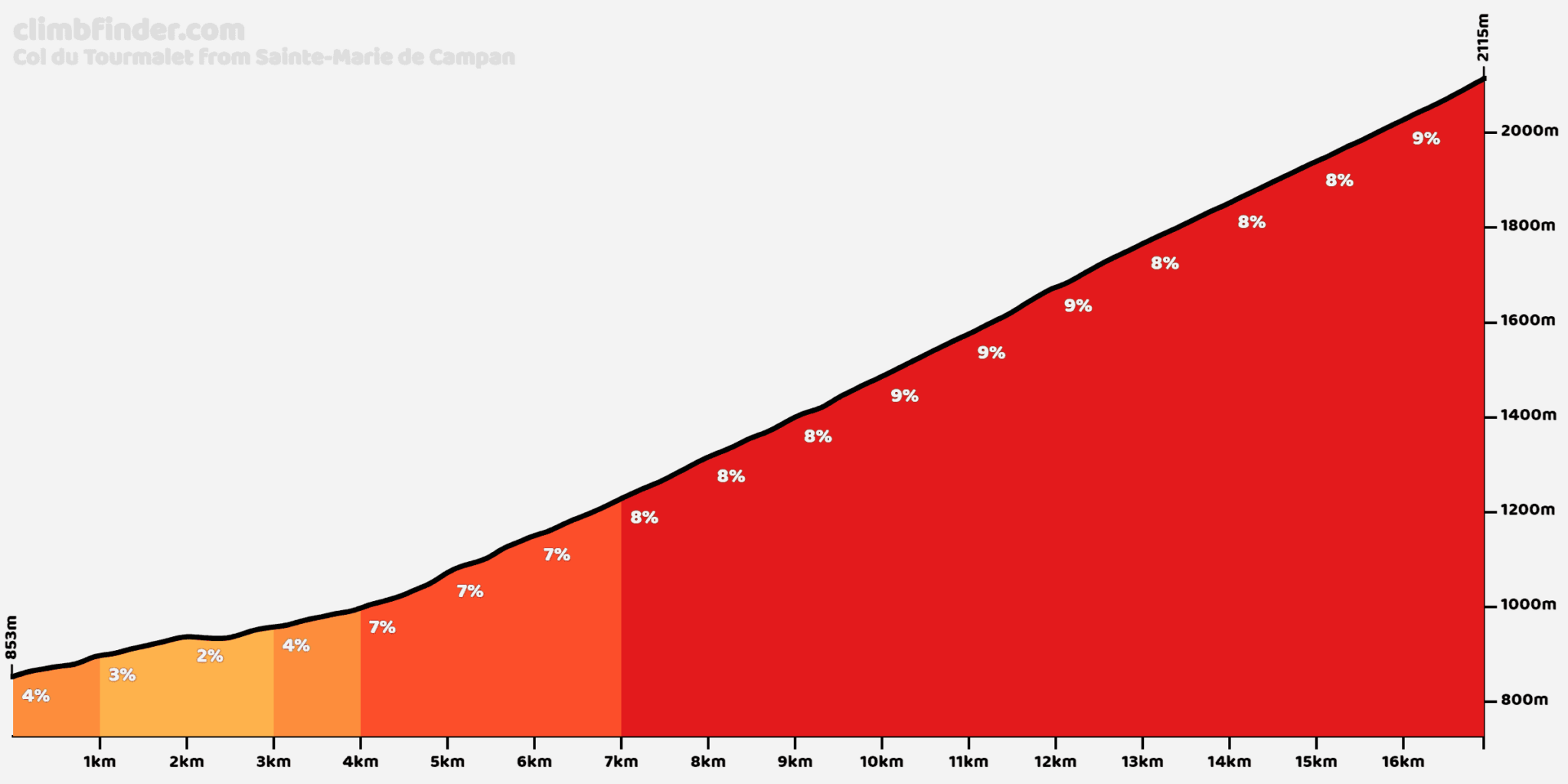
Deemed slightly “easier”, this ascent of the Col du Tourmalet is 16.9 kms long at an average of 7.5%, with 12% for the steepest 100 meter section(s).
Don’t be fooled – or tricked into pushing harder – during the first irregular “easy” kilometers, as even those have 10% stretches and you’ll regret not having heeded that warning later…
I rode this end, which was close to our base camp, during my Tour de France 2023. As I didn’t go for the Marmotte Pyrenees, I didn’t do both ends in one stage, but I did combine the Luz Saint-Sauveur end with Luz Ardiden.
Luz‑Saint‑Sauveur
- Longer and more progressive
- Narrower valley start, transitioning into high mountain terrain later
- Feels more remote in upper sections
- Often considered the more “natural” ascent
From Luz Saint-Sauveur, the Col du Tourmalet has two – almost identical – alternatives to get to the summit.

The standard climb is 18.3 kms long, at an average of 7.7%, but the advantage of this end is that it is a more even climb than the other end.
This is the road most traveled and the one I took as well during my Tour de France 2023 and to be honest, I didn’t consider taking a turn to cycle the other alternative.

For much the same route, this one travels part of the old road up the pass, named Touët et Labach or Voie Laurent Fignon. It’s some 2 kilometers past Barèrges where you can enter that road – no cars allowed – and it rejoins the new road just before Super Barège.
As you can see, the profile card of the alternative is eerily similar to the standard climb. It does add 600 meters to the distance, but only 2 meters to the total elevation.
Which side to choose?
The difficulty is comparable on both sides, but:
- East = slightly more controlled and “Tour-like”
- West = more scenic progression and atmosphere
Strong riders often link both sides in a single ride for the full Tourmalet experience.