
Dolomites pass
Steady, consistent, and built to be ridden to a pace
The Pordoi Pass (2,239m) is an Alpine pass in the Dolomites marking the border between Veneto and Trentino(-Alto Adige), located between the Sella Group to the north and the Marmolada Group to the south.
It connects Arabba in the Veneto province of Belluno, with Canazei in the province of Trento.
The Pordoi doesn’t try to surprise you. From the first kilometers to the summit, it holds almost the same gradient — steady, predictable, and evenly spaced through a long sequence of hairpins.
It’s a climb that feels engineered to be ridden well:
- nothing extreme
- nothing irregular
- just a consistent path from bottom to top
That simplicity is what defines it.
A climb you can settle into, measure, and repeat
Why ride it
Because this is the climb that lets you ride to a number — and hold it.
The gradient rarely forces a decision. Instead, it invites one:
- pick a pace
- stay with it
- see how far it takes you
The long sequence of hairpins reinforces that rhythm. They don’t disrupt your effort — they structure it. Each turn is a marker, not an obstacle.
That makes Pordoi different from most Dolomites climbs:
- no sharp ramps that force you out of rhythm
- no sections that dictate how hard you have to ride
- no real variation in how the effort feels from bottom to top
What you put into the climb is what you get out of it.
That’s why it works so well:
- early in a ride, to establish your pacing
- mid-ride, to settle into a sustained effort
- or late, if you still have the discipline to hold your line
You don’t react to Pordoi — you define it
It’s not the most dramatic climb in the Dolomites, but it’s the one that most clearly shows how well you’re riding.
There are several restaurants and souvenir shops at the summit – my favorite is Rifugio Maria.
Giro d’Italia
The Pordoi Pass has been included in a Giro d’Italia stage no less than 41 times since the 1940’s. It is often combined with the nearby Gardena, Campolongo or Pordoi passes.
It was crossed for the first time in 1940 and since 1965, the year Cima Coppi was established, it has been the highest passage of the Giro 14 times, lastly in 2022.
It has been the stage finish site 4 times, in 1990, 1991, 1996 and 2001.
In 2016’s stage 14, the Maratona course was included as a tribute the 30th Anniversary of the event.
There’s a (famous) Fausto Coppi monument on the Veneto end of the summit, next to the Sass Pordoi cable car and “the Great War” museum.
Arraba
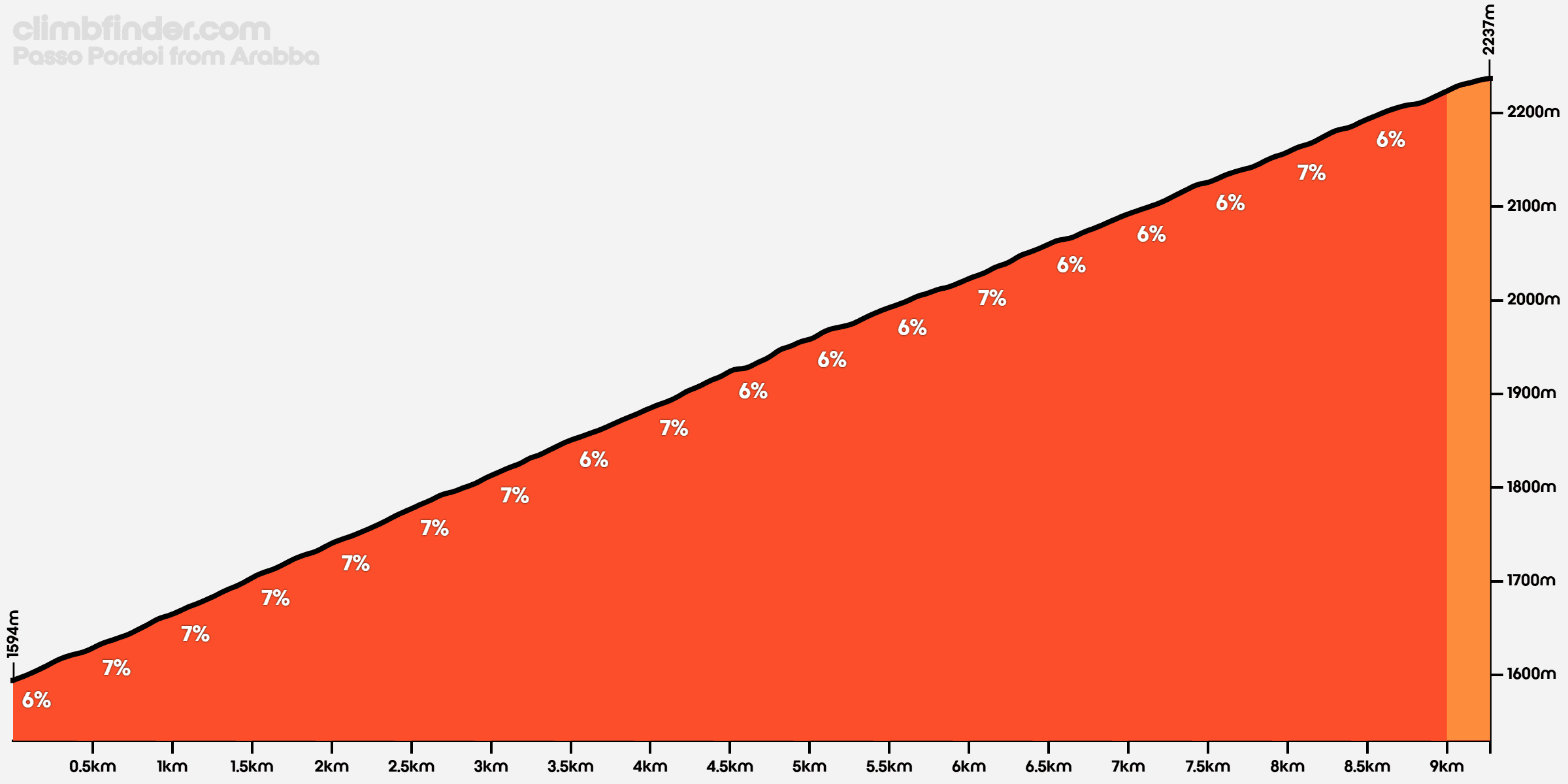
The ascent from Arraba is the shorter of the two: 9.3 kilometers with 643 meters of D+ or an average of 6.9% – this end has no less than 33 hairpins, 22 of which are in the middle 4.5 kms section.
It’s an eerily even profile picture and there are only a few steeper stretches of more than 8%. I find this end more attractive for its views.
When you descend to Canazei, you can switch to the Sella pass: 6.5 km down, in “Tornante 14”, turn right and climb the second half (5.5 km) of the Sella to get to Val Gardena. Or Corvara by switching again to the Gardena pass at Plan de Gralba.
I’ve cycled this end of the Pordoi twice: in 2015’s Giro and during my 2020 Maratona dles Dolomites.
Canazei
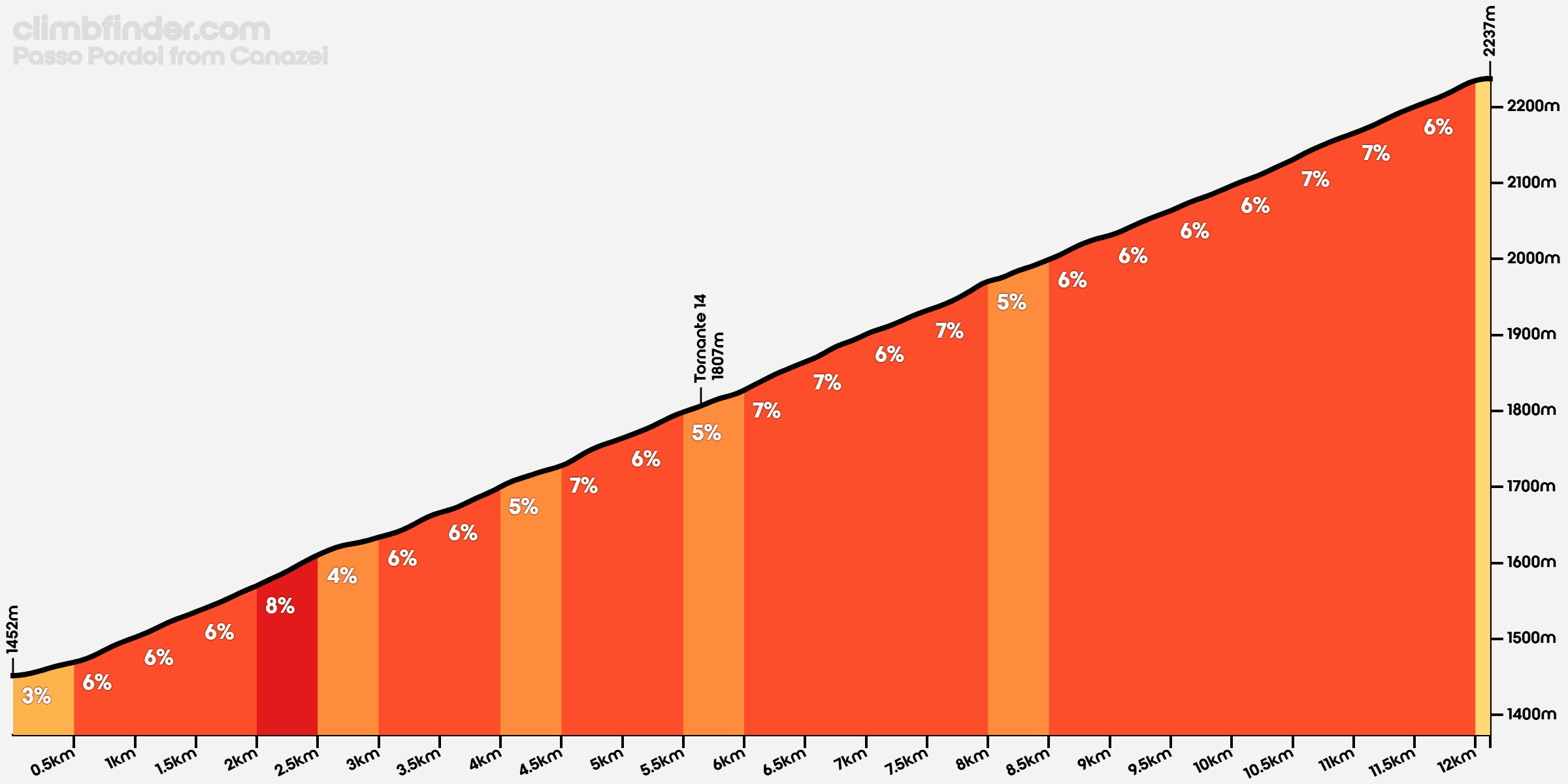
From Canazei, the ascent is 12.1 kilometers long with 786 meters of D+ or an average of 6.5% – this end features 27 hairpins.
It is a bit more irregular, the bits with gradients over 8% are few, but there is a steepest kilometer at 7.7%. The first 5.7 kilometers through the forest, up to “Tornante 14”, it shares the road with the Sella pass.
I’ve done this ascend in full only once, in 2015’s Giro – in 2011, I cycled the top half as part of my Sellaronda and the bottom half in stage 4.

Note that for the Sellaronda, a full Pordoi from Canazei is only included if you start there and ride the loop counterclockwise, the full Pordoi from Arabba is included in any clockwise Sellaronda.