
Extreme steep climb
Sustained high gradients with ramps that push beyond normal limits
Monte Zoncolan (1,750 m) is located in the Carnic Alps, in the region of Friuli Venezia Giulia, Udine Province.
It is considered the balcony of the Carnic Alps because of the 360° summit view of the valleys and mountains surrounding it.
The Zoncolan is not defined by a single brutal section or a late escalation. Instead, it establishes a level of steepness that is already beyond most climbs — and then builds from there.
From the key section onward:
- gradients settle deep into double digits
- long stretches rise toward 15%
- and individual ramps exceed what is typically considered sustainable climbing
What distinguishes it is not just the numbers, but their continuity:
- very little variation
- almost no opportunity to recover
- and a sustained level of effort that compresses the entire climb into a single, continuous demand
The setting reflects that character. Much of the ascent runs through forest, limiting visual distraction and reinforcing the focus on the gradient itself.
This is not a climb that unfolds, it is one where steepness defines the experience from the outset
If you average all three climbs, you’re looking at near 12% over the 30+ kilometers. You can’t prepare yourself for this, no strategy works.
Why ride it
Because you’re into suffering on a bike you like taking on the ultimate challenge. This is a climb that operates beyond normal pacing.
On most climbs, even hard ones, you can:
- find a rhythm
- manage your effort
- or anticipate where the difficulty lies
The Zoncolan removes that structure.
Instead:
- gradients remain consistently high
- steep ramps appear frequently enough to disrupt any sustained rhythm
- and the level of effort required never fully stabilises
On the hardest approach (Ovaro):
- a long central section sustains gradients approaching ~15%
- individual ramps push well beyond that
- and even brief easing rarely drops below what would normally define a hard climb
This creates a very specific experience:
- pacing becomes secondary
- movement becomes the priority
- and the effort shifts from controlled to continuous resistance
You are not riding at a chosen intensity, you are responding to what the road demands
That makes the Zoncolan:
- less about strategy
- less about rhythm
- and more about whether you can sustain forward momentum under extreme gradients
It’s not when to push — it’s whether you can keep pushing
Giro d’Italia
The Monte Zoncolan featured in a Giro stage nine times: seven times for the men and twice for the women.
When the Vuelta came up with the Angliru as a harder climb than the Mortirolo, the Italians where not impressed and introduced the Monte Zoncolan…
The most frequently cycled ascend is the one from Ovaro, which was included in a stage six times: for men five times and for women once. The ascent from Sutrio has been included three times: twice for men and once for women.
Heed the warning signs
Just outside Ovaro, the Church of the Holy Trinity is a fitting last opportunity to confess your sins and get absolved before you cycle on…
A bit further on, in Liariis, people are extremely helpful, offering several warnings and motivational quotes written on the walls of their houses:
- ‘lasciate ogni speranza voi che entrate’ – leave all hope, ye who enter
- ‘chi sa soffrire puo’ osare tutto’ – those who know how to suffer can dare everything
- ‘qui si va sulle salita dolente qui si va nell’eterno dolore’ – here we go on the painful climb here we go into eternal pain
While you may have missed these and did not turn around by now, there was a final warning which was harder to overlook.
Or ignore…

It reads ‘Gateway to Hell’ – no kidding – but this sign is now gone, so you’re on your own if you missed the heartfelt warnings.
On the upside: if you want to go on this suicide mission when there’s a Giro stage planned with a Monte Zoncolan finish, there will be additional ornaments along the road.
Honoring Cycling’s Legends
Speaking of ornaments: there are commemorate signs along the Ovaro ascend of the Monte Zoncolan every ~500 meters:
- Ottavio Bottecchia
- Alfredo Binda
- Louison Bobet
- Federico Bahamontes
- Jacques Anquetil
- Felice Gimondi
- Eddy Merckx
- Francesco Moser
- Bernard Hinault
- Giuseppe Saronni
- Gianni Bugno
- Miguel Indurain
- Marco Pantani
- Gino Bartali
- Fausto Coppi.
Near the summit there are three more:
- Gilberto Simoni (twice, as he was twice a stage winner)
- Annemiek van Vleuten (the only woman winning a stage from this end)
- Franco Ballerini.
The latter was posthumously honored as ‘friend of the Friuli region’ and promotor of the Monte Zoncolan in the Giro. Did that make him the devil’s advocate?
Bike Rebel’s Monte Zoncolan
In 2011, I took on the ascent from Ovaro, after a three-hour drive to get there and shortly before 1pm, with a temperature of well over 30 degrees Celsius at the foot, I got on my bike.
Feeling the fatigue from the days before, the temperature rising to 37 degrees didn’t do me any good. To date, this is the only ascend during which I thought several times that I would not make it…
Read the report of that struggle and weep.
Monte Zoncolan from Ovaro
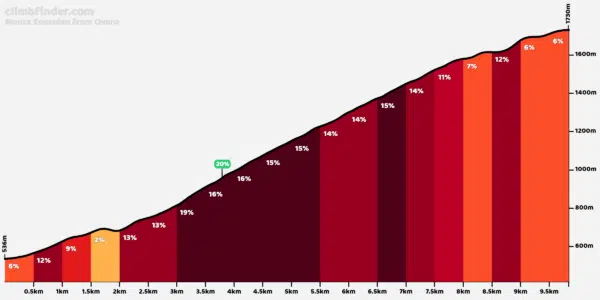
The most defining and widely recognised approach.
- The early kilometres lead into a long central section
- Gradients rise toward ~15% and remain there for several kilometres
- Steeper ramps interrupt any attempt at rhythm, often rising well beyond that
This is the climb’s defining version:
Extreme steepness sustained over a long, uninterrupted section
The steepest kilometer has an average of 17.2%, the steepest 5-kilometer stretch is 15.4%.
From Sutrio

A more progressive approach with a different structure.
- A longer, steadier opening at moderate gradients
- A brief easing before the final section
- A much steeper last few kilometres, including ramps well into double digits
The difficulty is still present, but concentrated later
The first 8 kilometers are definitely less hard, but the final 3 are just insane and way worse than the final out of Ovaro, averaging 12.9% with a kilometer at 14.1% and maxing out at 27%.
From Priola

The least commonly ridden but very demanding alternative.
- Less well-known
- Similar overall severity
- Variation in how the steepness is distributed
A different route to the same character, without redefining it
This was actually the ascent of Monte Zoncolan from the east, until the road from Sutrio was constructed. It’s 8.4 kms long and has the last ~4 kilometers in common with Sutrio.
However, the entire climb has an average of 13.5%, which is worse than the Ovaro climb.
Bonus: if you’re not impressed by the Monte Zoncolan and want something harder, you don’t need to go very far: at the other end of the valley, there’s the Passo della Forcella: 9 kilometers at 14.9%…
You might expect a nice little tavern at the summit of the Monte Zoncolan, a place where you can recover and enjoy a well-deserved snack. You will be disappointed: other than the summit monument, there is absolutely nothing there.
Oh well, the cows were friendly.
