
Border pass
One summit linking countries; the transition is the story
A legendary Alpine pass linking the Aosta Valley with the Valais, the Col du Grand‑Saint‑Bernard / Colle del Gran San Bernardo (2,469m) is a long, historic ascent with a true high‑mountain atmosphere.
It is the 3rd highest road pass in Switzerland, 7th in Italy and the 3rd highest international road pass in Europe.
The Swiss side offers a quieter, more remote approach through rugged alpine terrain, while the Italian side from Aosta is steady and scenic, climbing through forests and open slopes toward the ancient hospice.
Fully paved and ideal for a road bike.
Why ride the Col du Grand‑Saint‑Bernard
The Col du Grand‑Saint‑Bernard is a high Alpine crossing where both approaches offer a complete climb from valley floor to summit—but not the same kind of climb.
When ridden from Martigny or Aosta, the pass presents two equally substantial efforts:
- both long
- both sustained
- both reaching deep into high‑mountain terrain
What distinguishes it is not the scale, but how the effort is structured over that scale.
From the Swiss side, the climb develops gradually:
- the early kilometres remain close to valley riding
- gradients build slowly
- the sense of exposure and commitment increases over time
From the Italian side, starting in Aosta:
- the climb is more immediately defined as an ascent
- elevation gain begins earlier and continues more consistently
- the progression toward the summit is clearer from the outset
This creates a fundamentally different experience across the same distance:
- one side draws you into the mountains before becoming a climb
- the other is a climb from the moment you leave the valley
The summit is shared—but the way you reach it is not.
Unlike Petit‑Saint‑Bernard:
- this is not a case of continuous flow across the border
- but a case of different climbing logic on either side
Grand‑Saint‑Bernard suits riders who:
- are comfortable with long, high‑mountain efforts
- want to experience how terrain shapes a climb over distance
- are willing to choose a direction based on how they want the effort to develop
It also functions as a true crossing:
- linking the Rhône valley with the Aosta Valley
- often used as a transition between Alpine systems rather than a loop feature
This is not just a climb to complete—it is one to approach with a clear intention.
Seasonal notes
The Col du Grand‑Saint‑Bernard behaves as a high, fully seasonal border pass, with conditions driven primarily by altitude and exposure.
- Closed in winter
- Typically opens: late spring or early summer, once snow clearance is complete
- Best months: June through September
At 2,469 m:
- it sits significantly higher than Petit‑Saint‑Bernard
- and is therefore more weather-sensitive and less predictable
Key characteristics:
- The upper section is exposed, with limited shelter
- Weather conditions can change quickly, especially near the summit
- Temperature differences between valley and summit can be substantial
A defining feature is the restricted tunnel near the summit:
- cyclists are diverted onto the old road, which is steeper and narrower
- this final section adds both difficulty and atmosphere
Early and late season:
- snow walls and residual ice are possible
- opening dates vary depending on winter conditions
Grand‑Saint‑Bernard should be treated as a true high‑mountain objective, where timing and conditions are part of the ride.
Switzerland vs Italy
Martigny
- Very long (~40 km) approach
- Extended valley phase before sustained climbing
- Gradual transition into high mountain terrain
This side:
- feels like a journey before it becomes a climb
- allows extended pacing at lower gradients
- only becomes demanding late
Defined by progression and scale
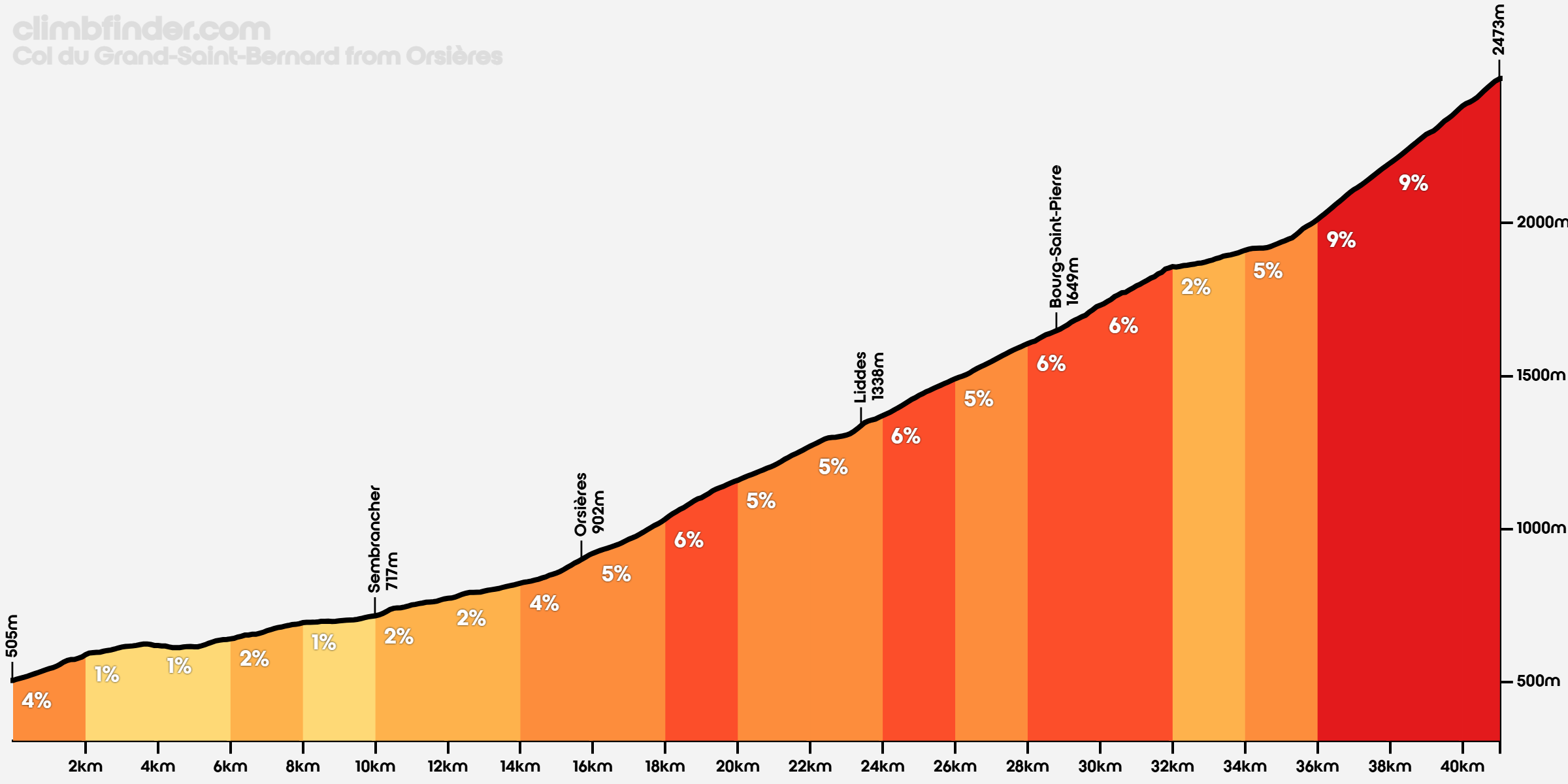
The main road includes several tunnel sections / avalanche galleries. While most of these are short or partially bypassed, some are long and I myself do not enjoy riding them.
The final tunnel before the summit is closed to cyclists. At this point, the route splits: motorized traffic continues through the tunnel, while cyclists are directed onto the old road, which climbs above it.
This diversion is decisive as the road narrows, gradients increase, and the character of the climb shifts abruptly from a steady valley ascent to a steeper, more exposed high‑mountain finish. The final kilometers on the old road are traffic‑free and form the most distinctive part of the climb.
Aosta
There are two distinct ways to build the Italian ascent, each shaping the experience in a fundamentally different way:
- Via Gignod (SS27) — the direct, standard route
- Via Porossan / Roisan — the quieter, more varied alternative
Both start from the same valley floor and converge higher up. Both reach the same summit. But they do not feel like the same climb.
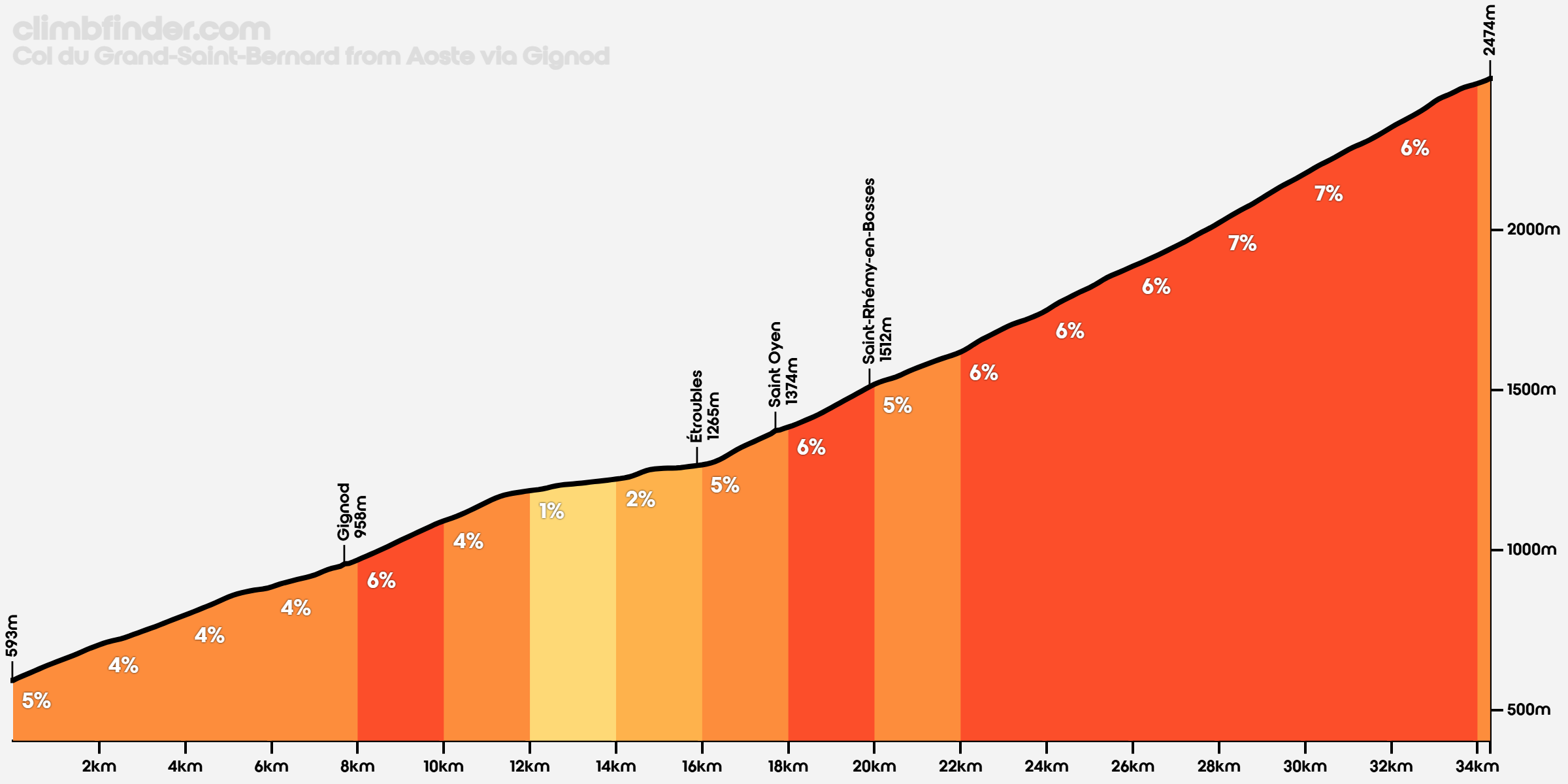
Via Gignod
The classic route follows the SS27 north-west from Aosta through Gignod and into the upper valley.
Its structure is straightforward:
- A continuous ascent, with very few interruptions
- A stable gradient, allowing a steady pacing strategy
- A clear progression, moving directly toward the high mountains
This is the most efficient way to ride the pass. The climb is long, but readable: once you settle into rhythm, it stays that way.
It defines the Italian side in its purest form—a sustained effort from valley to altitude without distraction.
Via Porossan and Roisan
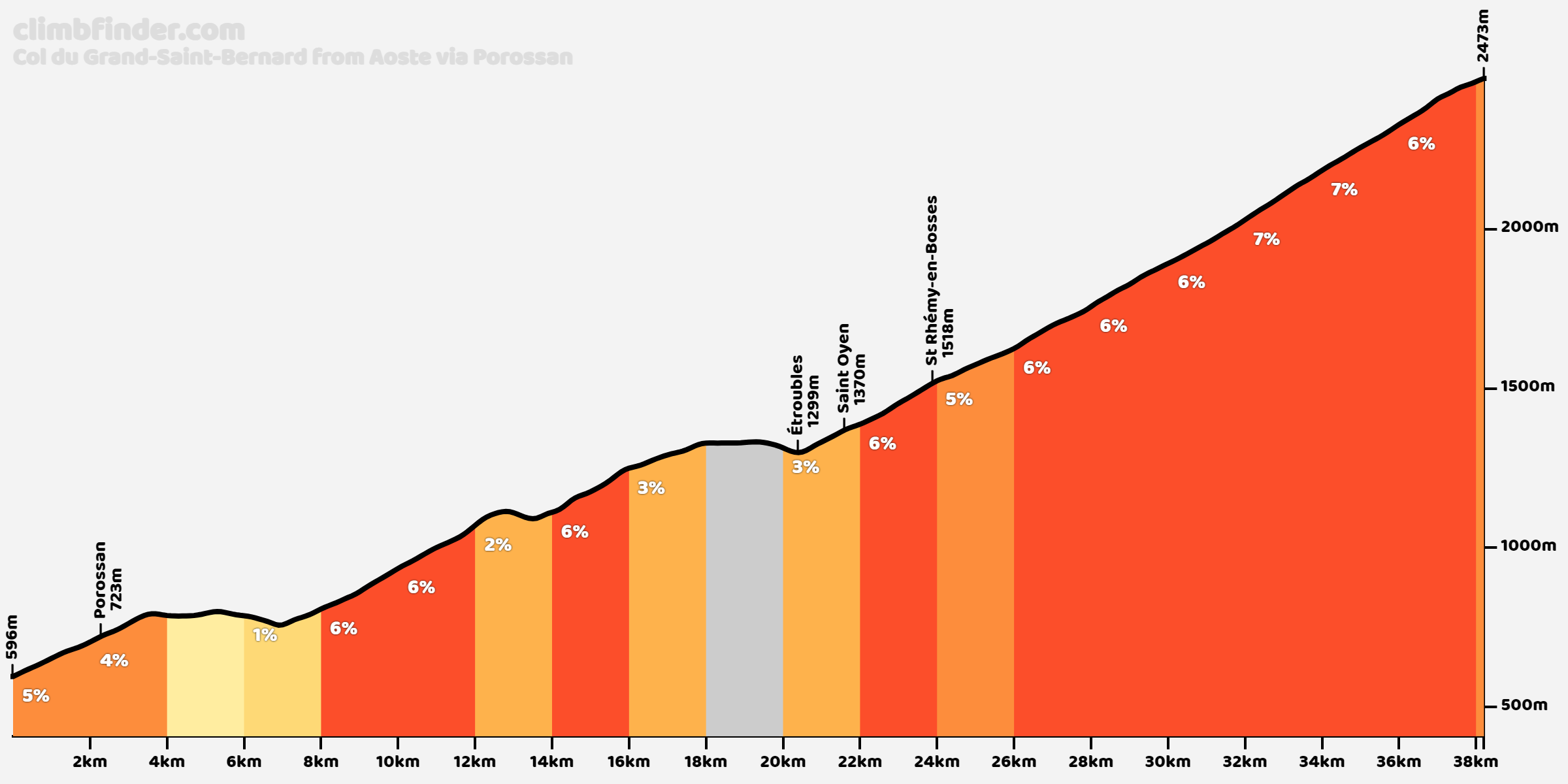
The eastern alternative leaves Aosta differently. Instead of entering the main valley, the road climbs immediately onto the slopes above it, passing through Porossan, Roisan and the hillside villages along the Buthier valley.
This changes the nature of the ascent from the very beginning.
Rather than a single, continuous gradient, the climb becomes segmented and irregular:
- Early ramps are steeper and more abrupt leaving Aosta
- The middle section crosses the mountainside, with short descents and renewed climbs
- Rhythm is repeatedly broken—effort becomes variable rather than sustained
- Only after rejoining the main road near Étroubles does the climb resolve into the standard upper section
Even over similar overall distance and elevation, the distribution of that effort is different.
This is not simply a quieter road—it is a different climbing logic.
How the experience changes
The contrast between the two approaches is not about scale, but about how the climb develops.
Via Gignod:
- Effort is continuous
- Gradient is predictable
- The climb builds in a single direction
Via Porossan / Roisan:
- Effort is interrupted and re-formed
- Gradient is variable
- The climb unfolds as a sequence of smaller climbs
This makes the alternative feel harder to control, even if the average gradient is similar. It demands more adaptation—less pacing, more response.
Road, environment and focus
Beyond structure, the environment reinforces this difference.
The main road:
- Wider, more exposed to traffic
- Oriented along the valley axis
- Feels like a route to somewhere
The hillside alternative:
- Narrower and quieter, especially in the lower sections
- Moves between villages, terraces and forest
- Feels like a route within the landscape itself
The visual perspective also shifts: instead of riding up a corridor, you ride across the mountain, looking back over Aosta and the valley as elevation builds.
Convergence: the upper mountain
After Étroubles, both routes merge and from here, the character stabilises:
- Long, steady gradients return
- The valley narrows and exposure increases
- The climb becomes more clearly alpine in scale
Above the final tunnel, the road diverts onto the historic alignment—the last kilometres to the pass—where traffic falls away and the setting becomes fully high-mountain.
At this point, the earlier choice of route no longer changes the terrain—but it continues to shape how the climb has been experienced.
Choosing your line
From Aosta, the Grand‑Saint‑Bernard is not defined by distance or gradient alone. It is defined by how you decide to arrive at the climb itself.
- If you want clarity, rhythm and structure, take the direct road via Gignod
- If you want variation, quiet and a more textured ascent, take the Porossan / Roisan line
Same valley, same summit, different climb.
Summary
With both sides starting from valley floors:
The difference is not length, but how the climb develops over that length.
- Swiss side → drawn-out approach into the climb
- Italian side → sustained climb from the start
And that leads to the key distinction:
One side eases you into the mountains
The other takes you there directly
Background image: Hagai Agmon-Snir, CC BY-SA 4.0,
via Wikimedia Commons
