
Controlled chaos on a closed road
Luz Ardiden (1,711 m) is a dead-end summit road, climbing directly above Luz‑Saint‑Sauveur to a ski station, without crossing into another valley.
That single fact defines everything and makes it an ideal Tour de France summit finish.
There is no transition, no layering, no narrative beyond the climb itself — just a continuous ascent that builds, repeats and accumulates, a pure, uninterrupted test of pacing and control
Why ride Luz Ardiden
What sets Luz Ardiden apart is not complexity, but clarity of purpose:
- Single, continuous effort: no passes, no transitions — just one climb from start to finish
- Repetitive structure: switchbacks stack into a rhythm that slowly builds fatigue
- Nowhere to hide: no descents, no real easing — pacing is exposed immediately
- Summit finish feel: designed to reveal what’s left, not create the race
- Two entry styles: one clean and controlled (Luz), one disruptive (Viscos)
This is a climb stripped back to its essentials. It’s not a journey through the mountains, it’s a pure test of sustained effort.
Tour de France
Luz Ardiden is a classic summit finish arena and it has been just that 8 times since its 1985 debut.
- Regularly used to decide stages outright
- Designed to expose pacing errors
- A place where riders are judged not on explosiveness — but on what they still have left
It doesn’t create the race, it reveals it.
Key historical moments
- 2021: Tadej Pogačar dropped Jonas Vingegaard and Richard Carapaz in the final kilometer to secure the stage win in the yellow jersey.
- 2003: Lance Armstrong crashed after his handlebars caught a spectator’s bag. He got back up, chased down the leaders, and won the stage.
- 1990: Miguel Induráin took his first-ever Tour de France stage win here, foreshadowing his five consecutive overall victories.
Climbing character
Luz Ardiden is built on repetition rather than variation:
- Switchbacks stack in sequences
- Gradients stay within a narrow band
- Effort becomes cumulative rather than explosive
There’s no defining moment — just a gradual realisation that the climb isn’t easing.
It’s not about surviving ramps, it’s about holding a constant output longer than you want to.
Practical notes
- Road: smooth, predictable, purpose-built
- Traffic: generally light
- Exposure: can be hot, especially mid-summer
- Mental game: repetition makes pacing critical
Luz‑Saint‑Sauveur
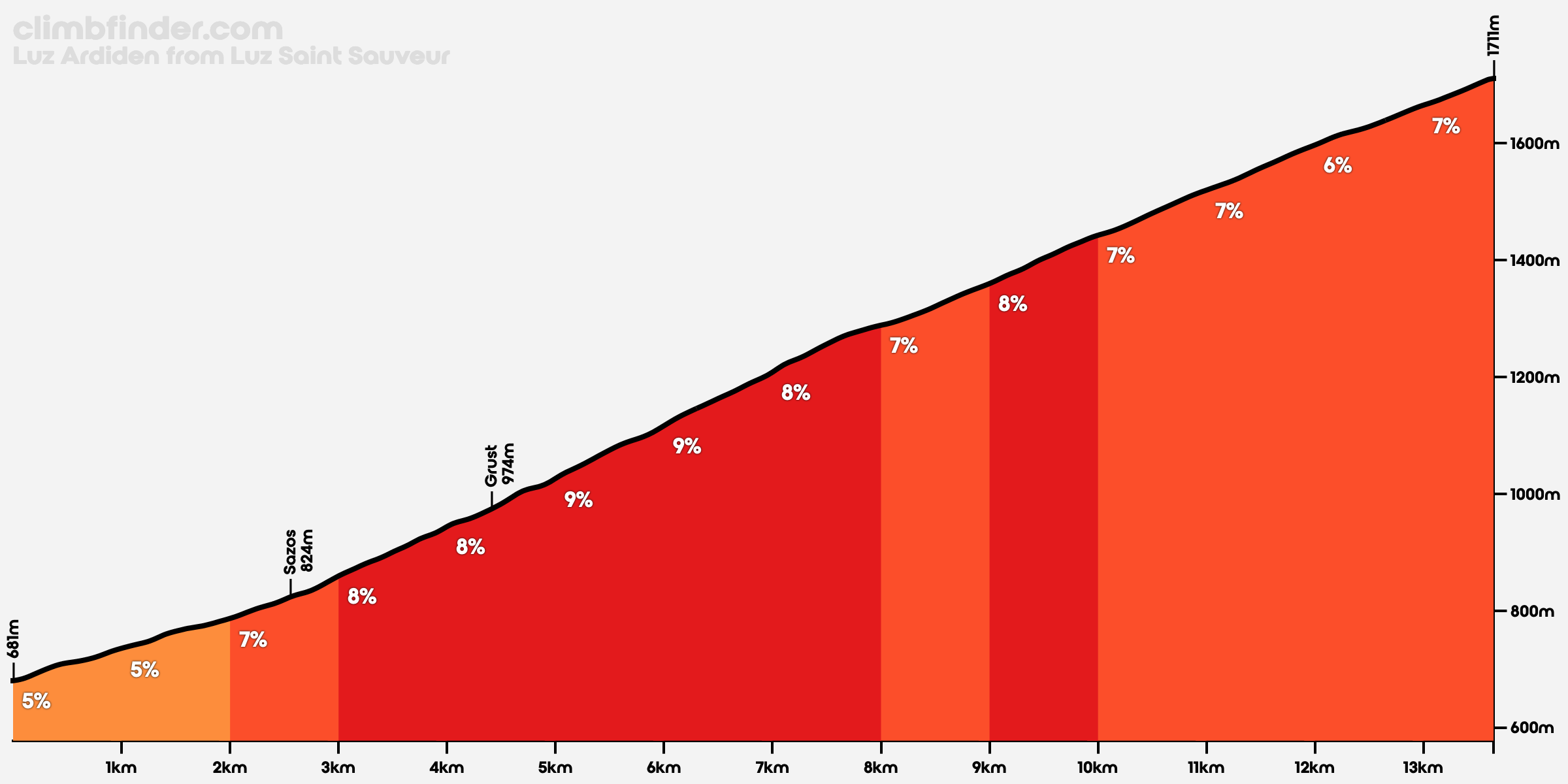
This is the clean, main approach — and the one that defines Luz Ardiden.
You leave Luz and immediately start climbing. No transition, no warm-up. The road commits early, and so do you.
The first switchbacks arrive quickly, threading through forest and setting the rhythm for what follows. The gradient is manageable, but the constant turning makes it harder to settle — your effort is steady, but your perception never fully is.
Higher up, the scenery opens. The trees thin, the valley drops away, and the switchbacks stretch slightly. What was enclosed becomes wide and exposed, but the effort remains unchanged.
The final section isn’t a sting — it’s a continuation. The slope eases only slightly as you reach the broad, open summit area, where the climb fades out rather than finishes.
This is Luz Ardiden in its purest form: structured, controlled, and steadily draining.
I cycled up this end in stage 10 of my Tour de France 2026, after which I descended back to Luz and climbed the Tourmalet.
Viscos
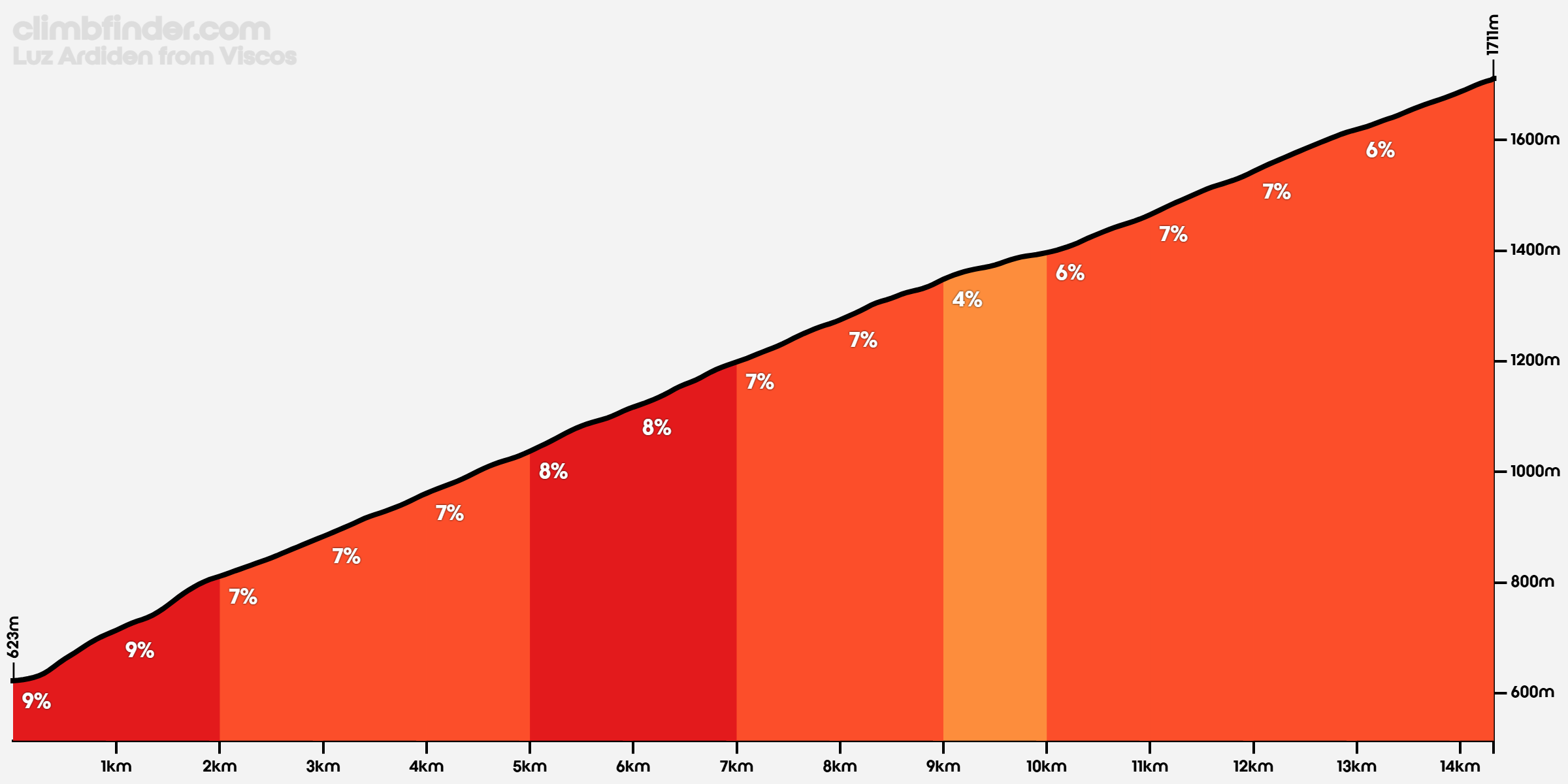
This is where the climb changes character.
Starting further north, you approach Luz Ardiden through a quieter, narrower road that climbs more irregularly before joining the main route above Luz.
From the beginning, this feels different:
- The road is tighter
- The gradients are less predictable
- The effort comes in bursts rather than steady flow
There’s no clean entry into the climb. Instead of settling into the Luz rhythm from the base, you’re already working before you even reach it.
When you finally connect with the main ascent, 4 kilomteres from the summt, the experience shifts again — but now you’re arriving with fatigue already in your legs. The switchbacks that define Luz Ardiden feel less controlled, more accumulative and harder to manage.
This isn’t just a different route, it’s a different interpretation of the same climb.
Bike Rebel Verdict
Luz Ardiden doesn’t surprise you. There are no hidden ramps, no sudden changes, no tricks.
And that’s exactly why it’s difficult: a climb defined by repetition, structure, and accumulation.
Ride it clean, and it flows, get it wrong, and it just keeps going.