
High mountain theatre, carved into the rock
The Col d’Aubisque (1,709 m) is one of the great Pyrenean passes, connecting the Ossau valley in the Pyrénées-Atlantique with the western slopes toward Soulor in the Hautes-Pyrénées.
If the Tourmalet is the giant and the Aspin the bridge, the Aubisque is the visual centrepiece — a climb where the terrain itself becomes part of the experience.
Why ride the Aubisque
What sets the Aubisque apart is not just difficulty, but how dramatically it unfolds:
- Iconic mountain road: cut directly into cliffs on the western side
- Tour heritage: part of the original 1910 Pyrenean invasion
- Changing terrain: forest, pasture, and exposed rock faces
- Unforgettable views: some of the most dramatic in the Pyrenees
- Linked climbs: often paired with Soulor or Marie‑Blanque
This is not just a climb — it’s a journey through different mountain worlds.
Tour de France
The Aubisque is one of the foundational climbs of the Tour:
- First included in 1910, alongside Tourmalet, Aspin and Peyresourde, the infamous ‘circle of death’
- Regularly featured in major mountain stages
- Often used in combination with the Soulor or Marie‑Blanque
It has always been a place where races are shaped — not always finished, but often decided.
Climbing character
The Aubisque is built around contrast:
- Long sections where you can settle into rhythm
- Sudden changes in terrain and visibility
- A clear transition from valley climbing to high-mountain riding
It doesn’t feel like one climb — it feels like several stitched together, each with its own identity.
The challenge is not just physical — it’s about adapting to a constantly changing environment.
Practical notes
- Roads: generally good, but narrow and exposed in places
- Traffic: can be present, especially in summer, livestock frequently roaming near the summit
- Conditions: weather can change quickly at altitude
Laruns
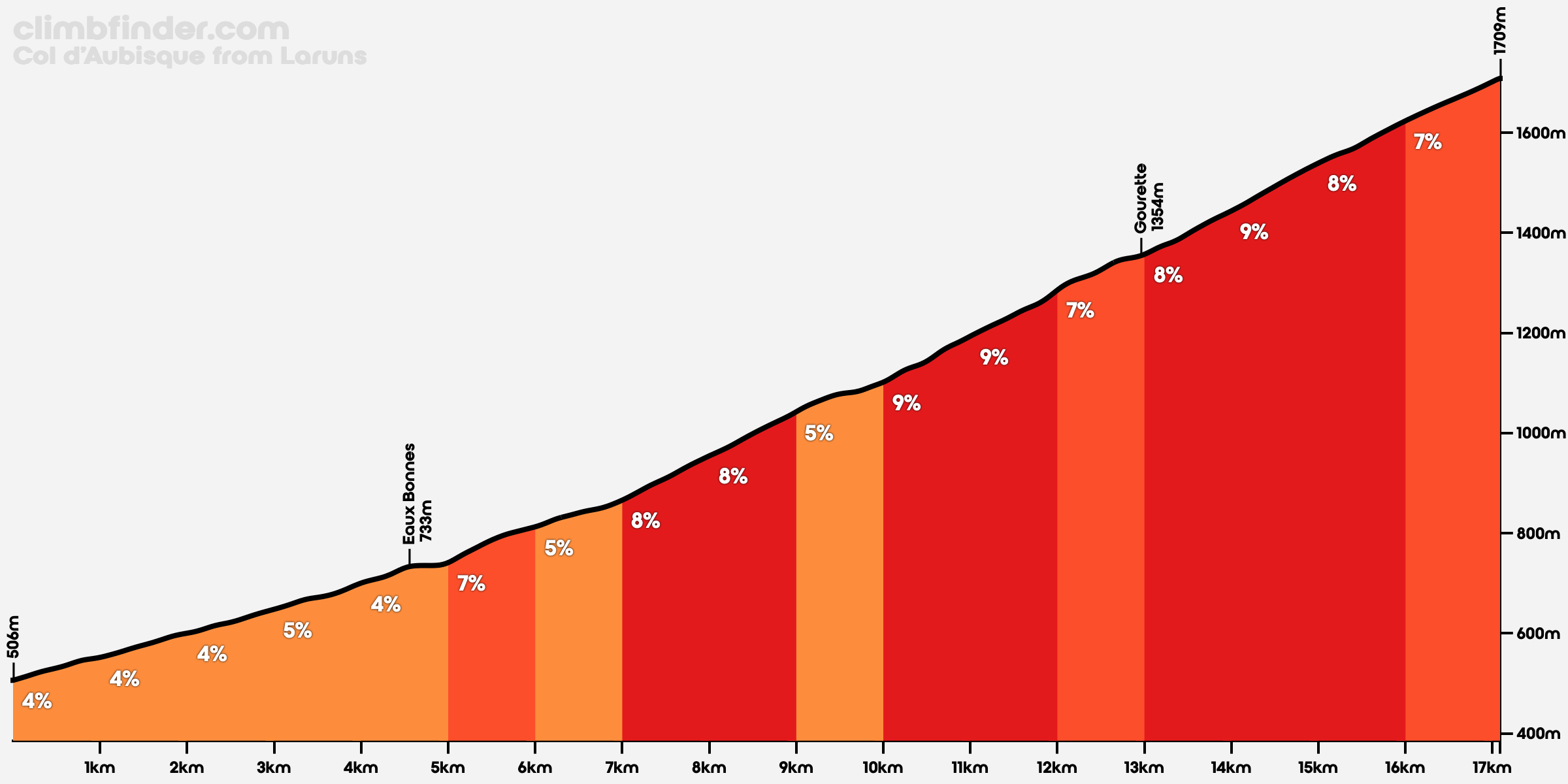
The Laruns approach is the most direct and most “classic climb” version of the Aubisque — a steady, continuous ascent that builds naturally from the valley.
Leaving Laruns, the road climbs immediately but not aggressively, winding through forested slopes where the gradient feels manageable and consistent. It’s a climb that finds its rhythm early and holds it, without major interruptions or structural breaks.
As you gain height, the scenery gradually opens. The enclosed lower slopes give way to wider views of the Ossau valley, and the sensation of climbing higher into the mountains becomes more pronounced.
Unlike the eastern approach, there’s no reset or interruption — just a single, sustained effort all the way to the summit. The upper slopes are more exposed, with fewer trees and a clearer sense of altitude, but the character remains steady rather than dramatic.
Via Col du Soulor
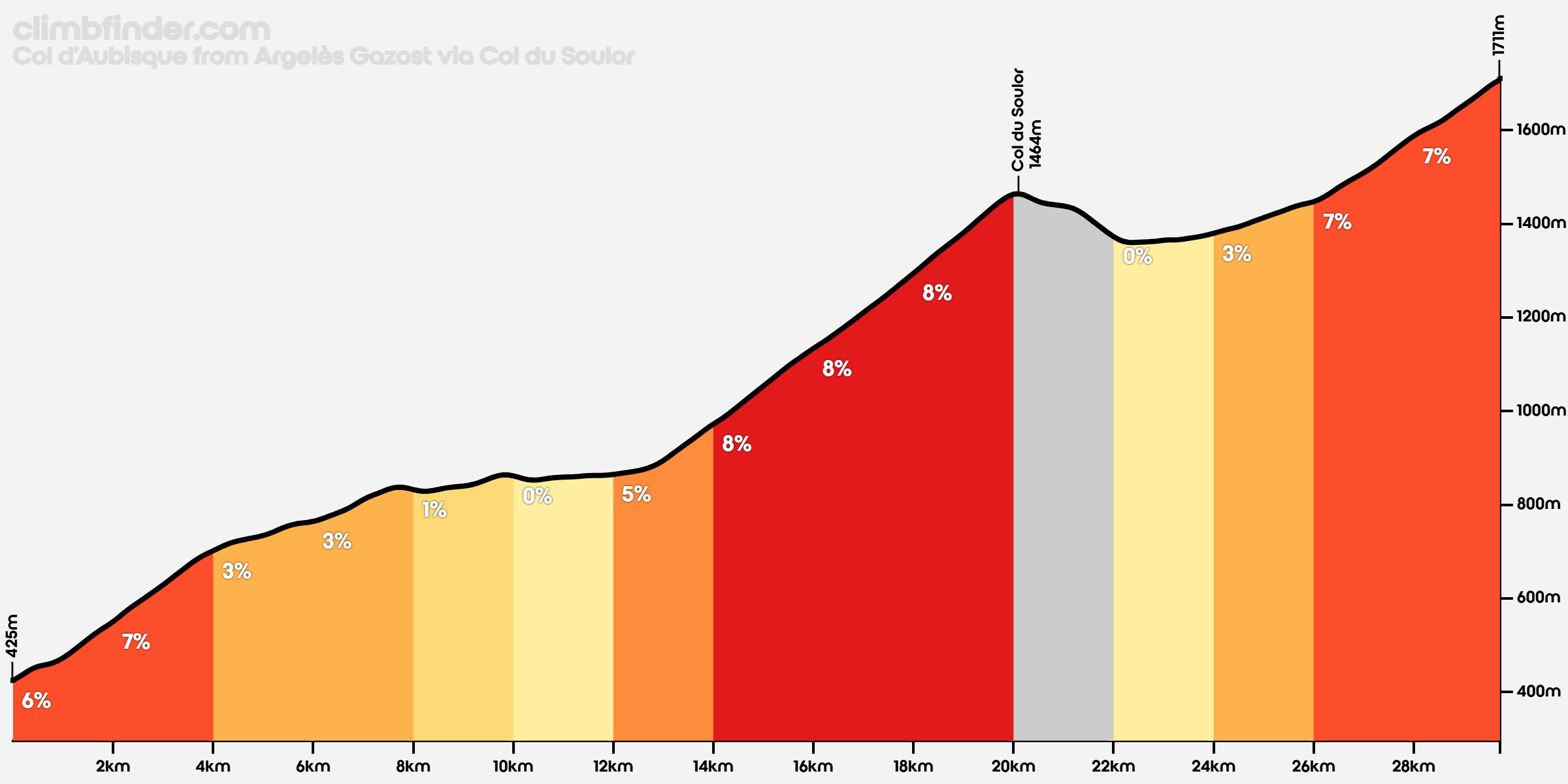
There are two approaches from the (north-)east, but they are both a two-stage effort as you ascend the Col du Soulor first.
Argelès-Gazost / Arrens-Marsous
Starting in Argelès‑Gazost, the road follows the valley toward Arrens‑Marsous over gently rising terrain. This opening section feels almost transitional: the gradients are mostly light, the road is open, and the effort is steady rather than demanding.
From Arrens‑Marsous, the character shifts as the climb to the Col du Soulor begins properly, winding upward through forest before gradually opening into high pasture. The Soulor itself feels like a logical summit, offering a moment to reset.
This is the ascent I cycled during my Tour de France 2023, stage 5, when both summits where chilly and foggy, but it cleared up during the break at the Abisque and I then cycled a scorching hot Col de Spandelles.
Arthez‑d’Asson
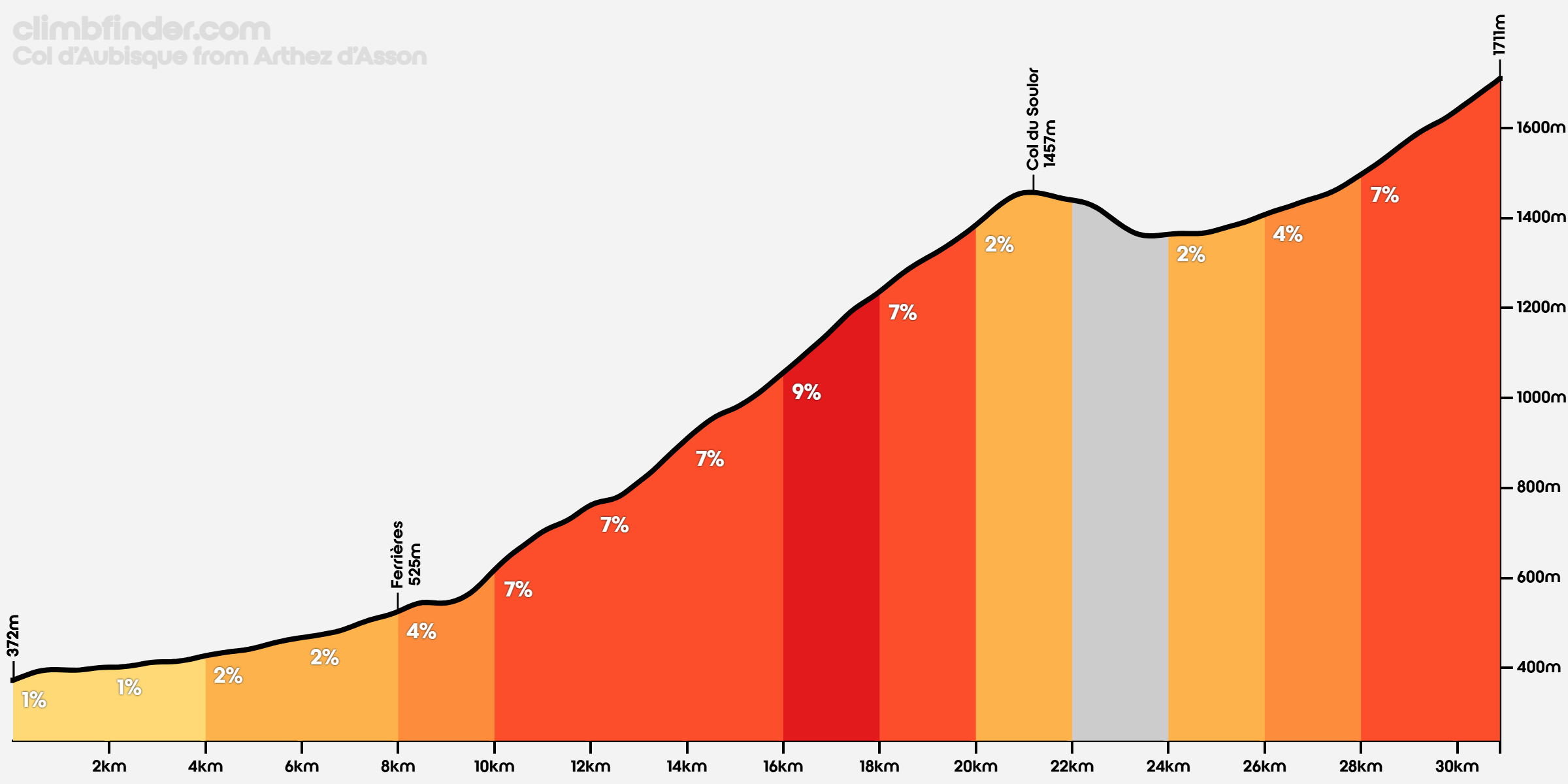
If you start further north in Arthez‑d’Asson, the experience changes completely.
Instead of a gradual buildup through a main valley, the road heads directly toward the mountains via the quieter D128, climbing more abruptly and with a narrower, more rural feel.
By the time you reach the Soulor, you’ve taken on a more irregular effort — this approach has been used in the Tour precisely because it introduces earlier strain and tactical complexity before the Aubisque itself.
Once you’ve reached the Soulor summit via either approach, the final to the Aubisque begins.
Cirque du Litor
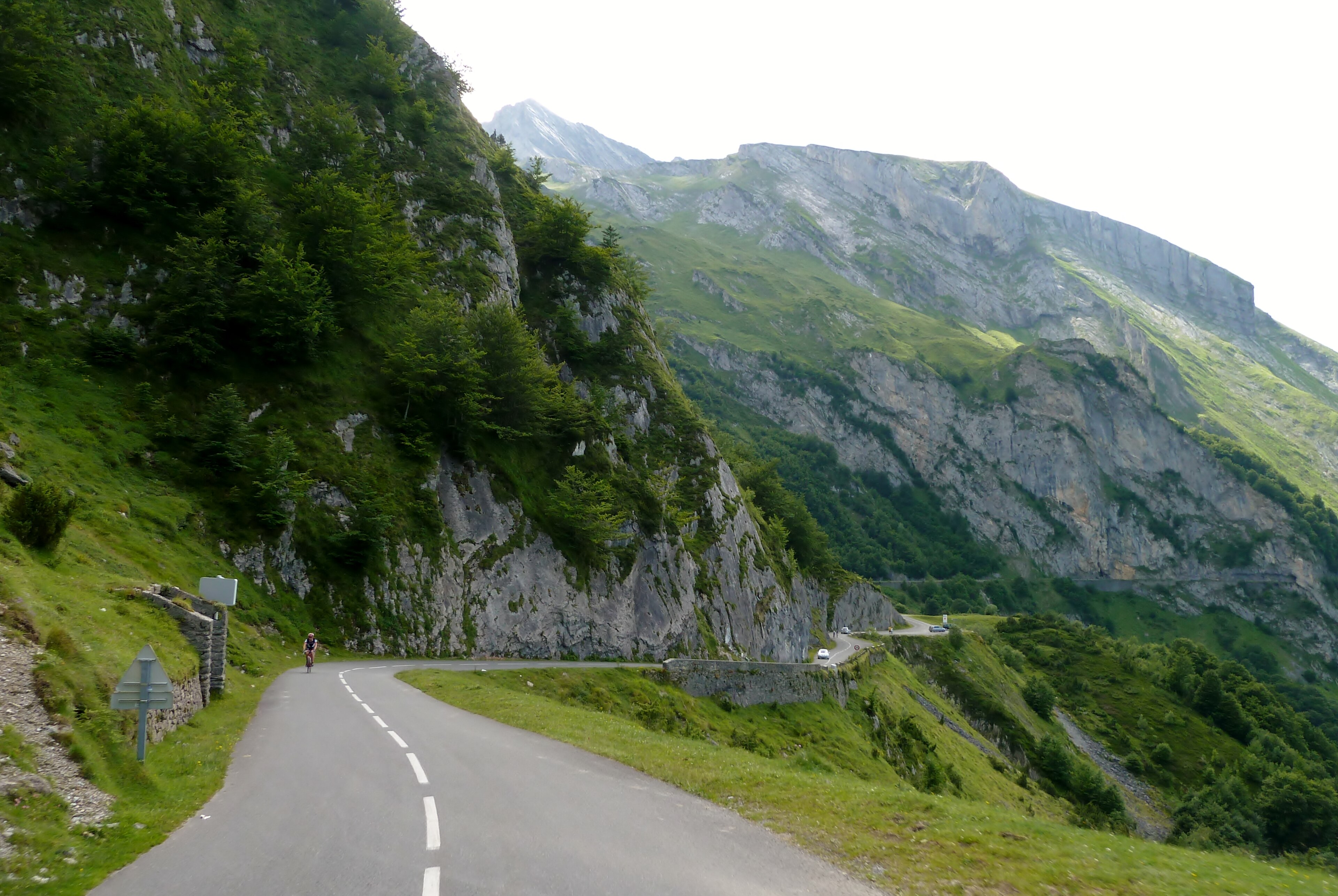
After a short descent, the road enters the Cirque du Litor — the defining section of the Aubisque. The road is carved into the mountainside, traversing high above the valley with sheer rock above and open void below.
The effort here is no longer about climbing alone, the gradient is secondary to the exposure and the setting. It feels less like climbing a pass and more like crossing a suspended mountain balcony.
Only after this traverse does the road turn upward again for the final run to the Aubisque summit, where the road feels more exposed and expansive, with longer sightlines and a greater sense of altitude.

Bike Rebel Verdict
The Aubisque is not just another climb on the list.
It’s the one that stays with you — not because of how hard it is, but because of how it feels.
A climb defined by space, exposure, and atmosphere. Ride it for the challenge, but remember it for the road itself.