
Wild, quiet, and deceptively brutal
The Port de Balès (1,755 m) is one of the more recent additions to the Pyrenean canon, linking the Barousse valley in the Hautes-Pyrenees to the Luchon region in the Haute-Garonne via a narrow mountain road.
Unlike the historic giants, the Balès built its reputation quickly: a wild, previously forgotten crossing turned into a modern racing battleground after being fully paved in the 2000s.
Why ride the Balès
What sets the Port de Balès apart is not just difficulty, but its unpredictability and isolation:
- Irregular climbing: long stretches of moderate gradients broken by sharp ramps
- Quiet roads: minimal traffic, especially compared to nearby classics
- “Hidden” feel: a climb that feels more remote and less developed than the big-name cols
- Modern Tour relevance: a decisive addition to recent Pyrenean stages
- Scenery progression: forest lower down, wide-open mountain above
This is a climb that feels less engineered, more natural — and harder because of it.
Tour de France
Defined by irregularity — and remembered for moments, not monuments.
Despite its recent arrival, the Balès has already left its mark:
- First used in 2007
- Scene of the infamous Contador vs Schleck “chaingate” moment in 2010
- Regular inclusion since, often as a key selection climb before a summit finish
It’s not the final climb — but it’s often the one where the damage begins.
Climbing character
The Port de Balès is best understood as an irregular endurance effort:
- Long distance: nearly 20 km on both sides
- Inconsistent gradient: oscillates between steady riding and sharp ramps
- Late difficulty: often saves its hardest sections for the final kilometres
You’re never fully settled — and that’s the point.
This is a climb that breaks rhythm rather than rewarding it.
Practical notes
- Road quality: generally good, but narrower and more technical than major cols
- Traffic: typically very light, livestock on the road isn’t uncommon
- Seasonality: often closed longer in winter due to snow
Mauléon‑Barousse
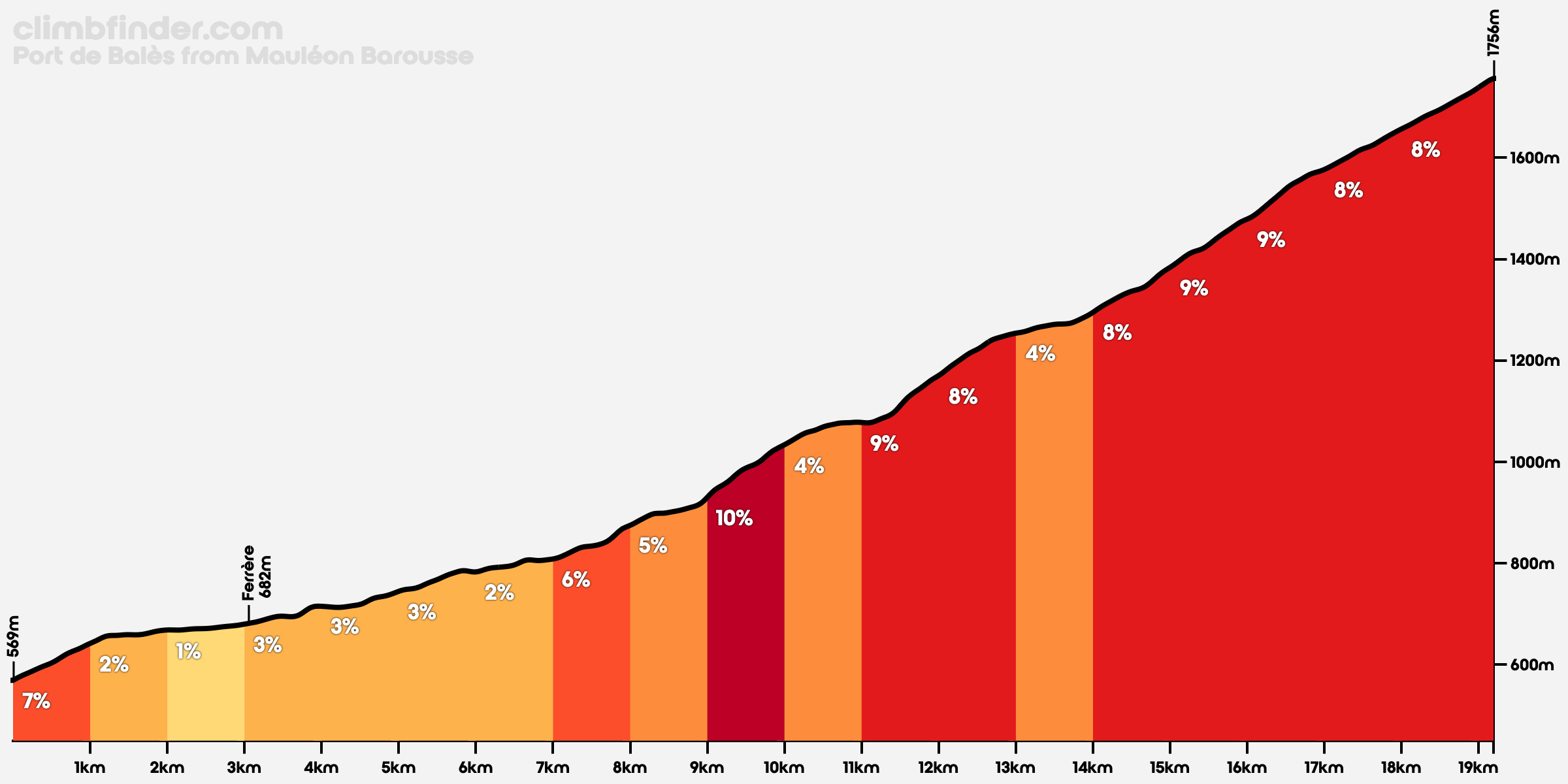
The northern approach is the defining side of the Port de Balès — rawer, more enclosed, and more physically demanding.
It starts quietly, climbing through forest roads that feel more like an upgraded farm track than a major col.
Through the middle section, there’s very little external reference — just the road ahead and the effort in your legs — which makes pacing harder than expected.
The wide, exposed upper section feels harder not because of extreme gradients, but because the earlier irregular effort has slowly drained your reserves.
This side is about attrition — a steady erosion of strength rather than a single decisive blow.
In my Tour of 2023’s Stage 1, this was my first climb, followed by the Peyresourde and Aspin.
Bagnères‑de‑Luchon
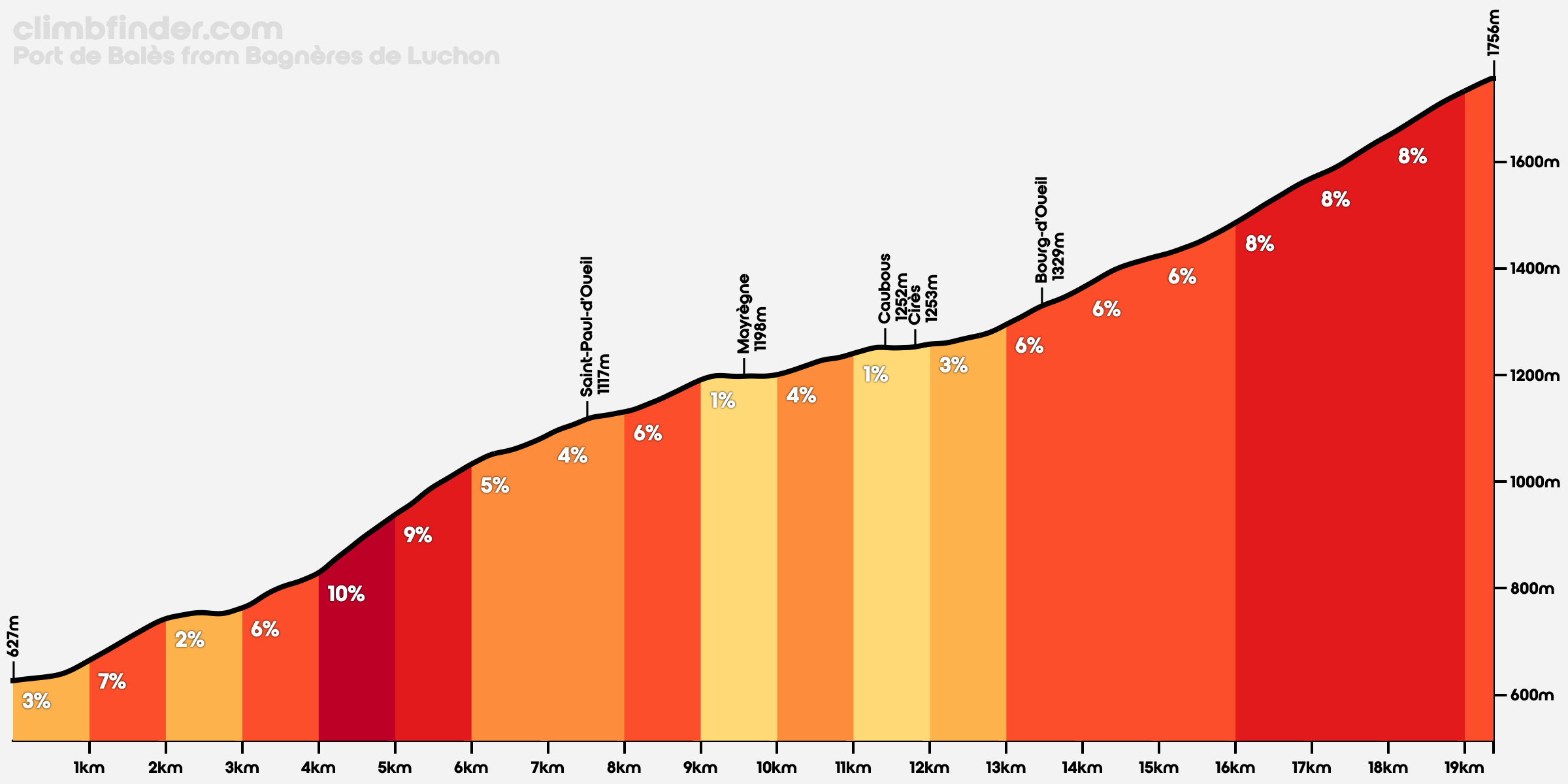
The Luchon approach’s early kilometers are rolling and relatively gentle, giving you time to find a rhythm and settle into the effort.
As the climb continues, the road winds deeper into the Oueil valley, with open views and a broader sense of space compared to the northern side.
The real challenge comes later, as the road begins to tighten and kick up, with longer sustained sections and fewer natural breaks.
This is the more strategic ascent: hold back early and it rewards you — go too hard and the final kilometres remind you why the Balès is a serious climb.
In my Tour of 2023’s Stage 15, the reverse of stage 1, this was my last climb.
Bike Rebel Verdict
The Port de Balès doesn’t have the mythology of the Tourmalet or the accessibility of the Peyresourde.
What it offers instead is something different: a raw, modern Pyrenean climb that still feels undiscovered.
Ride it well and it feels like flow, ride it poorly and it never lets you recover.