
The wider, quieter end of the valley
The Cirque de Troumouse (2,105 m) is another colossal, high-altitude dead-end climb that shares the exact same valley origin as the Col de Tentes.
While less famous than its neighbor, Troumouse is actually a bigger, more brutal mountain monster. It offers an incredibly wild, remote, and largely traffic-free alpine experience.
Why Ride Troumouse
What sets Troumouse apart is its sense of space:
- One of the widest cirques in the Pyrenees
- Quiet, narrow access road branching off the main valley
- Irregular climb with changes in gradient and surface feel
- Less visited than Gavarnie — noticeably quieter
- High-altitude riding without drama
This is not a climb that overwhelms you, it’s one that opens up around you.
Tour de France
Like the Col des Tentes, Troumouse has no Tour history and for the same reason: the Pyrenees National Park enforces incredibly strict conservation laws to protect fragile alpine pastures and local wildlife from the heavy environmental footprint of Grand Tour vehicles and spectators.
Climbing character
The defining feature is variation within progression:
- Sections of steady climbing
- Short ramps and flatter sections
- Moments where the road feels almost level before rising again
It doesn’t carry the clean rhythm of Luz Ardiden, nor the disruptive intensity of Hautacam, it sits somewhere in between — a climb that changes just enough to keep you engaged.
Practical notes
- Road: narrow from Gèdre, especially in lower section
- Traffic: depending on season heavy up to Gèdre, less traffic up to Héas and light traffic in the upper section
- Environment: forest below, open plateau above
- Experience: more about scenery than sustained difficulty
Luz-Saint-Sauveur
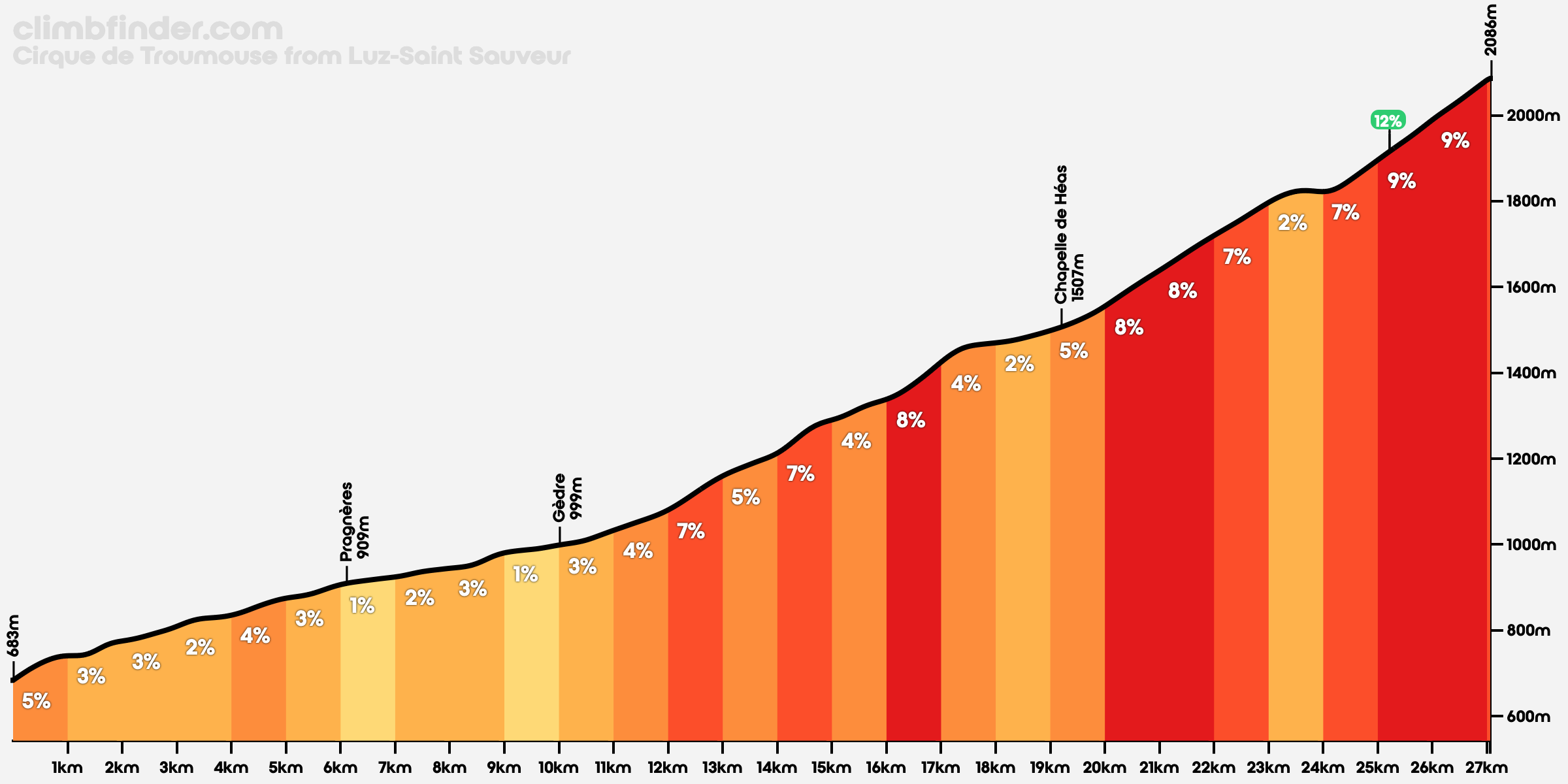
The full climb begins in the valley hub of Luz-Saint-Sauveur, with long, mostly straight ramps running parallel to the river valley towards Gavarnie. A long, grinding false flat that steadily pitches upward through a dramatic gorge, averaging roughly 3% to 5%.
From Gèdre, the roads splits into its own secluded valley, where the road is narrower and more irregular. The gradient comes and goes — never extreme, but never fully settling either.
Once you pass the tiny hamlet of Héas and the old toll house, the road begins twisting heavily up the mountainside. As you climb higher, the trees thin and the landscape begins to open. The climb becomes less about the road and more about the surroundings.
The densest, most spectacular collection of switchbacks is actually saved for the very end. After you pass the Auberge du Maillet, you hit a final, steep (9% to 10%) amphitheater wall that packs 12 tightly stacked hairpins into just the final 3 kilometers.
There are no motorized vehicles allowed on this stretch, only a small tourist shuttle operates here. This leaves the final, highest network of switchbacks entirely pristine and safe for cyclists.
I cycled Troumouse in stage 12 of my Tour de France 2023, after I already cycled Col de Tentes – a combo I do not recommend, even if the views at the end of either are breathtaking.
Bike Rebel Verdict
From the same valley, two completely different endings:
- Col des Tentes → linear, high, terminal
- Cirque de Troumouse → expansive, open, immersive
Tentes feels like the road is pushing outward, Troumouse feels like the mountains are opening inward. One ends at the edge, the other ends in the middle of something.
Cirque de Troumouse doesn’t compete with the big names, and it doesn’t try to. A climb defined by space, quiet, and an ending that isn’t really an ending.