
Few places reward suffering quite like the Dolomites. Here, pale limestone towers explode out of the valleys, roads cling improbably to their flanks, and climbing begins the moment you turn the pedals.
This is not a region of gentle build‑ups or long transitions: the Dolomites hit fast, steep, and repeatedly. Pass follows pass in relentless succession, each with its own character, its own sting, and its own view that makes you forget the last one ever hurt.
Riding in the Dolomites is intense, immersive, and deeply addictive—cycling reduced to its essentials, set inside one of the most dramatic mountain scenery in the Alps.
For any Giro d’Italia, I will look for a stay in the Dolomites first and my most favorite spot in this cycling heaven, is Corvara in Badia or Kurfar, in the Alto Adige region.
It’s located at the bottom of the climbs up the Campolongo and Gardena, the Valparola just around the corner in La Villa.
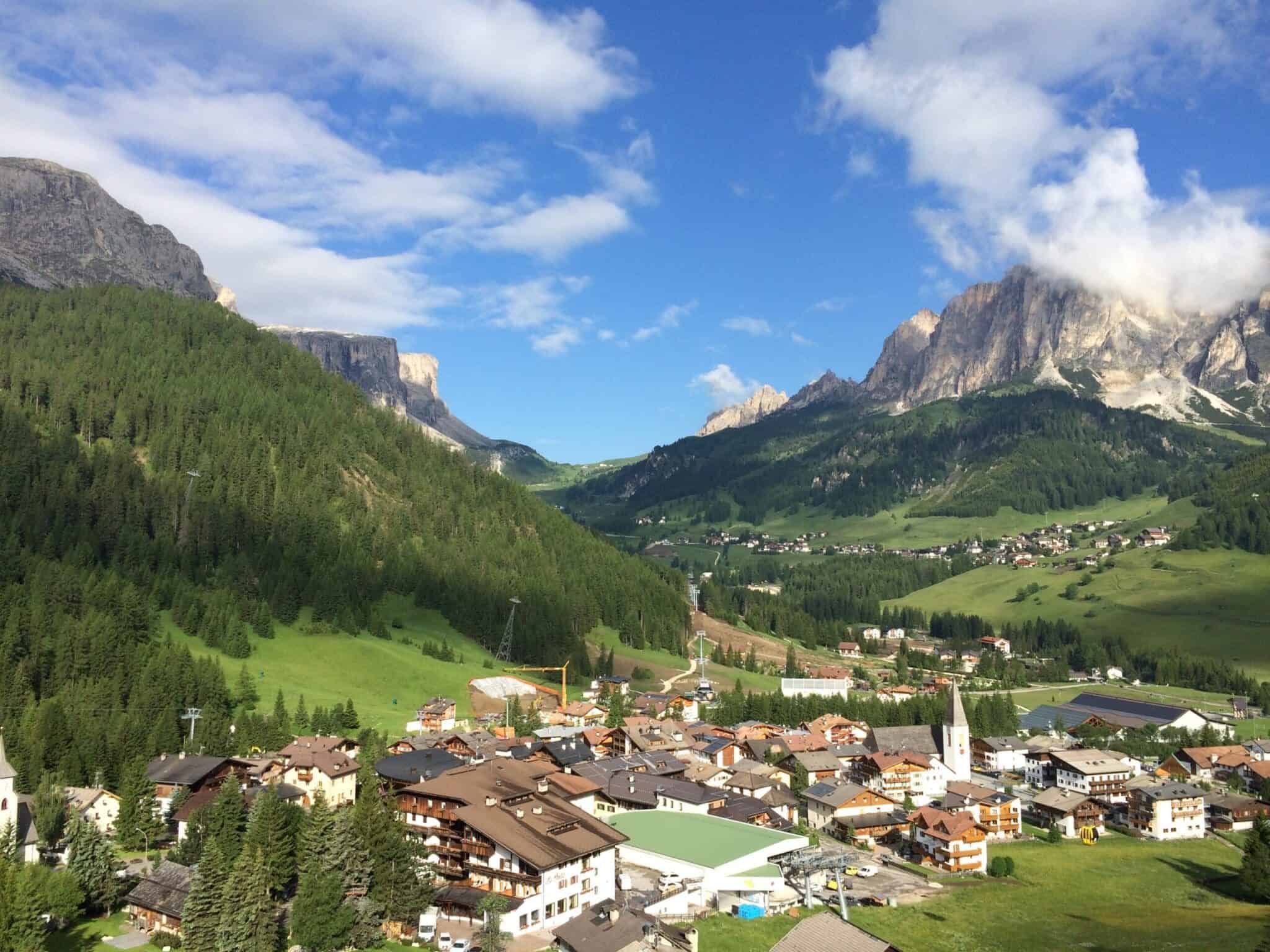
Geography
The Dolomites form a compact constellation of limestone massifs in northeastern Italy, rising abruptly between the Adige valley in the west and the Piave valley in the east, and bounded by the Puster and Sugana valleys to the north and south respectively.
Unlike a single continuous chain, the region is made up of numerous distinct groups—Sella, Marmolada, Pale di San Martino, Tre Cime, Rosengarten and others—each separated by deep valleys and linked by a dense network of high mountain passes.
These massifs rise steeply from the valley floors rather than gradually, creating short distances between climbs and an unusually tight concentration of high roads.
Almost every major route crosses a pass, and flat terrain is scarce, which gives the Dolomites their uniquely intense and vertical riding character.
World Heritage
In total, there are nine mountain systems that make up the Dolomites World Heritage Site:
- Pelmo – Croda da Lago: includes the iconic Mount Pelmo and the Croda da Lago massif
- Marmolada: the Queen of the Dolomites, with the highest peak at 3,343m
- Pale di San Martino, San Lucano, Dolomiti Bellunesi, and Vette Feltrine: a vast, horseshoe-shaped area featuring diverse landscapes across the Belluno and Trento provinces
- Dolomiti Friulane and d’Oltre Piave: the wildest and most unspoiled area, located east of the Piave river and geographically separated from the main range.
- Northern Dolomites: the largest of the nine systems, encompassing the Sesto (Sexten) Dolomites, the Fanes-Senes-Braies plateaus, and famous peaks like the Tre Cime di Lavaredo
- Puez-Odle: a prime example of classic dolomitic landscape with jagged peaks and high-altitude plateaus, home to the Sassongher group, towering over Corvara
- Sciliar-Catinaccio and Latemar: known for their complex rock formations and the dramatic “Enrosadira” color changes at sunset
- Bletterbach (Rio delle Foglie): a deep gorge often called the “Grand Canyon of South Tyrol,” revealing millions of years of geological history
- Brenta Dolomites: the only group located west of the Adige River, remaining geographically separate from the main range.
These systems are shown with a darker shade of blue in the interactive map at the bottom of this page.


The Dolomites’ main range exact geographical boundaries are defined by the Adige River, the Isarco River, the Rienza River, the Monte Croce di Comelico pass, the Piave River, the Brenta River and the Fèrsina stream.
The western border is defined by the Adige River, the eastern border by the Piave River.
The northern border is defined by the Puster Valley (Val Pusteria) and the southern border by the Valsugana and Valbelluna valleys.
This range is shared between the regions of Trentino-Alto Adige and Veneto, with the corresponding provinces
- Trento and Bozen – Trentino-Alto Adige.
- Belluno, Vicenza and Verona – Veneto
It includes seven of the nine mountain systems that form the World Heritage Site.
The Brenta Dolomites and Dolomiti Friulane are not a geographical part of it, although they are geologically akin.
(I’ve linked to Friuli-Venezia Giulia anyway, not for its Dolomites range, but because it’s home to Monte Zoncolan)
My Dolomites adventures are mainly in Trento-Alto Adige and the Belluno part of Veneto.
I’ve created a map for each of these “subs”:
Why Ride the Dolomites?
Cycling in the Dolomites is riding stripped of excess. The valleys are deep, the mountains rise fast, and the road almost immediately points uphill. Climbs are short, steep, and relentless, but they come thick and fast, each one different, each one framed by towering limestone walls that feel close enough to touch.
The scenery is intense, the rhythm unforgiving, and the rewards immediate: one pass crests into the next, descents are technical and absorbing, and every day feels fully used. Add world‑class road surfaces, deep Giro d’Italia history, and villages built around life in the mountains, and the Dolomites become one of the most concentrated and compelling cycling landscapes in Europe.
Where to Stay?
Choosing a base in the Dolomites is less about convenience and more about positioning yourself inside the web of passes. Because the region is made up of multiple discrete massifs rather than a single chain, the best bases sit between climbs, not beneath a single one.
Villages in Alta Badia and Val Gardena—such as Corvara, Arabba, and Selva di Val Gardena—offer the most efficient access, placing riders directly at the foot of the Sella group and allowing multiple major passes to be linked without long valley transfers.
From these towns, rides roll straight into Passo Gardena, Campolongo, Pordoi, Sella, Giau and beyond, making them ideal for multi‑day riding where every direction leads uphill.
Further east, Cortina d’Ampezzo works well as a base for riders focusing on the more dramatic, fragmented groups of the eastern Dolomites, including Tre Cime, Falzarego and Giau.
It offers more space, more infrastructure, and a broader spread of routes, though often with slightly longer connections between climbs.
Further south, bases such as Canazei, Val di Fassa, and the Primiero / San Martino di Castrozza area can also work, particularly for riders focusing on Marmolada, Giau, Rolle, and the Pale di San Martino.
These locations offer dramatic scenery and superb individual climbs, but the riding becomes more linear: big days are often built around one or two objectives rather than dense pass‑to‑pass loops.
The trade‑off is space and flow versus efficiency. Southern bases make sense if you value quieter roads and iconic single climbs; if your goal is maximum pass density with minimal transit, the central Dolomites remain unmatched.
What all strong Dolomites bases share is altitude—most sit around 1,200–1,600 m—meaning the climbing starts immediately and finishes late. In the Dolomites, a good base doesn’t reduce effort; it concentrates it.
Iconic Dolomites climbs
Unlike the Ortler Alps, where scale and altitude dominate, the Dolomites are defined by density. Iconic passes sit close together, allowing riders to link multiple classics in a single ride—or even a single afternoon.
Many of these climbs are inseparable from the Giro d’Italia, which has used the Dolomites as a decisive playground for nearly a century.
Passo di Giau
Often described as the most beautiful road climb in the Dolomites—and also one of the hardest. Rising steeply from both Selva di Cadore and Cortina d’Ampezzo, the Giau regularly features double‑digit gradients with no real easing. It has been a decisive climb in multiple Giro stages and remains a favourite among riders who appreciate suffering with a view.
Tre Cime di Lavaredo
A dead‑end climb that needs no pass sign to announce its importance. The road to Rifugio Auronzo beneath the Three Peaks is one of the most iconic summit finishes in Giro d’Italia history, first used in 1967 and revisited in legendary conditions ever since. Short, irregular, and brutally steep at the end, this is classic Dolomites theatre.
Passo Fedaia (Marmolada)
Climbing to the foot of the Marmolada, the Queen of the Dolomites, the Fedaia is among the toughest ascents in the region. The final kilometers after Malga Ciapela—often exceeding 12%—are infamous and have decided Giro stages multiple times. When people talk about “the hardest Dolomites climb,” this is usually the one they mean.
Passo Falzarego & Passo Valparola
These two passes are inseparable in Dolomites cycling history and are almost always treated as a single unit by the Giro d’Italia.
Compared to the drama of the Giau or the brutality of the Fedaia, these climbs are less theatrical—but that is precisely their danger. Gradients are steady, altitude creeps in almost unnoticed, and exposure builds as the road opens onto wide limestone plateaus.
More info: Falzarego / Valparola
Passo Sella
Perhaps the most visually dramatic of all Dolomite passes, with the Sassolungo rising straight from the roadside. The Sella is one of the four passes of the Sellaronda and it is not the hardest climb in isolation, but few feel as “Dolomites” as this one.
Passo Gardena (Grödner Joch)
A key connector between Val Gardena and Alta Badia and another pillar of the Sellaronda. The Gardena is steep enough to demand respect, especially from Corvara, and its narrow upper section adds to its character. The Giro often uses it in combination with other passes rather than as a standalone decider.
Passo Campolongo
The gentlest of the four Sellaronda passes, but no less important historically. Campolongo often appears early in Dolomite stages or as a warm‑up before harder terrain. It plays a crucial tactical role in long chains of climbs rather than as a finish in its own right.
Passo Pordoi
One of the most frequently used climbs in Giro d’Italia history and long regarded as a symbolic heart of the Dolomites. It is the “piece de resistance” in the Sellaronda.
The Pordoi is a regular Cima Coppi when the Stelvio is absent and sits at the centre of the Sella massif. Its steady gradients and endless switchbacks make it a pure rhythm climb rather than a brute test.
Why these climbs matter
What sets the Dolomites apart is not just individual difficulty, but how these passes interact. Giau, Falzarego, Valparola, Pordoi, Sella and Gardena are often linked together, creating stages—and rides—where recovery is brief and exposure constant.
This density is what makes the Dolomites uniquely rideable and endlessly returning‑to, even for riders who have already “ticked the boxes.”
Sellaronda & Maratona dles Dolomites
No discussion of the Dolomites on a bike is complete without the Sellaronda and the Maratona dles Dolomites, which together have shaped how this region is ridden and understood by cyclists.
The Sellaronda is a continuous loop around the Sella massif, linking Passo Campolongo, Pordoi, Sella and Gardena into a perfectly balanced circuit that can be ridden clockwise or counterclockwise.
What makes it unique is not just the scenery or history, but the way the passes flow into one another, turning four standalone climbs into a single, coherent ride.
The Maratona dles Dolomites extends on this concept, using the Sellaronda as its core and expanding outward to include additional passes such as the Giau and Falzarego.
Over time, the Maratona has become one of the most influential granfondos in Europe, reinforcing the Dolomites’ identity as a place where multiple iconic passes are meant to be ridden together, not in isolation.
Events like these—when the roads are closed to motorized traffic—only underline this philosophy and explain why the Dolomites remain uniquely accessible despite their global reputation.
Dolomites vs Ortler Alps
Although the Dolomites and the Ortler Alps both belong to the wider Alpine system—and even share some geological overlap—cyclists tend to experience them as fundamentally different environments.
The Dolomites are defined on the bike by compact geography, abrupt limestone massifs, and a dense network of short, steep passes. Rides here are rhythmic and repetitive: climb, crest, descend, repeat.
Gradients change constantly, recovery is limited, and multiple iconic passes are often linked in a single day, which gives the region its distinctive “playground of climbs” feel.
The Ortler Alps, by contrast, ride like true high‑alpine terrain. Climbs such as Stelvio and Gavia are long, continuous, and committing, with huge elevation gain from valley floors and extended time spent above 2,000 meters.
Once you start climbing, there are few interruptions and few easy exits. Weather, altitude, and endurance dominate the experience, and single ascents often define an entire day.
For cyclists, these differences in effort profile, altitude exposure, and route structure matter far more than formal geological classifications—hence the habit of speaking about the Dolomites and the Ortler Alps as distinct riding worlds, even where the maps overlap.
Map with passes and dead ends in the Dolomites, the solid grey line roughly tracking the outline of the picture above:

Info page by me, others point mostly to ClimbFinder