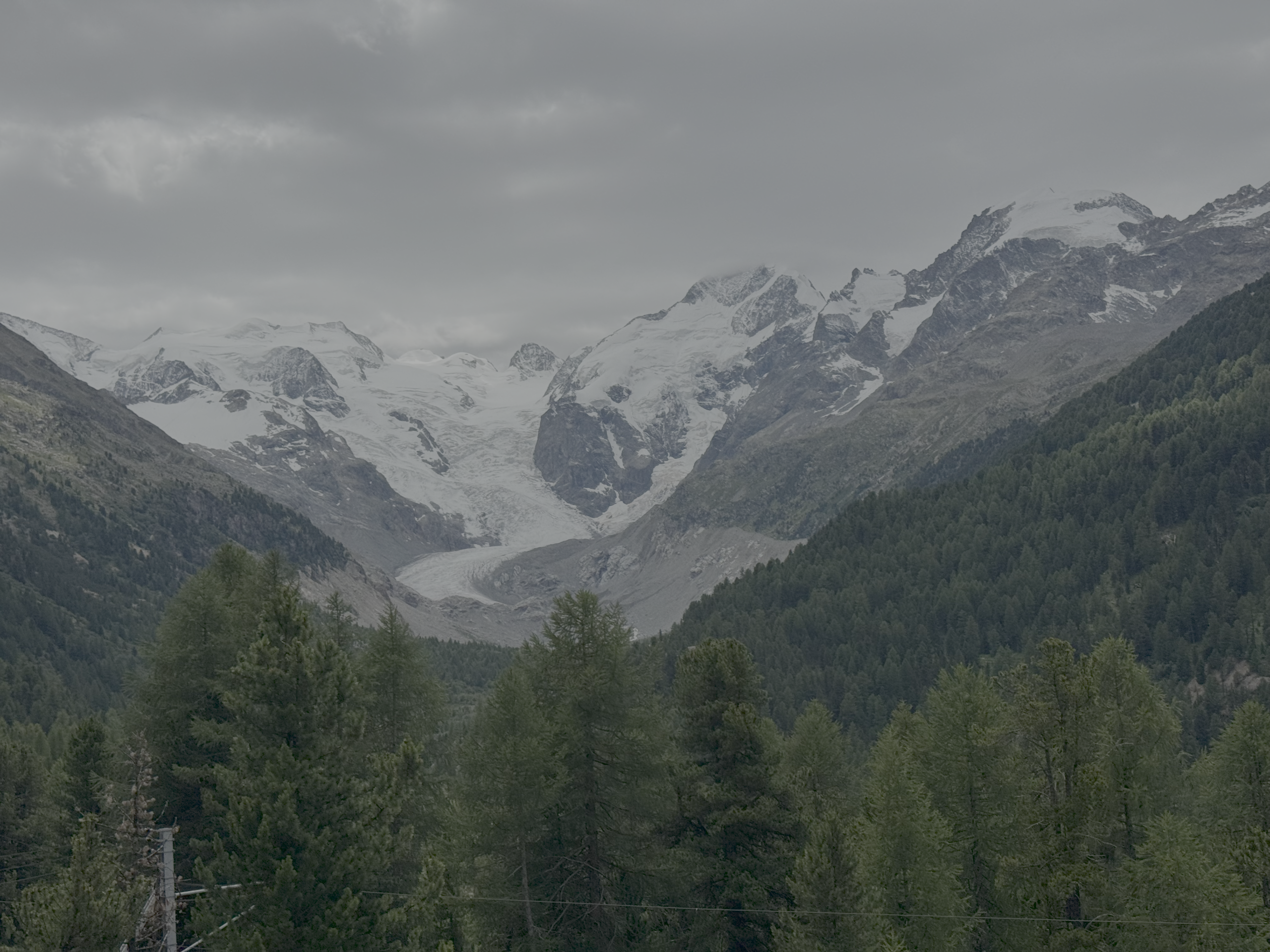
The high-altitude traverse into Italy
The Bernina Pass (2,330m) or Passo del Bernina in Italian, is the 6th highest mountain pass in Switzerland.
It connects the famous resort town of St. Moritz with the Poschiavo valley, which ends in the Italian town of Tirano in the Valtellina valley.
Why ride the Bernina Pass
The Bernina is different.
Not just another pass in the Engadin cluster, but a route that feels like it’s taking you somewhere, rather than simply testing your legs. It links the high Engadin plateau with Italy, crossing glaciers, lakes and open alpine terrain in a way that none of the other passes quite manage.
Where Albula, Flüela and Julier are defined by their climbing profiles, the Bernina is defined by progression:
- from valley to high mountain
- from Switzerland into Italy
- from climbing into travelling
It’s not the hardest pass in the region. From the north, it barely feels like a climb at all. But approached from the south, it becomes a structured ascent that builds gradually before committing to a long, sustained final section.
Either way, the Bernina is less about effort and more about scale, landscape and direction.
It’s the pass that turns a ride into a crossing of the Alps.
Traffic & Conditions
- Major route, so expect some traffic (especially summer)
- Wide road makes riding manageable
- Typically open year-round, weather permitting
- Can feel very exposed in wind or cold conditions at the top
When to Ride
- Best months: June – September
- Early or late in the day improves experience
- Clear weather makes a huge difference — this climb is about visibility
And when cycling either end of the Bernina Pass, chances are you will run into a Bernina Express train.
The Bernina line is the highest adhesion railway route in Europe and both the Bernina line and the Albula line are World Heritage Sites.
Samedan
The ascent of the Bernina Pass from Samedan is the easier of the two.
From the Engadin, the road rises gradually:
- Wide valley floor
- Gentle, consistent gradients
- No decisive sections
It never really feels like a “proper climb” in the Alpine sense. Instead, it’s a steady lift into altitude, where the effort is secondary to the surroundings.
What defines this ascent is the progression of landscape:
- From open valley
- To high alpine terrain
- To glaciers and exposed rock near the summit
The final kilometres don’t ramp up — they simply continue at altitude, passing lakes like Lago Bianco and rolling gently onto the pass.
This side is best thought of as an approach to the high mountains, not a climb to conquer.
From Samedan, the col marker is a short stretch past the parkings and the two ospizio’s, the second – on the right – having a splendid view on the Lago Bianco.

I cycled this end twice: in my Giro d’Italia 2015, when I cycled both ends consecutively and in the Prologue of 2025’s Giro.
Tirano
This is the side that gives the Bernina real substance as a climb.
Starting down in Tirano, the ascent unfolds in three very distinct phases. The first 8km lift you steadily out of the valley — enough to get into the effort, but still feeling transitional rather than decisive.
What follows is unusual for a major Alpine pass: nearly 10km along the lake that are flat or close to it. The climb effectively pauses here, breaking any rhythm and reinforcing the sense that this is a journey through terrain, not a single continuous effort.
Then the Bernina commits.
The final ~15km rise continuously at around 8%, forming the true core of the ascent. The road is characterized by long, straight sections rather than tight switchbacks, making the gradient feel even more relentless. Only near the top do you finally get a more classic Alpine touch, with a hairpin-led finish as you approach the summit and the high-altitude lakes.
This structure makes the south side unique:
- a gradual entry
- a complete reset halfway
- then a long, sustained final climb
Compared to the north side, this is the version that actually feels like earning the altitude.
Unlike the north side, this ascent feels like a true climb from valley to high mountain. It’s never brutally steep, but it is continuous, and the scale of the elevation gain makes it far more demanding overall.

I have done this end in full twice, in my Giro d’Italia 2015 and Giro d’Italia 2020 – neither was the best of experiences, but the downhill of this end is ultra fast 😂
Route Ideas
Engadin → Bernina → Italy (Classic Crossing)
The most natural ride:
- Easy build from St. Moritz / Pontresina
- Roll across the summit
- Long descent into Italy
Best ridden for the journey, not the effort.
Note that a few kilometers down from the Bernina Pass summit, you’ll be able to cross into Italy as well, cycling the Forcola di Livigno, which – as the name suggest – leads into Livigno on the Italian end.
Italy → Bernina → Engadin (Best Ascent)
The stronger pure ride:
- Full climb from Poschiavo
- Continuous elevation gain
- Proper high-altitude finish
This is the version that makes the Bernina feel like a true Alpine pass
Albula → Bernina (Extension)
The best pairing from the Engadin:
- Albula provides the structured climbing
- Bernina provides the scale and finish
Works particularly well north → south, turning the Bernina into a grand finale.
Verdict
The Bernina is not defined by difficulty, but it is defined by direction.
- From the north, it’s a high-altitude approach
- From the south, it’s a full Alpine climb
Either way, it delivers something the other Engadin passes don’t:
A genuine sense of travelling through the Alps — not just riding over them.