
No mythology. No distractions. Just what the road asks.
Col de la Loze reaches 2,304 meters in the Vanoise massif. That figure sets the ceiling, it doesn’t explain the climb.
This is not a traditional Alpine pass. It didn’t evolve through necessity, it was built—deliberately—for cyclists. Opened in 2019, it connects Méribel and Courchevel via a road that removes most of what normally moderates a climb.
No traffic in the final kilometres, no interruption, no dilution.
What remains is effort.
The Shape of the Climb
From Brides-les-Bains in the valley, both ends of the Loze present something familiar:
- ~22 to ~26 km
- ~1,700 m vertical gain
- ~6.5 to ~7.6% average gradient
Looking at the numbers, this is the part that encourages misjudgment.
The lower slopes behave as expected—steady switchbacks, controllable pacing, gradients that allow rhythm. You can ride within yourself here. You can believe you understand the climb.
You don’t.
Where It Changes
The transition is not gradual. Beyond Méribel or Courchevel, the road narrows into a bike-only track across open slopes.
From this point:
- Gradients spike unpredictably, often well above 10%
- Sections push toward 15% and beyond
- Flat recovery disappears
There is no repeatable pattern. No consistent pacing model.
The climb stops being something you manage, it becomes something you react to.
What It Demands
The Loze is not primarily about endurance, it is about maintaining control when endurance alone is no longer sufficient.
- Control when the gradient forces cadence into failure
- Control when pacing collapses because there is no rhythm to follow
- Control when altitude removes the buffer you rely on
Described as “relentless” and “unpredictable,” the difficulty is not just physical.
It is the absence of structure.
You are not solving the climb, you are responding to it, moment by moment.
Why It Decides Races
The Méribel end of the Loze has been in a Tour de France three times since 2020, once as a summit finish. Not because it is the highest climb available, but because it removes control.
Even elite riders—accustomed to pacing long Alpine ascents—are forced into instability here. The irregular gradients prevent the steady output that normally defines climbing performance.
The result is not a gradual selection, it is abrupt separation.
The Summit
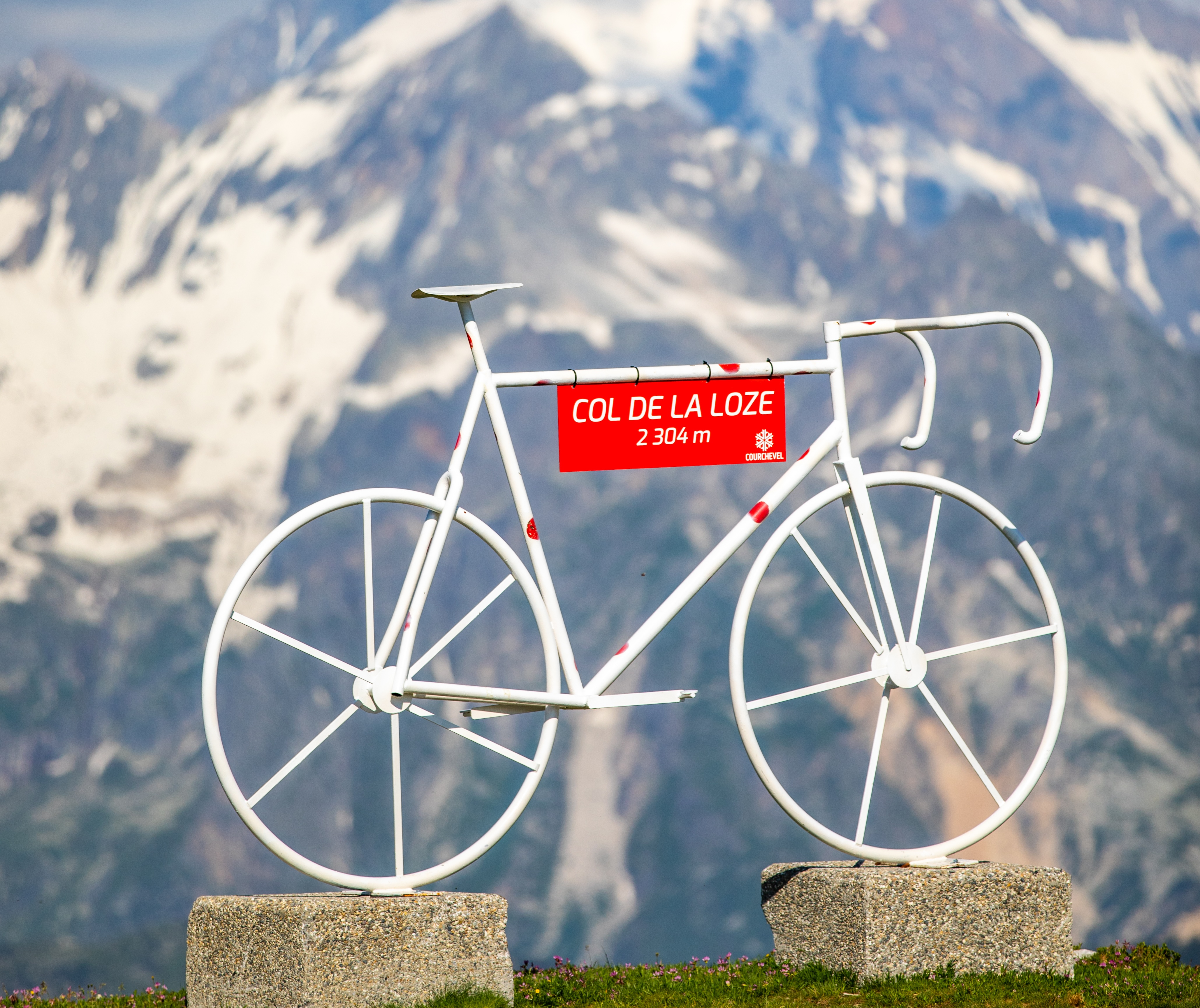
There is no constructed finish, no monument – okay, there’s a huge bike – no spectacle designed to signal completion.
But there is exposure as the col sits on an open ridge between Méribel and Courchevel, with no protection from wind or space.
At the moment the gradient releases, the landscape opens fully: a 360-degree horizon—ridges, ski lines, distant peaks, everything visible at once.
This is not a reward layered onto the climb, it is the natural result of where the climb ends.
The view does not compensate for the effort, but it does something more precise:
It places that effort in context.
For a brief moment, the physical intensity recedes and the scale of the terrain becomes clear. You see the structure you’ve just moved through—the valleys, the lifts, the broken line of the road that led here.
No narrative, no celebration, just clarity.
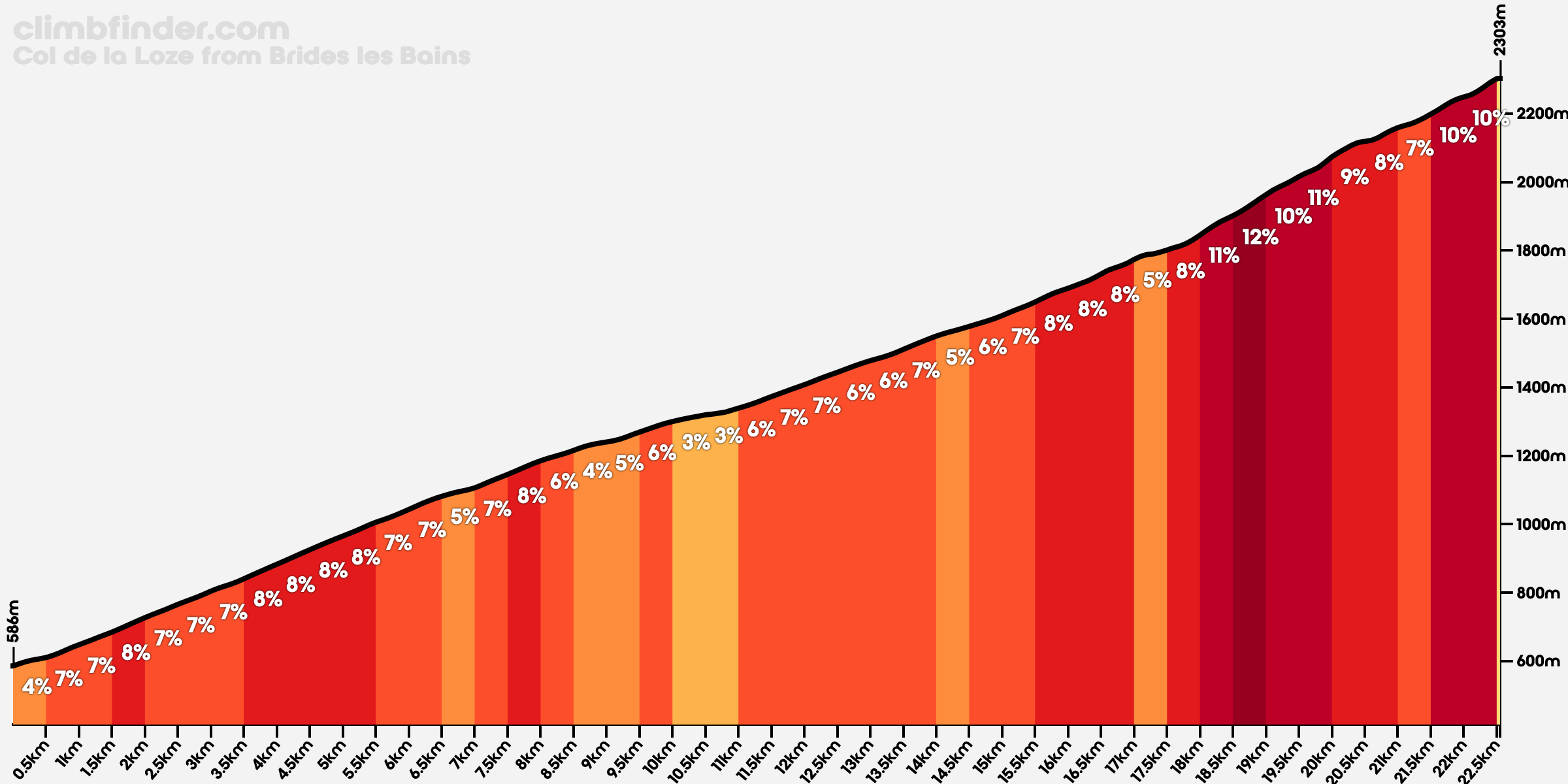
Méribel
- Total: ~22–23 km / ~1,700 m
- Upper section (Méribel → summit): ~10.2 km / ~870 m / ~8.5% avg.
The first 12 km build steadily:
- Classic Alpine gradients
- Forested switchbacks
- Manageable rhythm
You can ride this under control—but that control depends entirely on restraint. The effort accumulates quietly here, without forcing itself on you.
From Méribel, the climb changes form:
- Sustained average of ~8.5% masks large variation
- Frequent double-digit ramps
- Maximum gradients pushing toward ~20% in sections
The final kilometres are irregular and direct. There is no pacing pattern that survives this section, cadence is repeatedly broken.
This is where the Méribel side becomes defining: not just steep, but structurally inconsistent.
I cycled this end in my Tour of 2022, stage 5, after I aborted it in 2021 when I found out that Paula wasn’t allowed to follow in the car, and then subsequently blew myself to bits in the rerouted stage.
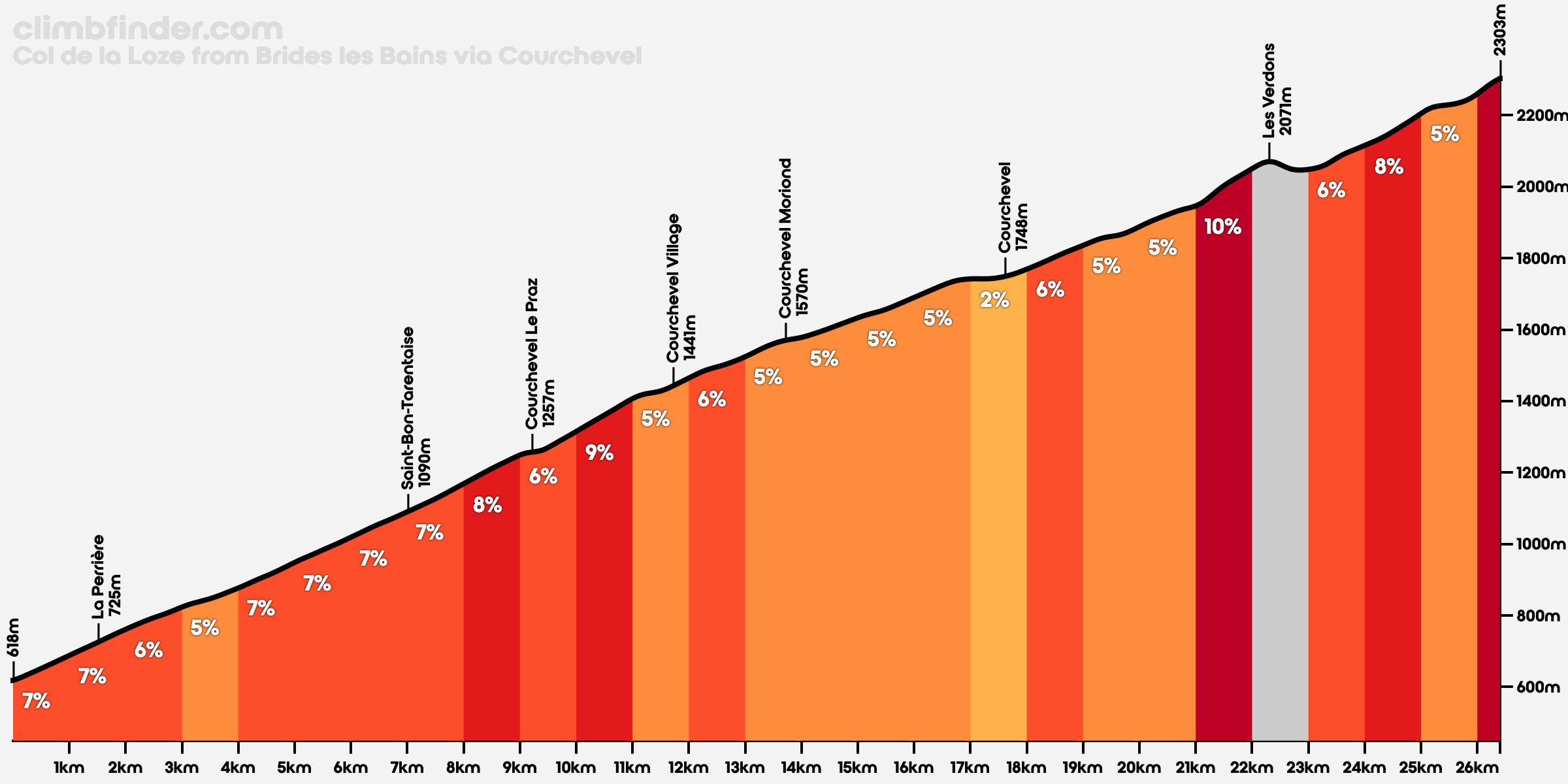
Courchevel
- Total: ~26–27 km / ~1,700 m
- Upper section (Courchevel → summit): ~8.8 km / ~585 m / ~6.6% avg.
The lower approach from Brides to Courchevel adds distance and elevation, but with less sustained load before the final climb.
Compared to the Méribel side:
- Gradients are more varied but less sustained early
- The effort builds less continuously
You can arrive at Courchevel with more in reserve—if you ride it correctly.
From Courchevel, the climb shares the same car-free path, but not the same difficulty profile.
- Lower average gradient (~6.6%)
- Fewer extreme spikes
- More opportunities to maintain cadence
The irregularity is still there—but less aggressive, less sustained and that matters.
Where Méribel forces repeated breakdowns in rhythm, Courchevel allows partial control to continue deeper into the climb.
It is still difficult, but it is not equally difficult.
Bottom Line
Col de la Loze removes what riders rely on:
- Rhythm
- Predictability
- Consistent pacing
What remains depends on how you approach it.
- From Méribel, the climb is defined by instability — longer, steeper, and structurally irregular. Control erodes progressively, then decisively.
- From Courchevel, the climb is defined by compression — the same summit reached through a shorter, more measured build, before the terrain finally asserts itself.
Both routes expose the same summit, but they do not expose the rider in the same way.
The Loze is not a single test, it is two different paths, ending at the same point.
Ride Col de la Loze if
- you want a climb where pacing strategy stops working, not one where it just gets harder
- you are prepared to manage effort without rhythm, not rely on it
- you want to know how your riding holds when gradients refuse to repeat
Choose Méribel if:
- you want the full expression of the climb
- you accept that control will be taken from you gradually, then completely
- you’re willing to trade pacing for survival
Choose Courchevel if:
- you want to reach the same summit with more control intact for longer
- you understand that “easier” still ends with the same exposure
- you want the Loze without its most aggressive instability
