
Dolomites climb
Two approaches — but only one defines the climb
The Fedaia Pass (2,057 m) is an Alpine pass in the Dolomites, marking the border between Trentino and Veneto (Belluno), connecting the Val di Fassa to the Agordino, at the foot of the Marmolada.
At the summit, there’s a plateau of about 2.5 kilometers, running along an artificial lake, Lake Fedaia, used for the production of hydroelectric energy.
The Fedaia, often called “Marmolada”, is well known among cyclists, especially for the hard eastern (Belluno) ascend.
It is a climb with one summit — but two very different ways of getting there.
From the east, the Fedaia builds gradually before turning into one of the hardest finales in the Dolomites. From the west, it climbs more steadily, never quite reaching the same intensity.
Both routes lead to the same place: the dam and lake beneath the Marmolada, but how you arrive there determines what the climb feels like.
From Caprile, the road is irregular from the start — shifting gradients, short steeper sections, and brief moments of relief. Then, halfway up, the nature of the climb changes completely.
From Canazei, the climb is far more predictable: a steady, moderate ascent for most of its length, with fewer abrupt changes.
This is a climb where the shape of the effort depends entirely on the side you choose — only the summit is the same.
From Caprile
This is the version that defines the Fedaia.
- an uneven opening that never quite settles
- a middle section that feels manageable
- and then a final stretch where the gradient rises into sustained double digits
This is where the Fedaia earns its reputation. The difficulty is:
- concentrated
- late
- and impossible to avoid
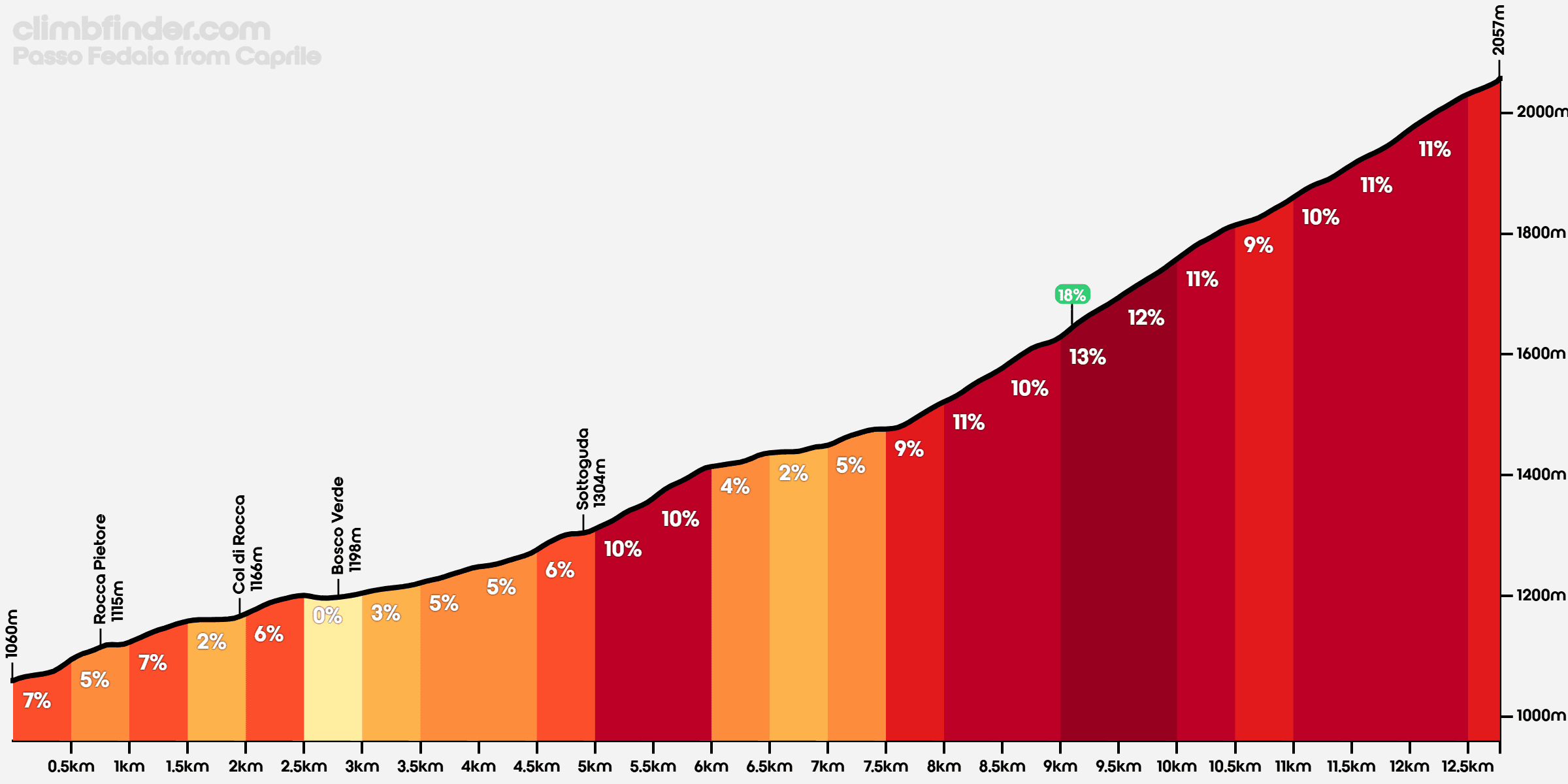
This end is most famous for Malga Ciapela straight: about three kilometers at an average of over 12% and a maximum of 15%.
The last 5 kilometers average 11.2% – it is one of the most difficult sections of all the Dolomite climbs, equal to the final of Tre Cime di Lavaredo.
Apparently the Malga Ciapela section allows for very high downhill speeds, the pros even hitting over 100 kilometers per hour. I must get back and try that one day 😁
From Canazei
A very different experience.
- a steady, controlled climb for most of its length
- gradients that remain manageable
- a more traditional rhythm that never escapes you
Even the harder upper section:
- is shorter
- less sustained
- and lacks the same defining intensity
This is not a “watered down” version, it’s simply a different climb to the same summit
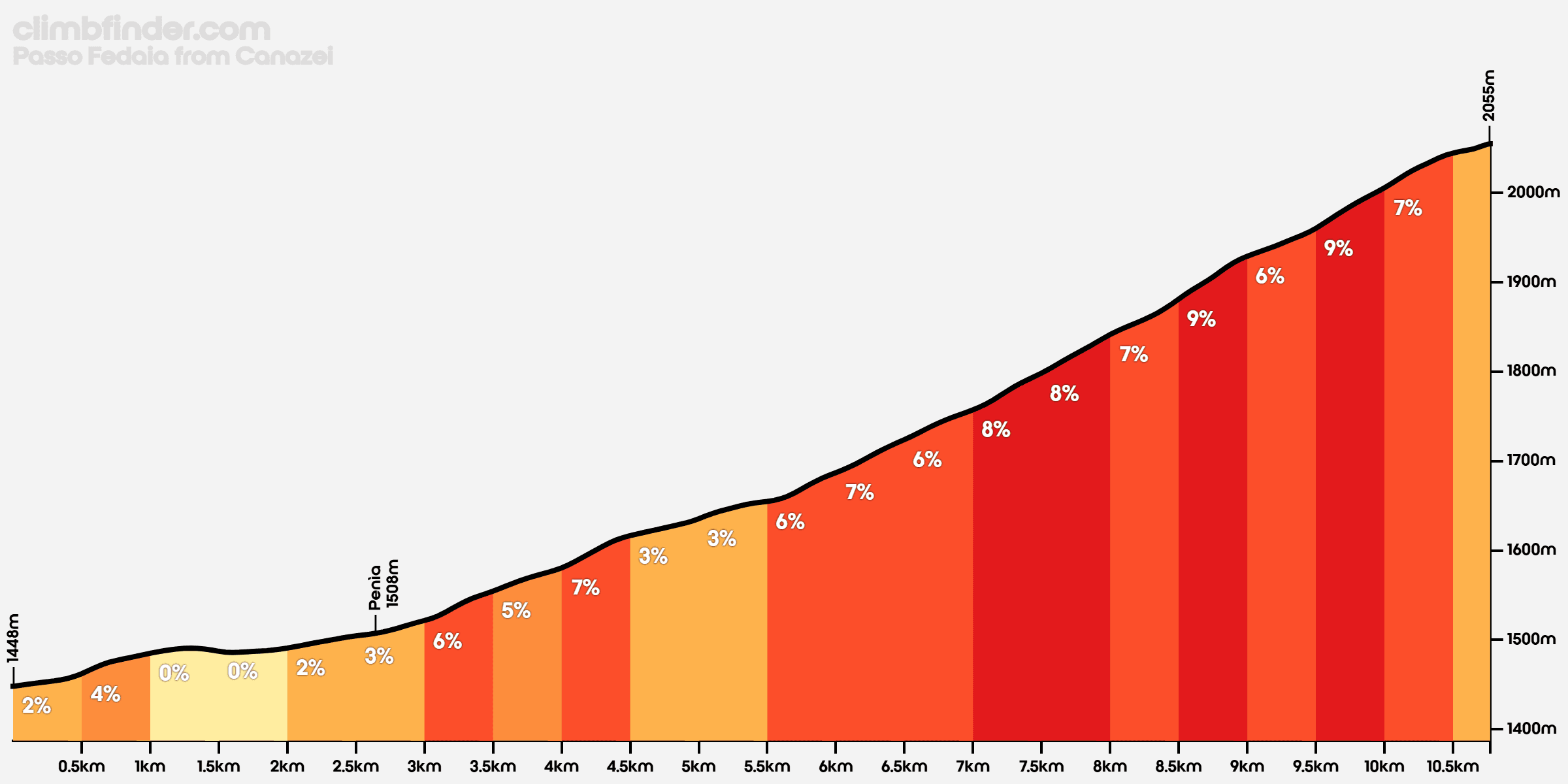
This ascent is 10.8 kilometers long at a 5.7% average and I labeled it as a recovery in 2011.
However, the second half is averaging 7.7% with a kilometer at 8.6% and a max of 10% – not what I would consider a recovery nowadays.
Giro d’Italia
The Fedaia has been in a Giro d’Italia stage 15 times since 1975, lastly in 2022.
In 2008 and 2022 it was a stage finish, but it has never been awarded the Cima Coppi.
