
Historic crossing
Only one side defines it
The Gotthard is not about altitude, it’s not about gradient either.
It’s about the road.
This is the historic crossing of Switzerland, the route that tied north and south together long before tunnels and highways took over. You can still ride that road almost exactly as it was built — up the Tremola, a stack of granite cobbles and tightly engineered hairpins on the southern side.
Most Alpine passes are remembered for their views.
The Gotthard is remembered because it feels different under your wheels.
With a summit at 2,106 meters1, it doesn’t earn a high ranking in the European list of ‘highest passes’, but the old Via Tremola is a more than fair compensation.
Why ride the Gotthard
The cobbles define everything
This isn’t a gimmick — it’s the whole climb.
The Tremola road is Switzerland’s longest memorial road construction. It snakes up the slopes of the Val Tremola as a light-coloured ribbon from Airolo and offers impressive views.
In the most spectacular section, the road climbs up 300 meters over a 4 kilometer stretch, incorporating no less than 24 hairpins, each with its own name. The Tremola road today still largely retains the appearance of the reconstruction completed in 1951.
The Tremola isn’t rough in a chaotic way, but it’s just uneven enough to:
- kill your momentum
- force you into a steady seated effort
- make every km feel longer
It changes how you ride the climb completely.
Hairpins, but not drama
There are plenty of them — but not in a Stelvio sense.
They’re tighter, more uniform, and stacked in a way that feels engineered rather than spectacular. You don’t ride them for the view — you ride them for the rhythm.
The summit is secondary
Unlike the Furka or Grimsel, the top isn’t the highlight.
You don’t ride the Gotthard for the final view, you ride it for the way up.
1 Coming from Airolo, when you arrive at the Guex memorial, you’re not quite there yet. There’s a sign to be found, reading 2,091 meters, but it’s not the summit. Follow the main road past the Lago della Piazza and you’ll bump into the official sign…

Traffic & Conditions
Because of the tunnels, the old road is surprisingly calm:
- very little heavy traffic on the Tremola
- mostly cyclists, motorbikes, and tourists
The main road on the north side can be a lot busier, but it is also wide and predictable.
Dry conditions matter — the cobbles are manageable, but they demand respect, especially if you’re thinking about descending them.
When to Ride
- Best months: June – September
- Early or late in the day improves the experience
And if you can:
- ride the Tremola in dry weather
- take your time
- don’t rush it
This is not a climb you want to tick off quickly.
Airolo
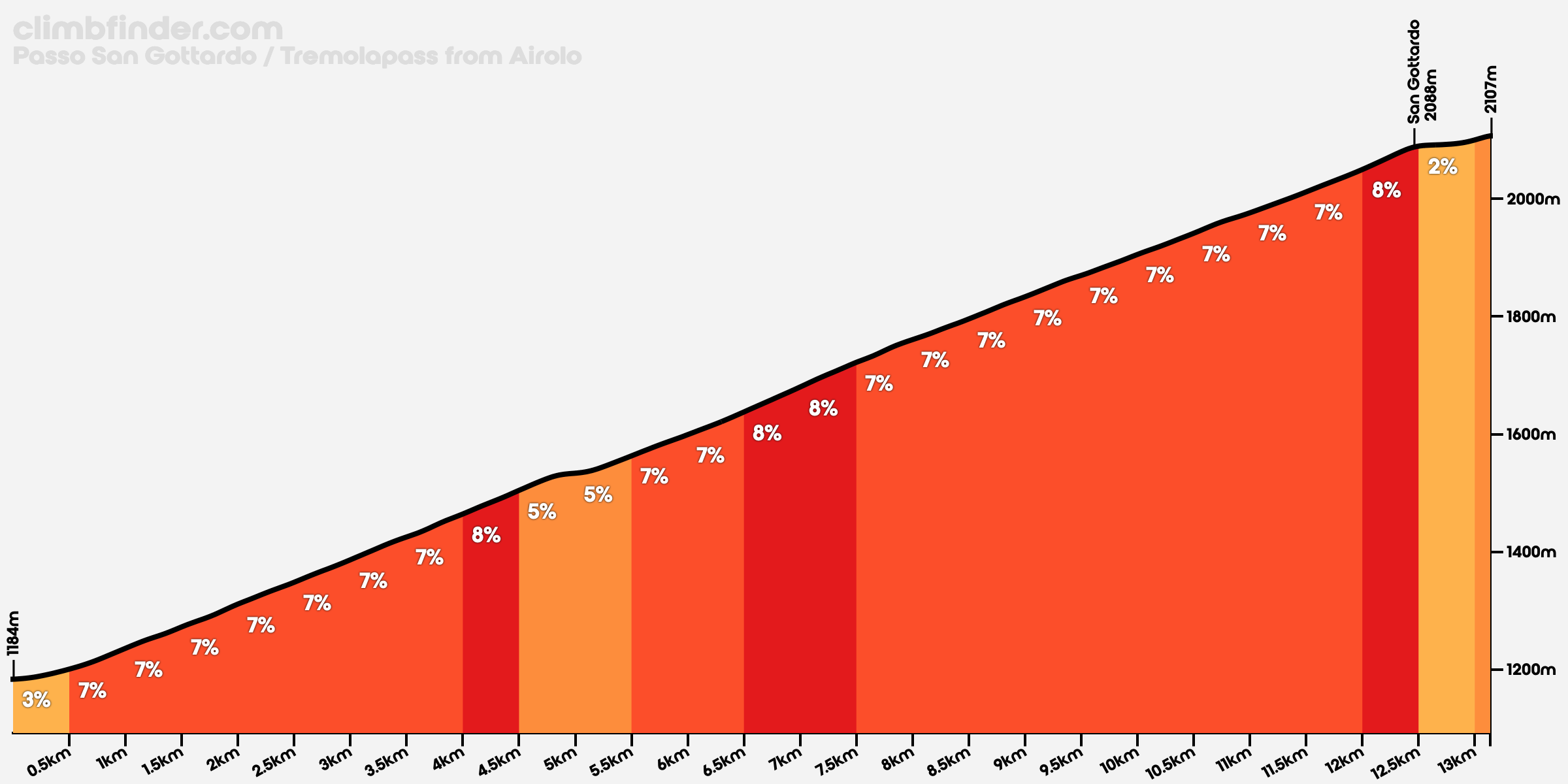
You can start the southern ascent as far out as in Biasca, but while this (probably) allows for a splendid prelude or warm up, Airolo is more frequently referred to as the start of the climb.
This is the Gotthard.
Out of Airolo, you briefly follow the modern road before it splits — and that’s your moment. Ignore the fast lane 2 and take the old Tremola road.
From there, the climb settles into a steady rhythm:
- consistent gradients around 7%
- a long middle section where the road really finds its flow
- no brutal ramps, no breaks
And then it changes.
The upper part becomes a cobbled staircase of hairpins:
- tightly stacked
- uniform
- almost mathematical in how they climb
There’s nothing explosive about it. But the cobbles take away your momentum. You can’t dance on the pedals, you can’t fake smoothness — you just grind your way upward.
It’s slower than it looks, harder than the numbers suggest, and far more memorable than a normal climb.
2 You can cycle the new Tremola, but that is the ‘fast lane’ with lots of traffic and there are a couple of avalanche tunnels, one of them quite long, that will not be enjoyable.

I cycled the Gotthard’s Tremola road as part of the ‘Swiss Stage’ at the end of my Giro d’Italia 2015 – report here. In 2019, during my ‘Tour de Suisse’, I revisited this climb unplanned, as my trip from the other end was supposed to continue with the Nufenen, but as that was closed, I returned the way I came – report on that here.
Andermatt
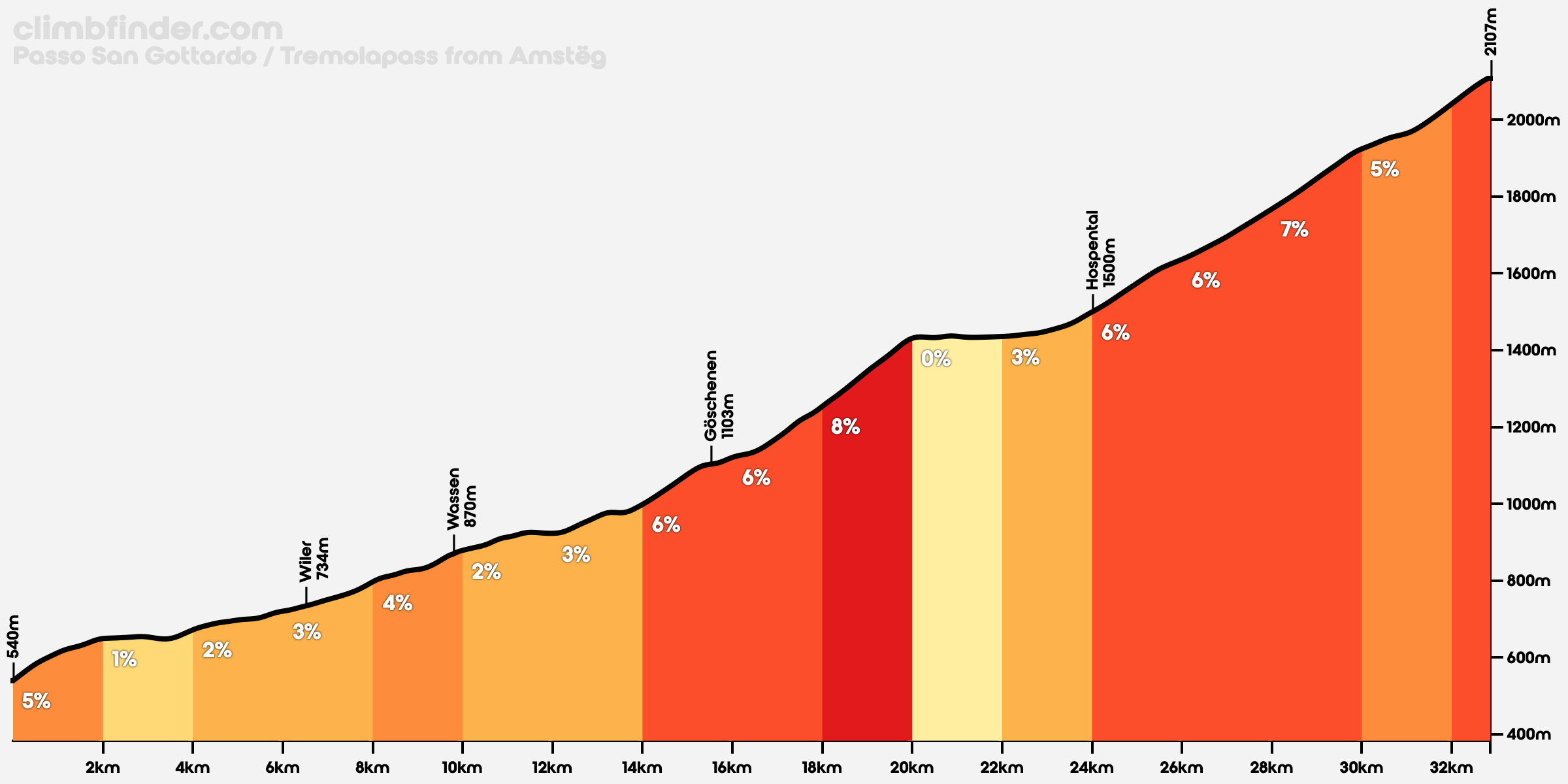
The north side is more conventional — and a lot less defining.
From Andermatt:
- the climb is shorter
- gradients are similar, but less consistent
- the road is wider, faster, more functional
There’s a bit of variation early on, and you can choose to join sections of the old road near the top, but it never becomes the central experience the way the Tremola does from the south.
This side gets you over the pass, the south side makes you remember it.
However, if you do want to make this end more interesting, start between Amsteg and Göschenen. You will be diverted off the main road to follow a bicycle path, which is quieter and safer, but has some bad patches.
It’s in this part of the route that you will pass through the ‘Schöllenen Gorge‘ with the famous Teufelsbrücke (Devil’s Bridge), before you join the main road again.
I cycled this end during my ‘Tour de Suisse 2019’, when I started in Wassen – report on that here.
The descent
If you continue Airolo, the new Tremola is the faster option downhill, and that way you also get one of the best views over the old road. In fact, I would not recommend descending the old, cobbled section on a road bike, even though the surface is well kept. In any case, this is not a pass where you switch your brain off after the summit. Respect the road all the way down.
Route Ideas
Gotthard as a standalone
If you’re riding the Gotthard on its own:
Start in Airolo
That’s where the old Tremola begins. From Andermatt, you can get over the pass — but you’re missing the point.
Gotthard in a crossing route
If you’re not looping:
- North → south: practical, but ordinary
- South → north (Tremola): the real experience
This is one of the few climbs where direction isn’t a detail — it’s the whole decision.
The Classic: Furka – Nufenen – Gotthard
This is the big one, starting in Andermatt:
- Furka for drama
- Nufenen for altitude
- Gotthard for character
As opposed to starting in Airolo or Ulrichen/Obergoms, the Gotthard comes last — and that works best. After two big Alpine climbs, the cobbles force you into a completely different rhythm.
The Quieter Trinity: Oberalp – Lukmanier – Gotthard
Everyone talks about the Furka–Nufenen–Gotthard loop. Big names, big numbers, glaciers, and bragging rights.
But there’s another loop starting in Andermatt, less aggressive, less hyped.
This loop doesn’t try to crush you. It draws you in, pulls you across languages and landscapes, and lets the Alps unfold gradually instead of throwing them at you all at once.
What makes this loop special is not altitude or difficulty—it’s contrast.
The Furka–Nufenen loop is dramatic and relentless, this one is layered, progressive, almost narrative.
Alpenbrevet
The Gotthard is part of only two of the Alpenbrevet courses:
- Silver course: Andermatt – Gotthard – Nufenen – Furka – Andermatt
- Bronze course: Ulrichen – Nufenen – Gotthard – Andermatt
The bronze course is the only course ascending the Tremola, the silver course descends the new Tremola.
Verdict
The Gotthard shouldn’t be compared to other climbs.
- Not the hardest
- Not the highest
- Not the most scenic
But probably the most distinctive.
Because once you’ve ridden the Tremola, every other road in the Alps feels just a little bit… smooth.
This one is about the road.
Background picture: StudioJS, CC BY-SA 4.0, via Wikimedia Commons
