
Gravel, glory, and 29 reasons to question your life choices
There are climbs that hurt.
There are climbs that last.
And then there’s the Colle delle Finestre—a climb that changes character mid‑sentence, rips the tarmac from under your tires, and dares you to keep going.
This isn’t just another Alpine pass, this is the Giro’s dirt‑strewn crucible, where road racing meets off-road instinct—and where pacing plans quietly die somewhere around the Colletto.
Why the Finestre matters
The Colle delle Finestre is one of the few major Alpine climbs where:
- road racing history meets unfinished road
- strategy gets rewritten by surface conditions
- and the climb itself feels like two different mountains stitched together
It’s also one of the rare Grand Tour ascents where the dirt road is not a gimmick—but the defining feature.
Rider Notes
- Gravel tires? Not mandatory—but wider rubber helps and I recommend you mount them.
- Pacing strategy? Tear it up when the asphalt ends.
- Descending Susa side? Technical, exposed, not a victory lap.
- Weather? Can flip from summer to alpine in minutes.
Giro d’Italia
Where the dirt gets dressed up—but never tamed
The Colle delle Finestre didn’t need decades to earn its reputation. From its first appearance in the Giro in 2005, it was obvious: this climb was different. Steeper than it had any right to be, and—crucially—unfinished.
That last detail is what made it legendary.
The Gravel in a Race Context
When the Giro rolls through town, the Finestre’s famous sterrato doesn’t disappear—but it does get reimagined.
- The final ~8 km remain unpaved
- But the surface is typically graded, compacted, and cleaned ahead of the race
- Loose rocks get pushed aside
- The worst ruts get flattened
The result? Not quite asphalt—but not the wild, line-picking battle you’ll meet on a random July ride either.
Trust me, I know.
Think of it as:
- hard‑packed dirt motorway
- fast enough for attacks
- still rough enough to punish bad choices
This is the Giro’s compromise: keep the identity, reduce the chaos.
Why It Matters in Racing
Even cleaned up, the Finestre changes races because:
- Pacing collapses at the surface change
- Equipment begins to matter (pressure, grip, handling)
- Drafting becomes inconsistent
- And the climb naturally splits into two acts:
tarmac war → gravel showdown
The Giro doesn’t just include the Finestre. It weaponizes it.
Legend Status
- First used in 2005, instantly iconic
- Rare among Grand Tour climbs: a gravel sector at altitude
- Scene of some of the race’s boldest long-range moves
It’s a climb where:
- riders attack because they must
- rivals crack because the surface forces mistakes
- and the mountain decides outcomes long before the summit
Bike Rebel Take
Yes, the Giro smooths it out. Yes, it becomes faster, cleaner, more “raceable.”
But don’t get it twisted: even neatly bulldozed, even packed down like a runway, the Finestre is still a dirt climb at 2,000+ meters.
And that’s enough to break anyone.
Susa
The real Finestre. The legendary one. The one with dirt in its soul.
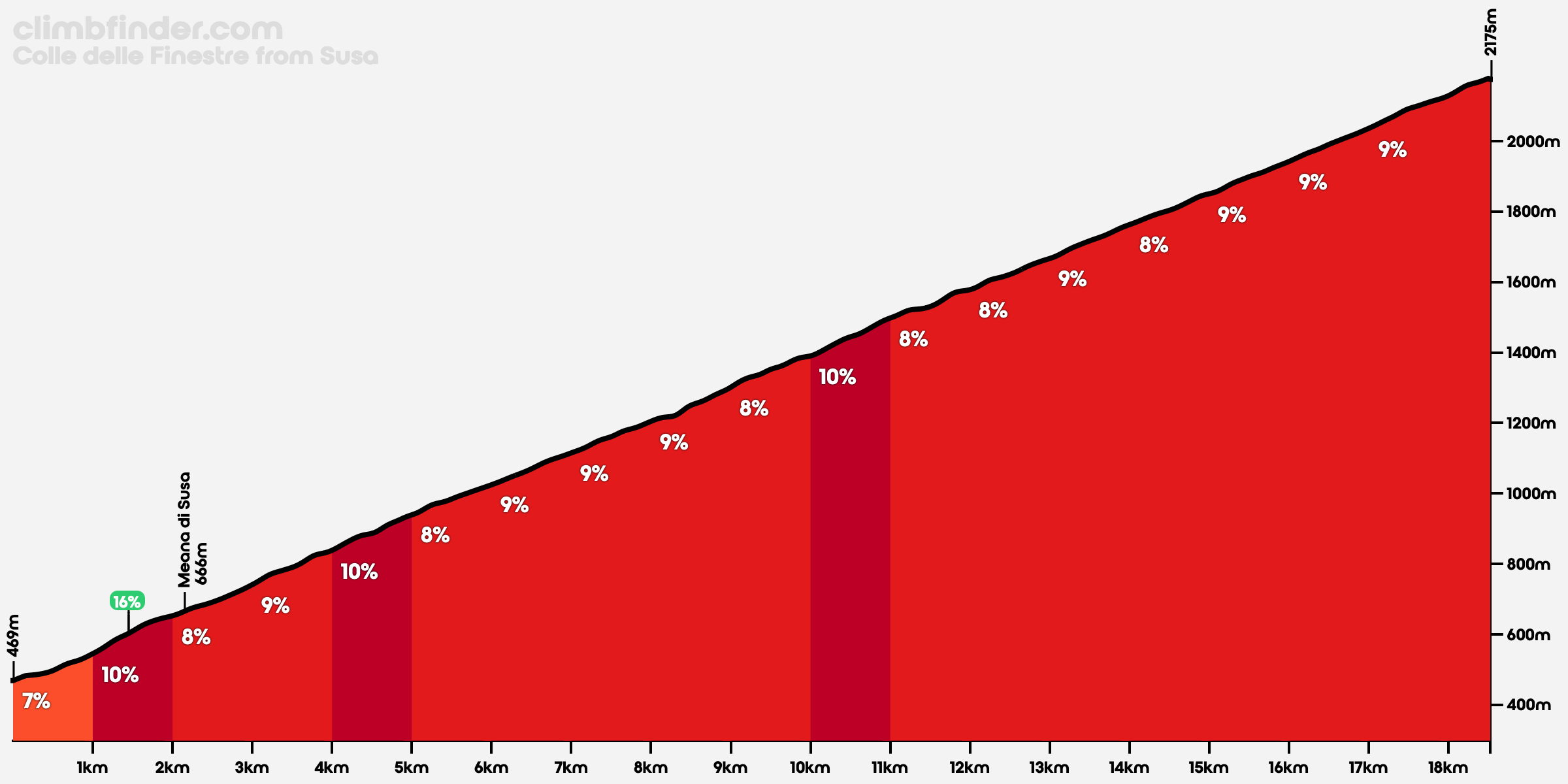
From the start, the Susa side is all business. The climb heads up from the valley into the trees with almost no real concession to rhythm or comfort, and by the time you reach Meana di Susa, the road has already made its point. This is a sustained, punishing ascent before the gravel even enters the conversation.
Then, past Meana, some ~4 kilometers in, the road starts folding back on itself over and over, deep in the forest, with the gradient remaining severe rather than theatrical.
In less than 4 kilometers you face 29 tightly stacked switchbacks—a relentless staircase.
Then the script flips again. At Colletto di Meana, with around 8–9 km to go, the road abruptly turns to gravel. No warning. No easing in. Just dust, stones, and suddenly a different sport:
- 8 km of unforgiving sterrato
- Lines matter
- Traction matters
- Ego absolutely does not
This is where the Finestre earns its myth. The gradient doesn’t soften, the air gets thinner, and the road—snaking endlessly upward—feels carved rather than built.
You’re no longer riding a climb, you’re surviving a surface.
The south side alternatives
Same summit, very different conversations
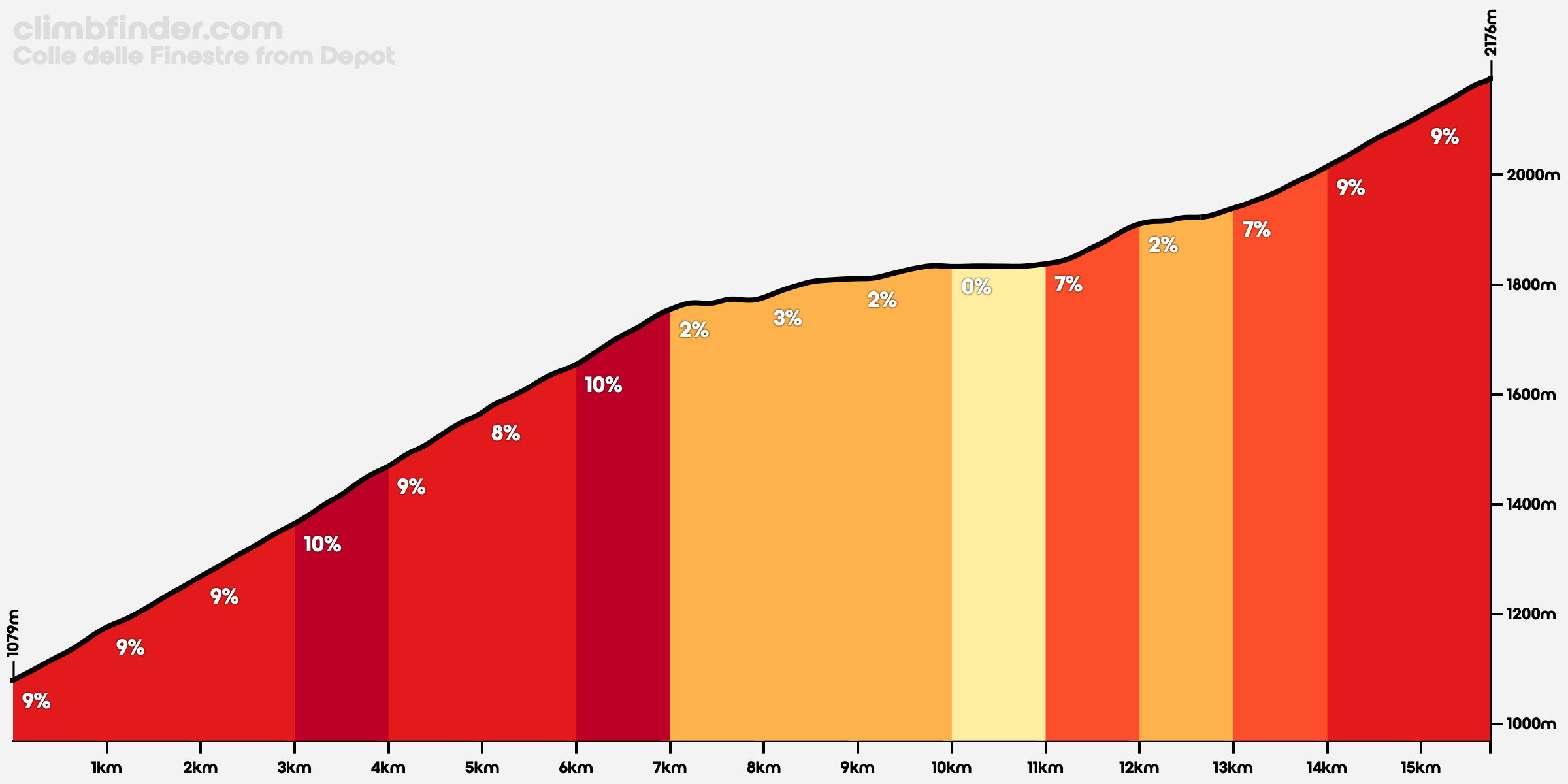
The southern approaches from Val Chisone don’t shout like Susa. They negotiate. They lure you in with smoother roads and lower drama—until you realize you still have to reach the same 2,176m summit.
Dépot
The long grind with a hint of history
- Distance: ~15.7 km
- Elevation gain: ~1,100–1,130 m
- Average gradient: ~7%
- Surface: Mostly paved, occasional rough/gravel sections
The Dépot side is the connoisseur’s route—less famous, but far from easy. It’s longer than it looks on paper and steady enough to keep you on the limit for a long time.
There’s less spectacle here:
- fewer hairpins
- fewer crowds
- more solitude
But that’s the point. The Dépot side feels like an old military road (because it is)—purpose-built, direct, and quietly relentless.
Think: rhythm over survival. Until the altitude reminds you it’s still the Finestre.
Pourièrres
The “easy” side (that still isn’t easy)
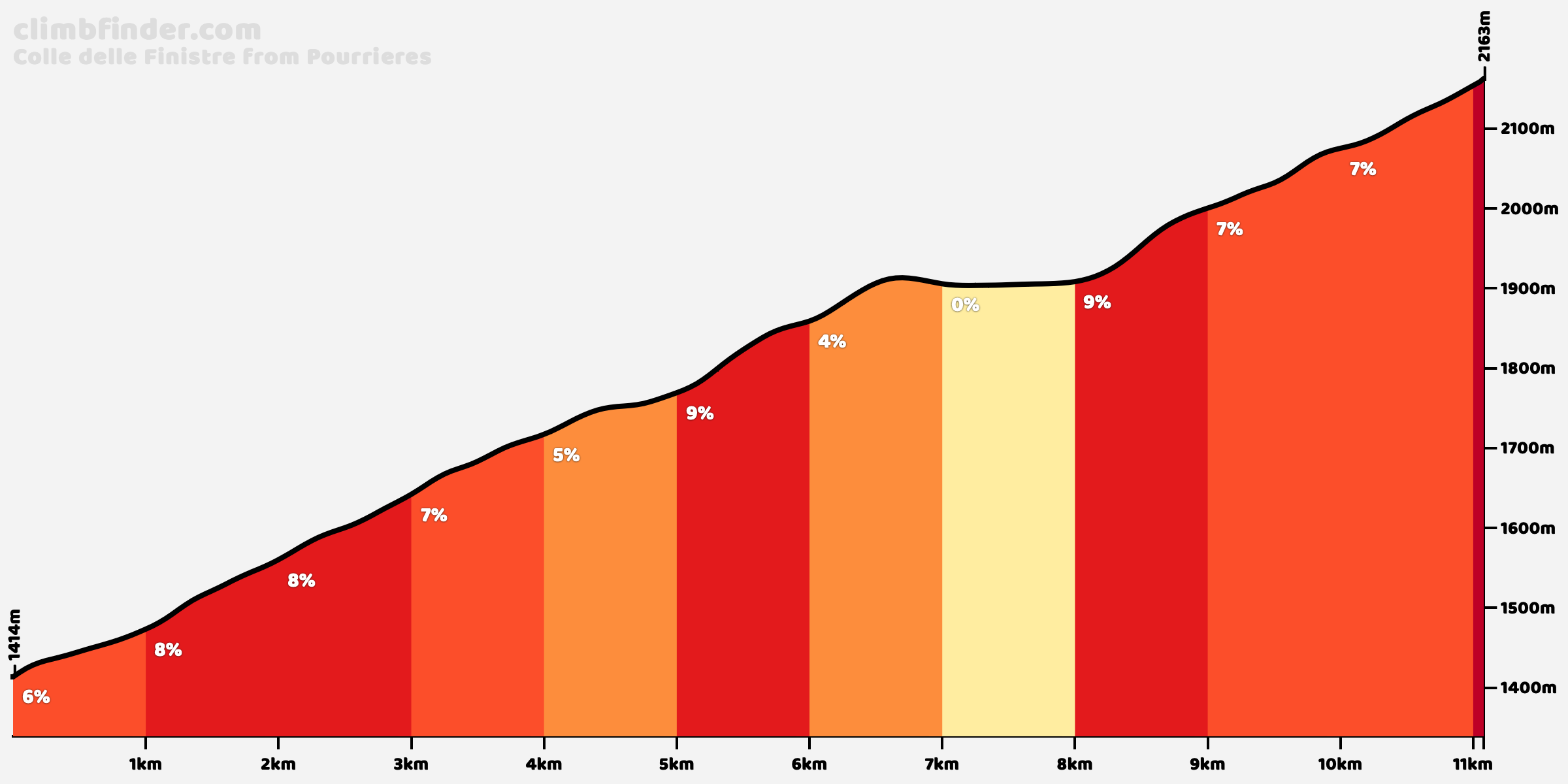
- Distance: ~11 km
- Elevation gain: ~750–790 m
If Susa is a battle and Dépot is a siege, Pourrières is a steady negotiation.
Shorter. Smoother. More predictable. And crucially: no gravel section on the ascent itself.
That doesn’t make it easy—it just makes it different:
- sustained gradients
- fewer hairpins (~11)
- scenic, open riding
This is your gateway route—or your recovery line if you’ve already danced with the gravel on the north side.
Bike Rebel Verdict
Ride it from Susa if you want the full mythology: the steep opening, the packed hairpins on the paved middle section, and the famous gravel haunches above the tree line.
Ride it from Dépot if you want a quieter, long-form mountain road with history under the tires.
Ride it from Pourrières if you want a more conventional southern climb to one of cycling’s least conventional summits.
Whichever side you choose, the essential truth stays the same: the Finestre is not memorable because it is fashionable. It is memorable because it remains fundamentally uncompromising.
The Finestre doesn’t care how you got there, only whether you had enough left to finish it.