
Border pass
One summit linking countries; the transition is the story
Rising to 2,744 meters on the French–Italian border, the Col Agnel / Colle dell’Agnello is one of the true giants of Alpine cycling. It is the highest paved international mountain pass in Europe and ranks among the very highest road crossings of the Alps.
It connects the French département Haute-Alpes with the Italian region Piedmont.
Unlike more theatrical climbs, the Agnel does not rely on hairpin spectacle. Its reputation is built on altitude, scale, and a sustained sense of exposure that grows the higher you climb.
Whether approached from France or Italy, this is a pass that feels serious from start to finish — remote, uncompromising, and unmistakably high‑mountain.
Why ride the Agnel / Agnello
Few passes combine altitude, length and calm in the same way as the Agnel. What makes it special is not a single feature, but its overall feel. This is a climb that exists outside the main Alpine transit routes: no tunnels, no shortcuts, no reason for heavy traffic to be there at all.
Both sides reward a steady rider — someone comfortable settling into a rhythm and letting the mountain unfold over time. If you enjoy long efforts, thin air, and the sense of being properly removed from the valleys below, this is one of the most satisfying climbs in the Alps. It’s also one of the rare big passes where you can still feel alone, even in high season.
Seasonal notes
Like all very high Alpine passes, the Agnel is highly seasonal. Snow can linger well into late spring, and early‑season attempts are often limited by closures or unstable conditions near the summit. Even in midsummer, weather can change quickly.
What stands out here is the exposure. Once you’re above the tree line, there is nowhere to hide from wind, cold, or sudden storms. I’ve experienced large temperature differences between valley and summit on this pass more than once — warm air below, near‑freezing conditions above.
If you plan to ride the Agnel, build in flexibility. Check local conditions, carry extra layers, and be prepared to turn around if necessary. When conditions are good, it’s sublime. When they’re not, the mountain gives you very little margin.
France vs Italy
Despite sharing a summit, the French and Italian sides ride very differently.
From the French side, the Agnel is defined by flow. Gradients are generally regular, with few abrupt surprises, and the climb encourages a measured, tempo‑based approach. It’s a mountain that rewards discipline: ride it too hard early on and the altitude will catch up with you later; pace it well and it feels almost meditative. The decisive part comes in the final kilometers above Fontgillarde, where the landscape opens up, vegetation disappears, and the effort becomes more exposed both physically and mentally.
The Italian side is more irregular and more severe. After a long approach through the Valle Varaita, the character changes sharply above Chianale, the last village before the summit. From here, the climb becomes concentrated and demanding, with sustained double‑digit gradients and a stark, almost lunar environment. This final section is what gives the Italian side its reputation: fewer places to recover, fewer visual distractions, and a very direct confrontation with altitude and fatigue.
Neither side is easy. They simply test you in different ways.
Whichever side you choose, the Agnel doesn’t really reward comparison. It rewards commitment. Ride it well, pace it honestly, and it will give you one of the purest high‑mountain experiences the Alps still have to offer.
French Ascent
Among cyclists, the French side is regarded slightly less dramatic, but it is still highly respected.
It is often described as more rideable rather than easier — you’re almost never off the pedals, but you’re also rarely forced out of the saddle for prolonged stretches.
Cyclists who value long tempo climbing and sustained efforts often prefer this side, especially when starting from Guillestre, as a big endurance day.
Tour de France
The Col Agnel was included in a Tour de France stage only twice (2008 and 2011) but as the Galibier (2,556m) was in those Tours as well, those passages were awarded the Souvenir Henri Desgrange instead.
Profile
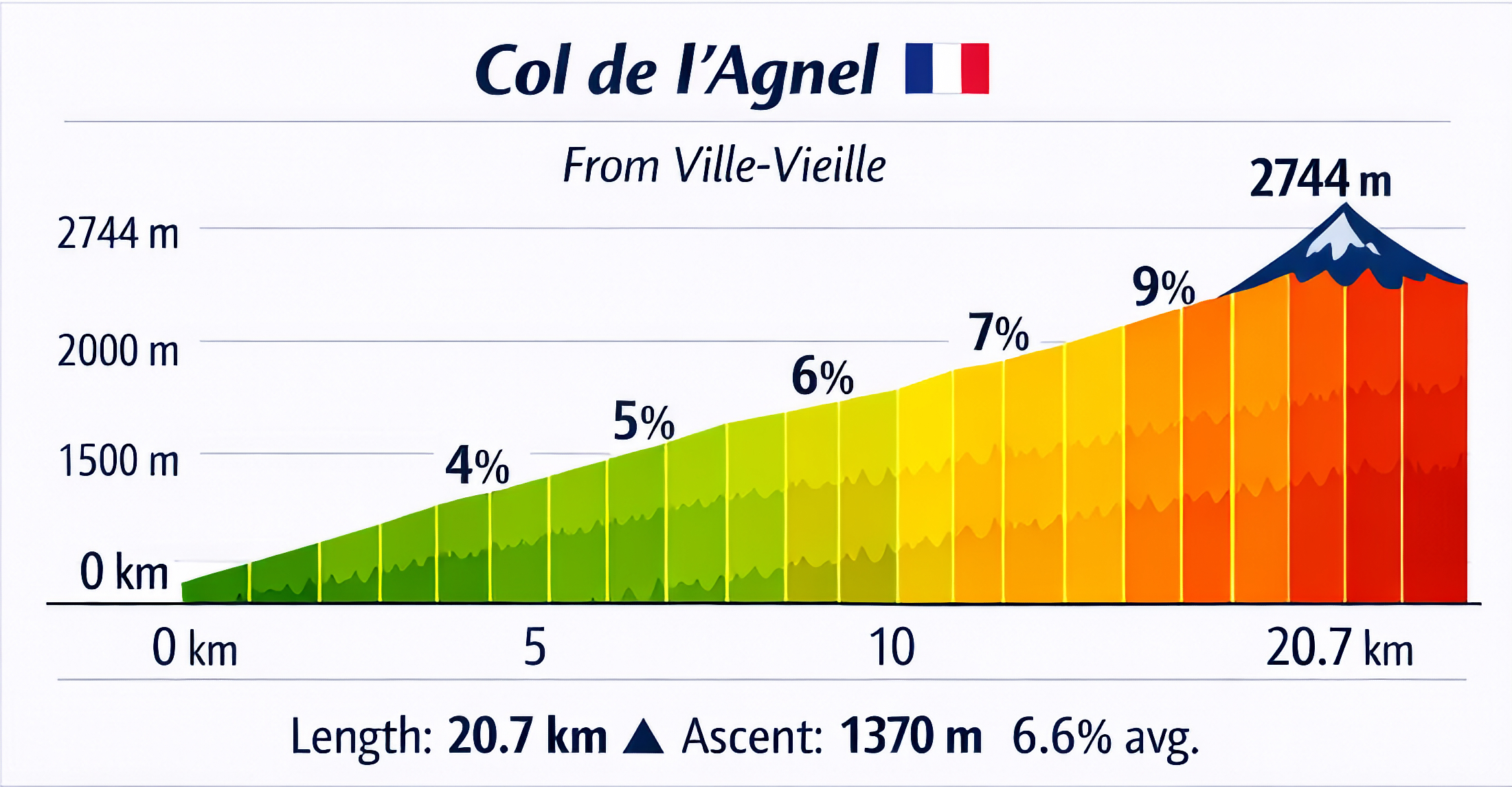
Although the official climb begins in Ville‑Vieille, you should start in Guillestre, following the D902 through the spectacular Gorges du Guil.
This approach adds roughly 20 km of gentle climbing and serves as a dramatic warm‑up, with sheer rock walls, tunnels, and steadily increasing altitude — but very little sustained gradient.
Report on my climb up this end of the Col Agnel in 2014 here.
Italian Ascent
The Italian ascent is more often mentioned as the standout side.
The final ~9 km after Chianale are frequently described as the hardest and most memorable part of the entire pass, with long double‑digit ramps and an almost lunar landscape.
That combination makes the Italian side feel more “epic” and more Giro‑like — which explains why many cyclists single it out as the more rewarding challenge.
Giro d’Italia
The Colle dell’Agnello has been climbed four times in the Giro d’Italia, in 1994, 2000, 2007 and 2016. It has been the Cima Coppi in the Giro d’Italia three times, as in 1994 the Stelvio was in the Giro too.
Profile
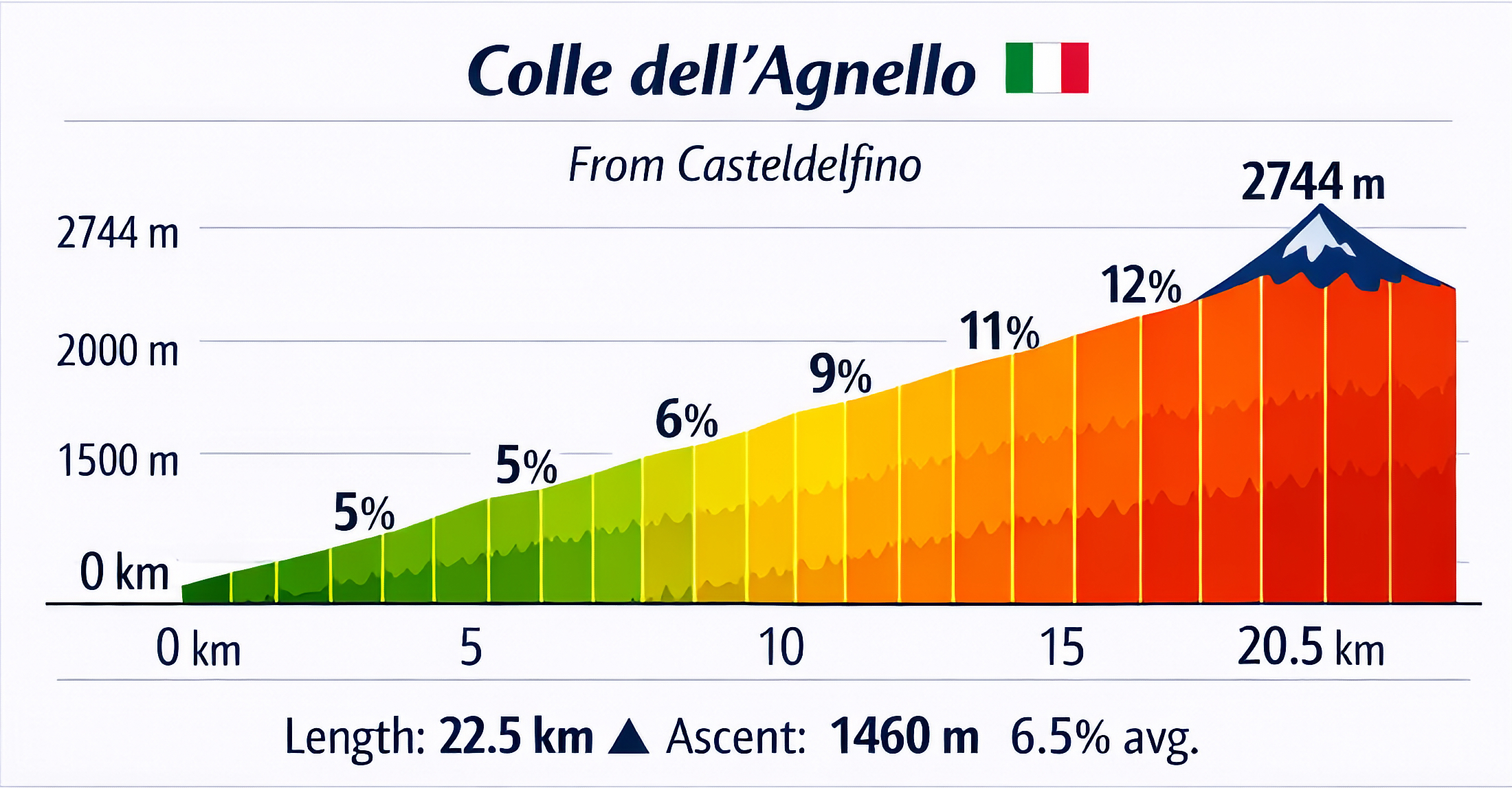
The Italian ascent of the Colle dell’Agnello starts in Casteldelfino, but you can start in Sampeyre, lower down the Valle Varaita.
While this section does not include sustained steep gradients, it adds distance and a steady gain in altitude before the official start of the climb.
I have not climbed the Colle dell’Agnello myself as in 2014 I turned around at the summit, descended back to Ville-Veille and climbed the Izoard instead.
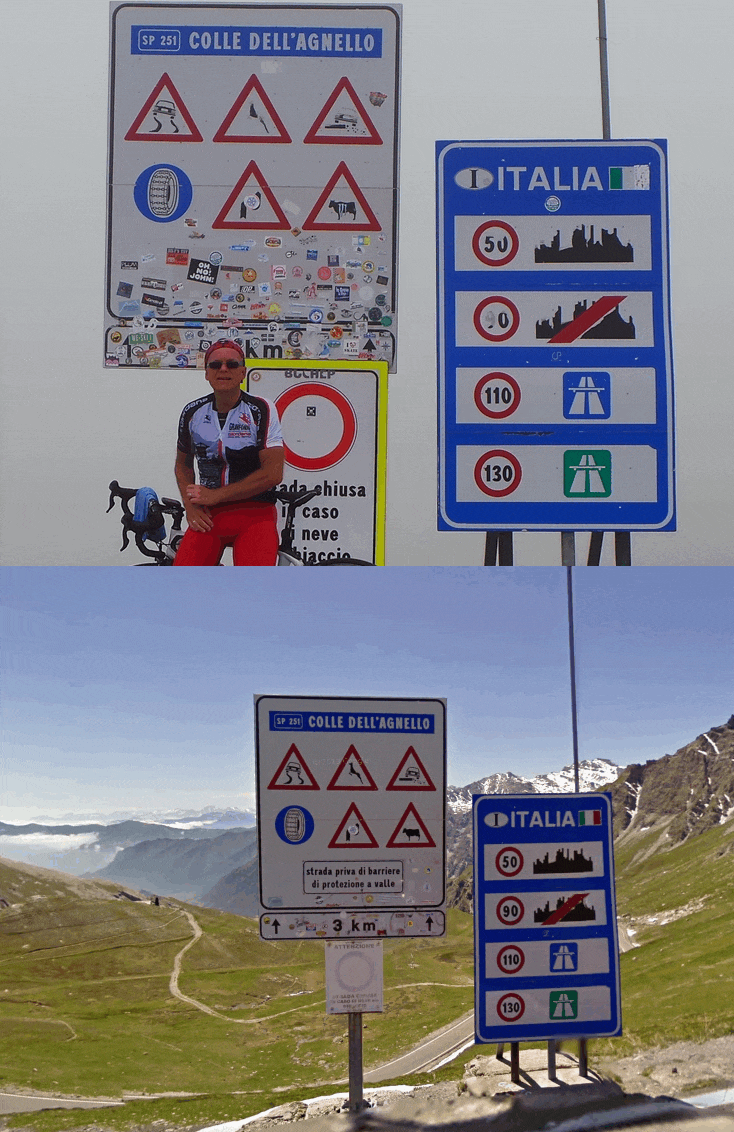
Background image: Mikel Ortega from Errenteria, Spain, CC BY-SA 2.0,
via Wikimedia Commons
