
The Swiss Alps are often seen as the “clean” or “civilized” side of Alpine cycling, but that surface impression hides what actually defines riding here: order, scale, and consistency.
Roads are immaculately engineered, gradients are deliberate rather than chaotic, and the mountains tend to reveal themselves slowly.
This is not a region of sudden brutality or visual overload. It is a place where effort accumulates quietly, hour after hour, and where the biggest mistakes usually come from underestimating how much work remains once the climb has properly begun.
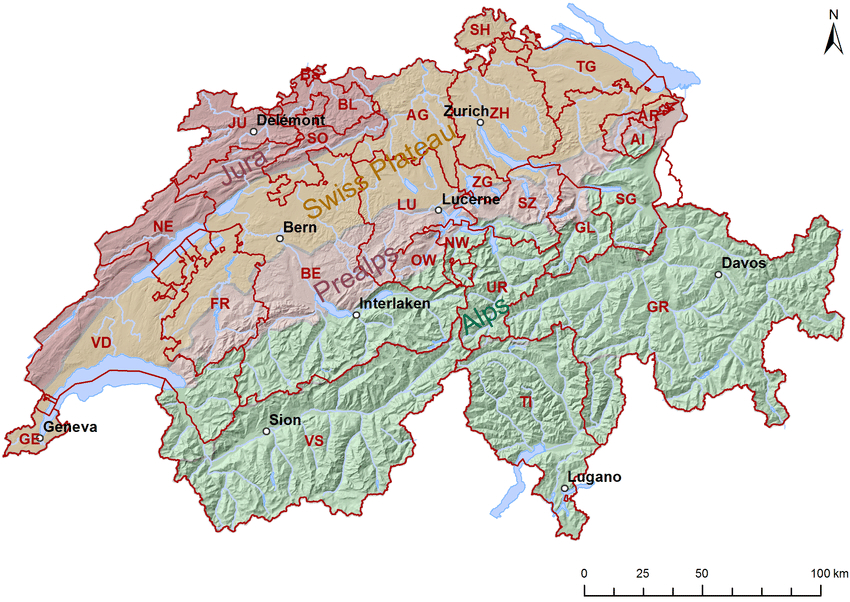
Geography
The Swiss Alps form a broad, high‑altitude core of the Alpine system, structured around long valleys that funnel riders toward a relatively small number of major passes.
The western ranges occupy the greatest part of Switzerland while the more numerous eastern ranges are much smaller and are all situated in the canton of Graubünden.
While the northern ranges from the Bernese Alps to the Appenzell Alps are entirely in Switzerland, the southern ranges from the Mont Blanc massif to the Bernina massif are shared with other countries such as France, Italy, Austria and Liechtenstein.
Unlike the fragmented massifs of the Dolomites or the compact severity of the Ortler Alps, the Swiss Alps are coherent and expansive.
Valleys are wide, approaches are long, and climbs often begin far earlier than expected when viewed on a map.
Passes such as the Gotthard, Furka, Albula and Bernina sit high and are connected in ways that allow multiple major ascents to be combined into enormous days without ever leaving paved ground.
What Makes the Swiss Alps Different
Cycling in the Swiss Alps is about continuity rather than intensity.
- Climbs are usually long and consistent rather than steep and irregular
- Gradients tend to be predictable, often sitting in a narrow band for kilometres
- Valleys create extended transitions that reward patience and discipline
- Descents are long, fast, and technically forgiving but mentally demanding
Where the Dolomites interrupt rhythm and the Ortler Alps demand commitment, the Swiss Alps test restraint.
Riders who overreach early often don’t realise they’ve made a mistake until there’s no easy way to recover it.
Swiss Alps in Context
Within Bike Rebel’s Alpine framework:
- French Alps teach pacing through long, steady climbs and classic valley‑to‑summit structure
- Swiss Alps refine that lesson, adding altitude, length, and logistical elegance
- Dolomites break rhythm and force intensity
- Ortler Alps remove safety nets altogether
The Swiss Alps sit between approachability and seriousness — but they are not gentle. They are simply honest in a quieter way.
Riding Character
A typical Swiss Alpine ride unfolds slowly. You roll through a valley longer than planned, start climbing earlier than expected, and only reach the upper slopes when fatigue has already set in.
The difficulty here isn’t surprise — it’s duration. Climbs don’t spike; they grind. The weather is often more stable than in the high Italian Alps, but altitude exposure is sustained, and cold descents are common even on warm days.
This is a region that rewards riders who think in terms of hours rather than kilometers, and who are comfortable settling into an effort without constantly reacting to the road.
Where to Stay?
Good Swiss Alpine bases tend to sit low enough to allow movement, but high enough to avoid wasted climbing.
Places like Andermatt, Davos, Samedan, and Disentis work well because they sit at the junction of multiple valleys rather than at the foot of a single pass.
From these towns, riders can build long, logical routes that thread several major climbs together without backtracking.
Unlike the Dolomites, where staying “too low” costs you effort every morning, Swiss bases trade altitude for reach.
Why Ride the Swiss Alps
Ride the Swiss Alps if you value measured suffering: long climbs, clean lines, and days that grow steadily heavier rather than explosively hard.
This is a place for riders who want to learn how their body behaves deep into an effort, who respect pacing, and who understand that the hardest part of a ride is often the last hour, not the steepest kilometer.
Swiss Alps Bike Rebel Style
While I have limited experience cycling the Swiss Alps, I did organize a “Tour de Suisse” in 2019. That was after I vowed to come back at the end of my “Swiss Stage” in the Giro d’Italia of 2015.
Map with cols I cycled during those events, plus a few I did not but are well known. The track is that of the Alpenbrevet Platina course.

Cycled, info page by me

Cycled, link to ClimbFinder

Not cycled, link to ClimbFinder