The Col du Galibier (2,642m) is located in the south-easternern region of the French Dauphiné Alps, marking the border between the Savoie (Auvergne-Rhône-Alpes) and the Haute-Alpes (Provence-Alpes-Côte d’Azur).
The tunnel at 2,556 meters used to be the only through road until 1976.
When the tunnel was closed for restoration, a loop around the summit, similar to the one over the Bonette, was constructed.
This reaches the ‘official’ summit of 2,645 meters.
With this loop included, it claims 9th spot in the highest paved European roads list, and 5th spot of highest mountain passes.
Without it, it’s ranked 11th and 6th respectively.
Like all passes in the area, it’s closed during winter, roughly between October and June.
What makes climbing the Galibier hard, is the distance.
It can only be reached via the Col du Télégraphe from Saint-Michel-de-Maurienne, or via the Col du Lautaret from either Briançon or Bourg-d’Oisans (Le Clapier).
I cycled up the Lautaret side from Le Clapier on June 9th, 2012 and found the final loop closed from the Valloire end.
Luckily, I could still cycle up from my end, after which I returned to the Lauteret end and continued by car through the tunnel.
When I tackled the northern ascent in 2014, as well as when I combined it with the Lautaret from Briançon in 2017, the road was free of snow, but in 2017, it was freezing cold up there.
I revisited the Galibier from the north during my Tour de France 2021.
That year I also cycled the Marmotte, albeit I started and ended in Saint-Jean-de-Maurienne.
Tour de France
The Col du Galibier was first cycled in the Tour de France in 1911 and has been a regular appearance in a Tour stage ever since.
With a total of 64 appearances, it’s only surpassed by the Col du Tourmalet.
It has also been crossed twice in a Tour, in 2011’s 100th-Anniversary and 2022.
A 2015 double was cancelled due to the collapse of the Chambon tunnel in the Lautaret descend.
In the last stretch towards the tunnel, coming from the south, there is a monument in honor of Henri Desgrange, instigator and first director of the Tour de France.
The memorial was inaugurated in 1949 and whenever the tour crosses the Col du Galibier, a wreath is laid on the memorial.
The first rider to cross the summit when it’s in a Tour stage, is sure to get the Souvenir Henri Desgrange.
The rule is, that the award is given to the rider who first passes the summit of the Galibier, regardless of possible higher cols in the same Tour.
There are only a few passes higher than the Galibier: the Agnel, the Iseran and the Bonette, but all three have been awarded the Souvenir only once, in 2011, 2019 and and 2024 respectively.
Saint-Michel-de-Maurienne

The approach from the north is 35.1 kilometers long, starting in Saint-Michel-de-Maurienne.
Télégraphe
At 12.1 kilometers in length, with an elevation of 852 meters (7%), the preceding Télégraphe (1,566m) is not to be mistaken as merely a warming up for the Galibier.
The 4.7-kilometer-long descent into Valloire, has its own segement going in the opposite direction.
Galibier
In Valloire, the actual ascent of the Galibier starts: 18.1 kilometers, with 1,245 meters of elevation, or a 6.9% average.
That may seem almost friendly, but the final 8 kilometers of it averages around 8.5% and the final kilometer – the loop over the tunnel – has an average of over 10%.
You may need a few seconds to recover, before being able to fully appreciate the incredible view you have from up there – I know I did.
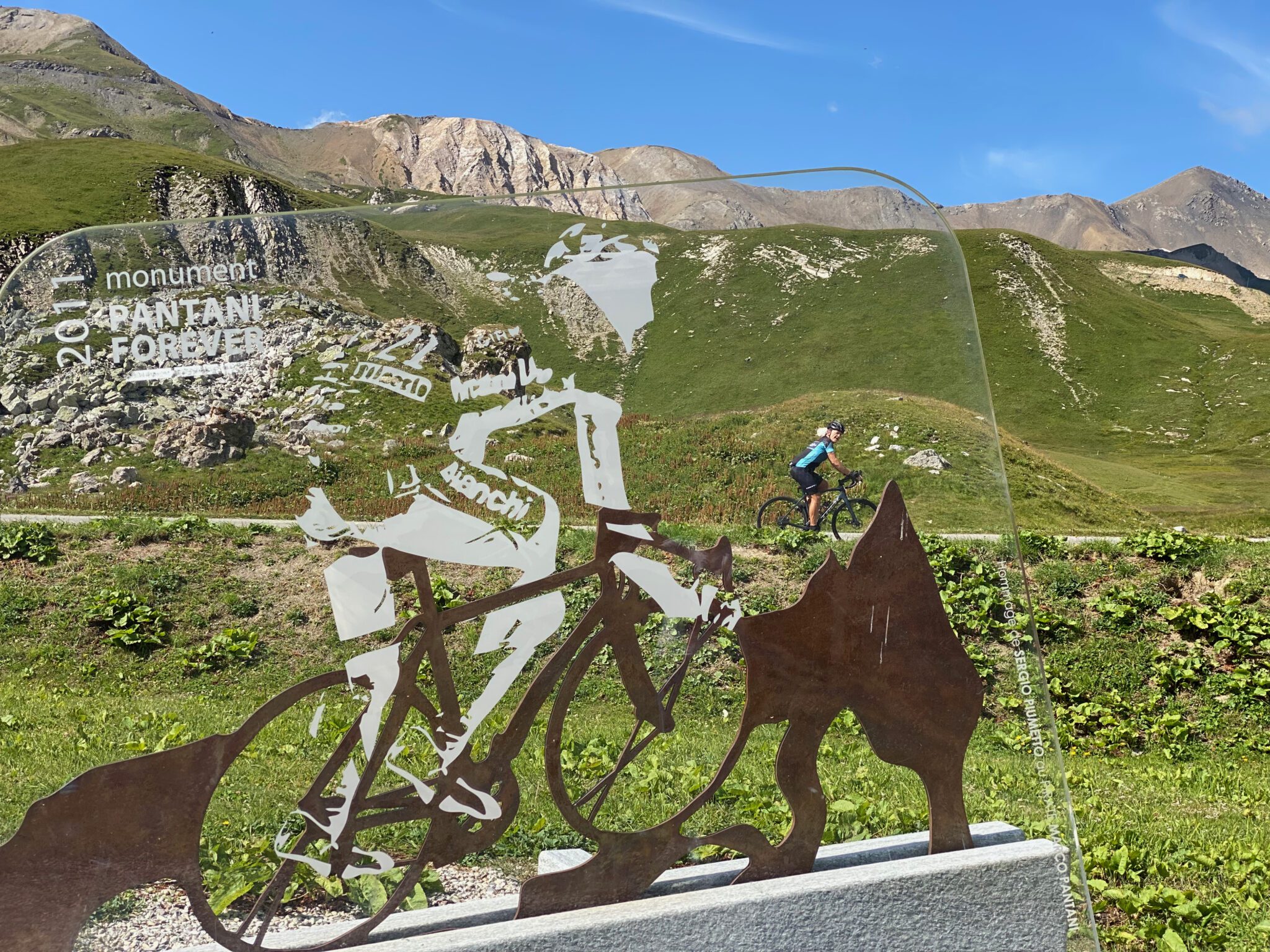
About halfway up the final, some 4 kilometers from the tunnel, there is a monument in honor of Marco Pantani.
It’s located at the right side of the road and you may miss it if you don’t know where to look, as it is a positioned in a field just off the road.
As soon as you reach the scattered buildings at Les Granges, you’re near it.
South

From this end, you can only get to the summit of the Galibier by first climbing the Lautaret (2,057m).
Briançon
To the summit of the Lautaret, the approach from Briançon (south-east) is 27.7 km long, with 876 meters of elevation, an average of 3.1%.
This ascent is quite easy, provided you do not have to battle a head wind. The last 10 kilometers, the gradient exceeds 5% but there are no really steep bits.
Le Clapier
The ascent of the Lautaret from the south-west, starting at le Clapier, is 34.1 kilometers long, with 1,416 meters of elevation, an average of 3.9%.
Not only is this ascent longer, it is also a bit more challenging.
However, even if this end has a 5-kilometer stretch of 6.2% towards the final, the hardest bit is in the first 2.5 kilometers and the gradients do not exceed 7% very often.

Galibier
The final stretch of the Galibier itself, is 8.5 kilometers from the summit of the Lautaret.
With an altimeter gain of 590 meters (7%) it’s similar to, but a little easier than, the ascent from Valloire.
Also from this end, the final up the loop is steep, at an average of 10%…